Pre-Op Clearance: What It Is, What to Expect, and How to Get It Done Before Your Surgery Date
Medically reviewed by Bruna Jebelev, MD, board-certified in internal medicine · Updated November 26, 2026
On This Page
- What is pre-op clearance?
- Pre-op clearance vs. pre-op appointment: what’s the difference?
- Who needs pre-op clearance?
- What happens during a pre-op physical?
- How long is pre-op clearance good for?
- Pre-op clearance for plastic and cosmetic surgery
- What to bring to your pre-op clearance visit
- Medications before surgery: don’t stop anything on your own
- What can delay your surgery
- How to get pre-op clearance when you’re short on time
- Pre-op clearance in Lakewood Ranch
- Frequently asked questions
- Sources
What is pre-op clearance?
Pre-op clearance goes by a lot of names: medical clearance for surgery, surgical clearance, preoperative evaluation, or simply a pre-op physical. They all mean the same thing. Before your operation, a doctor reviews your overall health and tells your surgeon and anesthesia team what they need to know to keep you safe.
The goal is simple: find and manage health risks before the operating room, not after.
”Clearance” is really a risk check
The word “clearance” makes it sound like a pass/fail stamp. It isn’t. Your doctor isn’t approving your surgery. Your surgeon decides whether to operate. What your doctor does is:
- Look for health problems that could raise your risk during or after surgery
- Make sure conditions like blood pressure, blood sugar, and heart or lung problems are as well controlled as possible
- Plan what to do with your medications around the surgery
- Recommend extra testing only when your health calls for it
Current cardiology guidelines follow a simple principle: heart testing and treatment before surgery should generally be the same as what you’d need if you weren’t having surgery at all. Surgery alone isn’t a reason for a pile of extra tests.
Pre-op clearance vs. pre-op appointment: what’s the difference?
People mix these up all the time, and you may need both.
| Pre-op clearance | Pre-op appointment | |
|---|---|---|
| Who does it | Your primary care doctor (or an internist or a pre-op clinic) | The hospital or surgery center, often a nurse or the anesthesia team |
| Where | Your doctor’s office | The hospital or surgery center, in person or by phone |
| When | As soon as you have a date, usually within 30 days of surgery | Usually in the days or weeks before surgery |
| What happens | Health history, medication review, exam, any needed tests, risk assessment | Registration, consent forms, anesthesia questions, fasting and arrival instructions |
| What it’s for | Making sure your health is ready for surgery | Making sure the logistics of surgery day are ready |
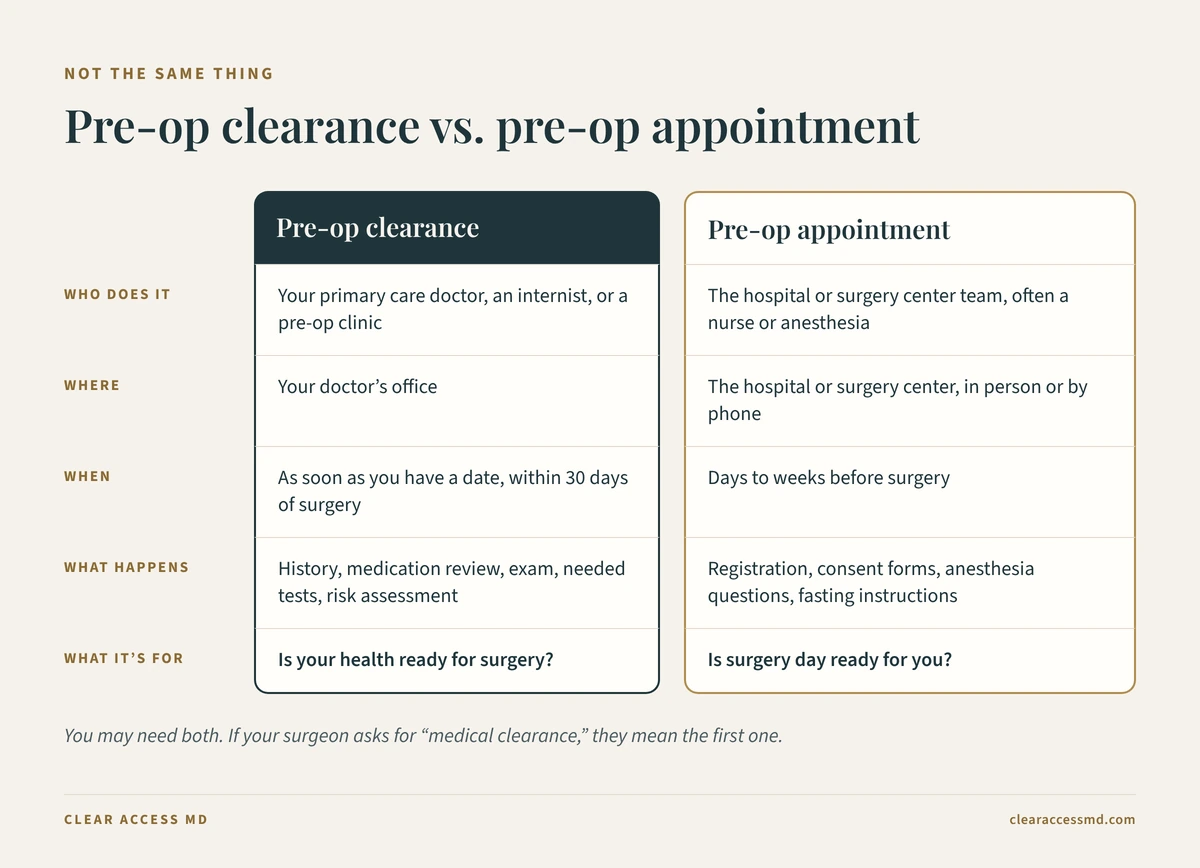
One doesn’t replace the other. If your surgeon’s office asks for “medical clearance,” they want the first one.
Who needs pre-op clearance?
Your surgeon or anesthesia team decides whether you need it. You’re more likely to be asked for clearance if:
- You’re older, or you have ongoing health conditions like high blood pressure, diabetes, heart or lung disease, or kidney problems
- You take several medications, especially blood thinners or diabetes medications
- You’re having a longer or bigger operation, or one that requires general anesthesia
- You’re having plastic or cosmetic surgery (more on that below)
A healthy person having a short, low-risk procedure may need very little, sometimes just a quick review.
What happens during a pre-op physical?
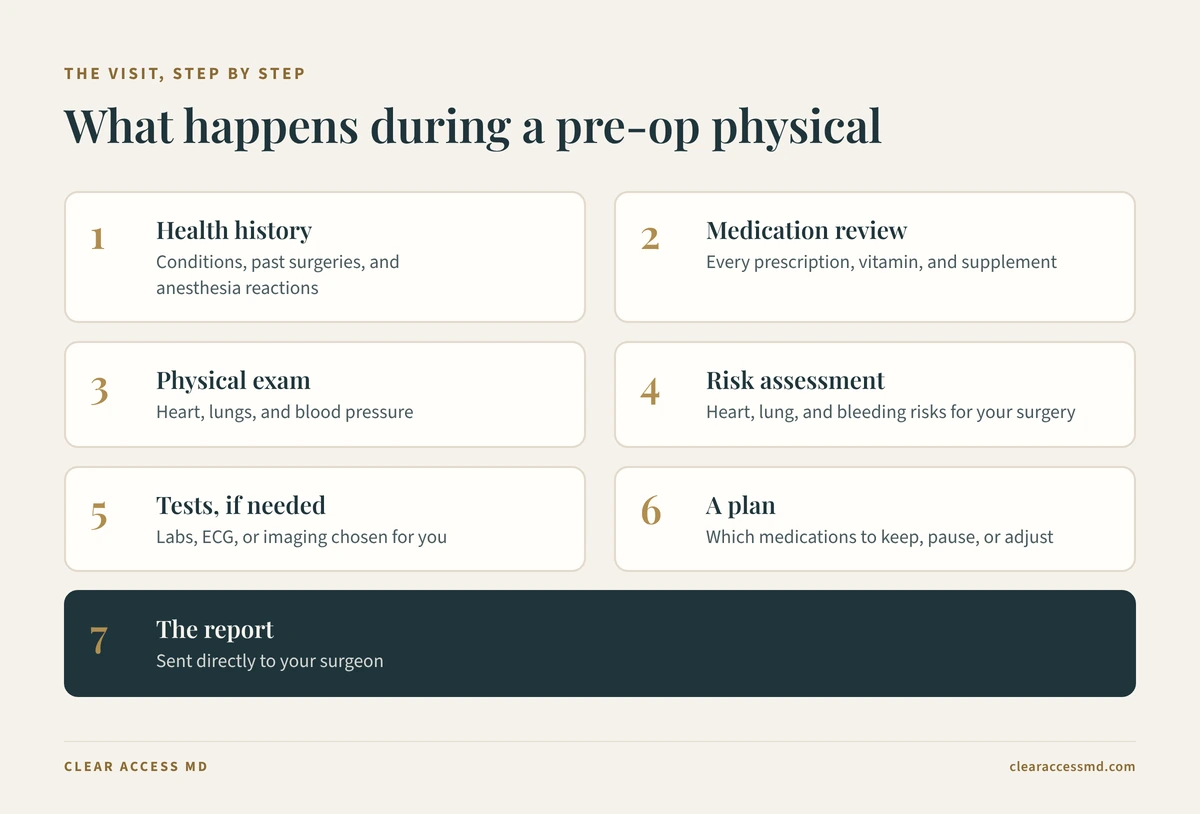
A good pre-op visit follows a clear sequence:
- Health history. Your current and past conditions, previous surgeries, and any problems you or your family have had with anesthesia.
- Medication review. Every prescription, over-the-counter medicine, vitamin, and supplement you take.
- Physical exam. Heart, lungs, blood pressure, and anything related to your procedure.
- Risk assessment. How likely you are to have heart, lung, bleeding, or other complications, based on your health and the type of surgery.
- Tests, if needed. Labs, an ECG, or imaging, chosen for you rather than from a one-size-fits-all list.
- A plan. Which medications to keep, pause, or adjust, and anything that should be treated before surgery.
- The report. A written summary sent to your surgeon’s office.
Pre-op labs and tests
There’s no universal pre-op test panel. What you need depends on your health, your medications, and your procedure. Common tests include:
- Complete blood count (CBC): checks for anemia and platelet problems
- Metabolic panel: kidney function, electrolytes, and blood sugar
- A1c: if you have diabetes or prediabetes
- Clotting tests: if you take blood thinners or have a bleeding history
- Pregnancy test: for anyone who could be pregnant
- ECG (electrocardiogram): depending on your age, heart history, and type of surgery
More tests aren’t always better. For low-risk procedures, research shows routine pre-op blood tests and ECGs don’t reduce complications in healthy patients. Unneeded tests can turn up borderline results that delay surgery without making it any safer. A careful doctor orders what’s useful and skips what isn’t. (For more on what labs measure, see Understanding Your Annual Blood Work.)
When you might need cardiac clearance
Most people don’t need to see a cardiologist before surgery. A referral makes sense when you have heart symptoms, known heart disease, or a high-risk heart profile and poor or unknown exercise tolerance before a higher-risk operation. Current guidelines recommend stress testing before surgery only for a small, carefully selected group of patients.
What goes in a surgical clearance letter
The report your surgeon receives usually includes:
- A summary of your health history and current medications
- Your exam findings and test results
- Your doctor’s assessment of your risk
- Recommendations, such as medication changes or precautions for surgery day
It goes directly from your doctor’s office to your surgeon’s office, so make sure you have the right fax number or email.
How long is pre-op clearance good for?
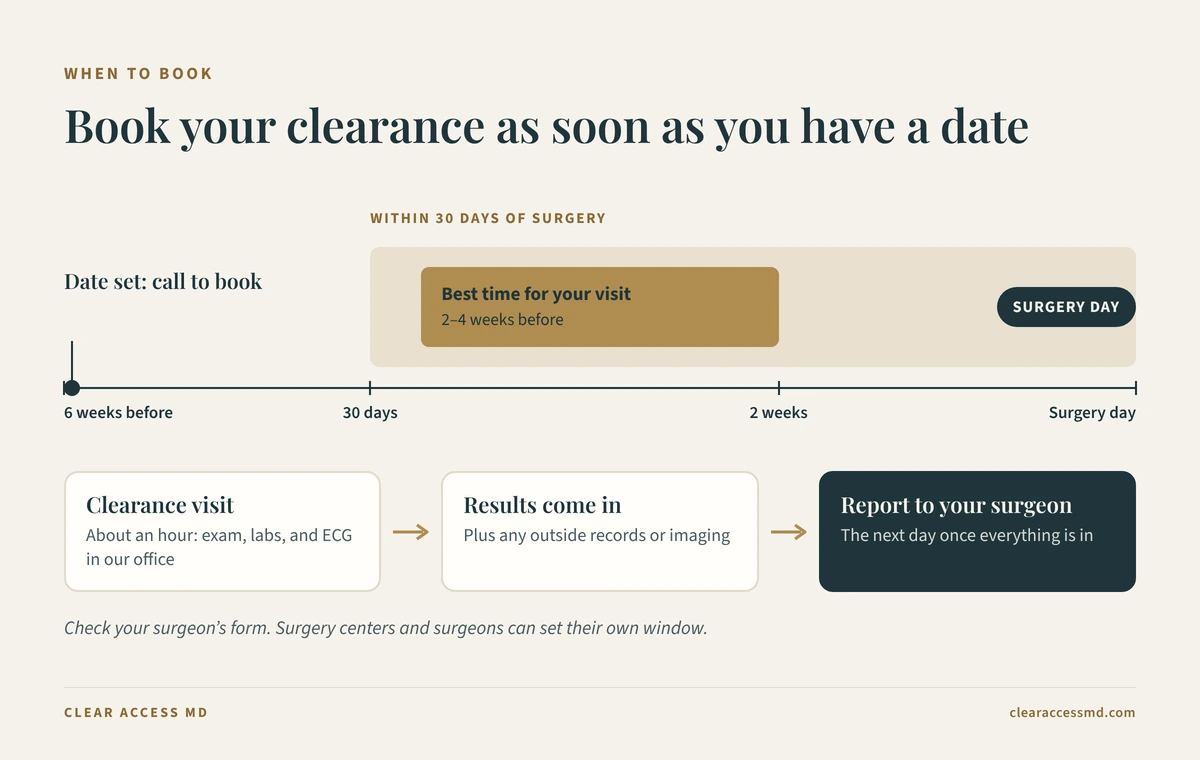
Hospitals generally require your history and physical to be done no more than 30 days before surgery, with a quick update when you arrive. Surgery centers and individual surgeons can set their own rules, so check your surgeon’s form for their exact window.
Tip: Book your clearance visit as soon as you have a date. Aim for about 2 to 4 weeks before surgery. That leaves time to repeat a test or treat something that comes up, while still landing inside a 30-day window.
Pre-op clearance for plastic and cosmetic surgery
If you’re planning a tummy tuck, breast augmentation, liposuction, a BBL, a facelift, or a “mommy makeover,” expect your plastic surgeon to ask for medical clearance, and to be strict about it.
Why plastic surgeons are especially careful
- It’s elective. If anything is off, the safest choice is to postpone, and plastic surgeons will.
- Procedures are often combined. Doing two or three procedures at once means more time under anesthesia.
- Many are done outside hospitals, in office-based surgical suites or surgery centers, where the team needs to be confident you’re a low-risk patient.
- Healing is the result. In cosmetic surgery, how your skin and tissue heal is the outcome you’re paying for.
Labs and tests your plastic surgeon may ask for
Plastic surgeons commonly ask for a blood count (hemoglobin matters more for procedures with more blood loss, like liposuction or a tummy tuck), a metabolic panel, and a pregnancy test. Some also want clotting tests or an ECG, depending on your age and health. Your surgeon’s form lists exactly what they need, so bring it to your visit.
Nicotine testing before surgery
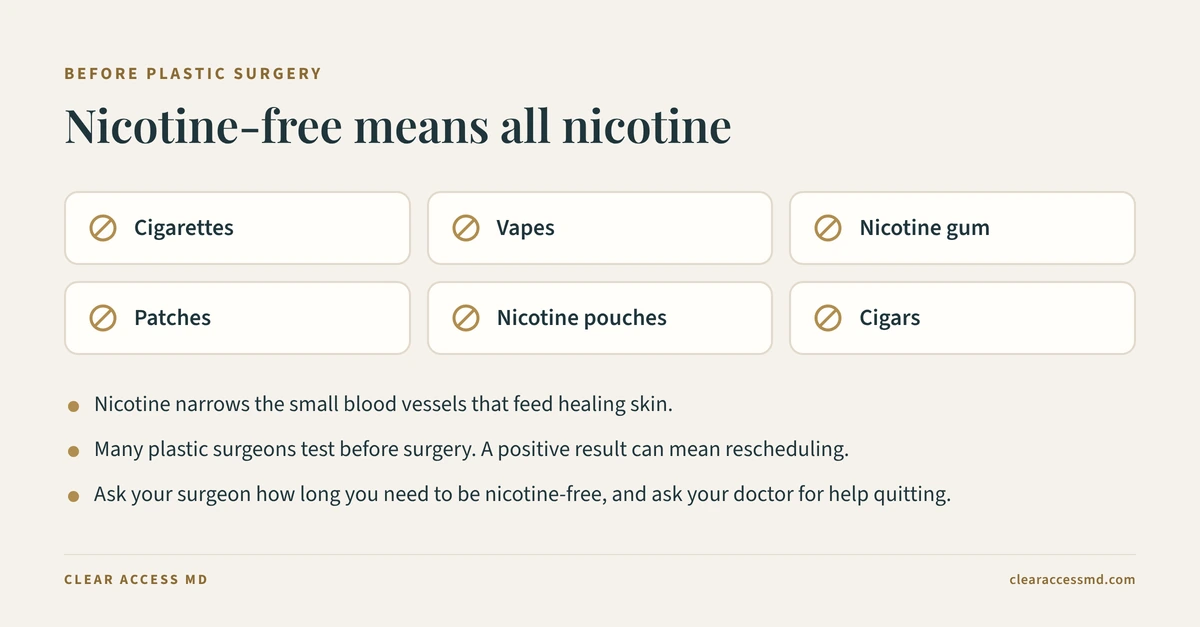
Many plastic surgeons test for nicotine before surgery, and a positive result can mean your surgery gets rescheduled. Nicotine narrows the small blood vessels that feed healing skin. A plastic surgeon writing for the American Society of Plastic Surgeons warns it can lead to skin loss after a facelift, breast lift, breast reduction, or tummy tuck, plus infections, hard lumps from fat necrosis, delayed healing, and thick, wide scars.
What to know:
- It’s not just cigarettes. Vapes, nicotine gum, patches, pouches, and cigars all count.
- Quit early. Some surgical centers require you to be nicotine-free for at least 6 weeks before surgery, and they test to confirm it.
- Ask your surgeon for their exact rule, and ask your doctor for help quitting if you need it.
Weight loss medications and body contouring
If you’re losing weight with a GLP-1 medication before body contouring, ask your surgeon how long they want your weight to be stable before surgery, and see the GLP-1 section below. If you’re working on weight loss with us, we can plan the timing together. (Learn more about medical weight management.)
How to keep your surgery date
- Book clearance the same week you pick a date.
- Bring the surgeon’s form and their fax number or email.
- Leave room for a repeat test, whether that’s a lab result or a nicotine test.
- Tell your doctor about every medication and supplement, including weight loss medications.
What to bring to your pre-op clearance visit
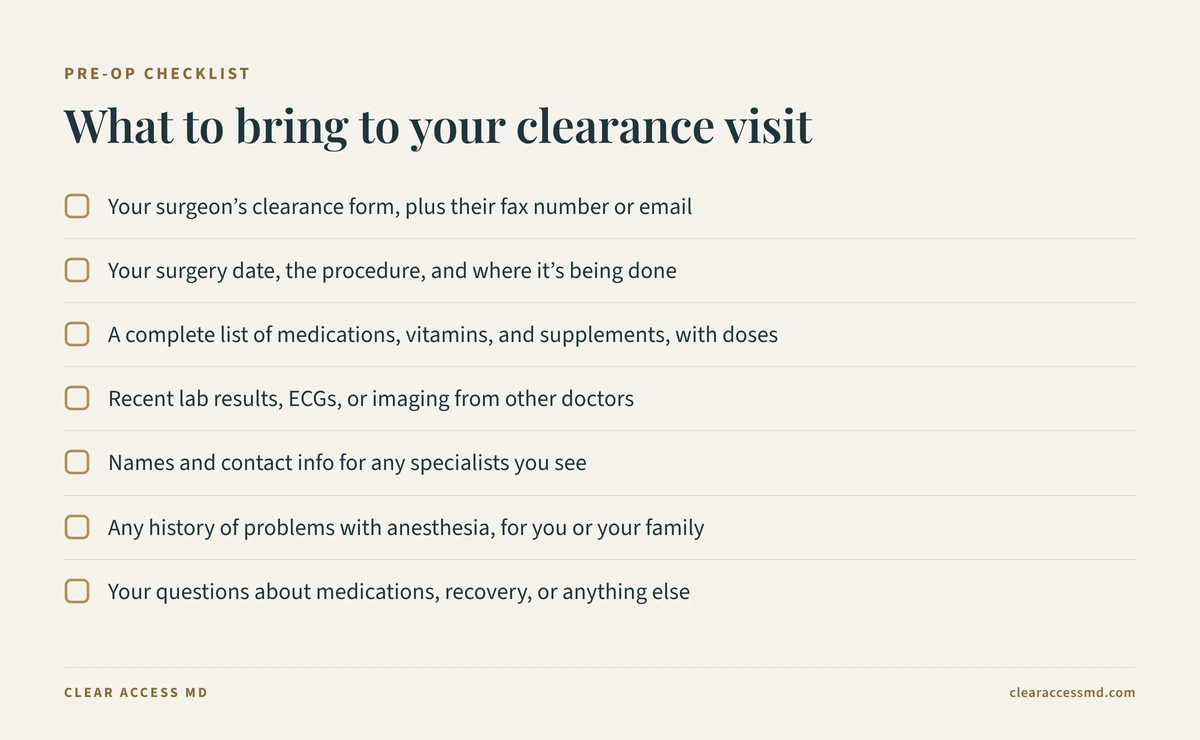
Use this checklist:
- Your surgeon’s clearance form, plus their fax number or email
- Your surgery date, the procedure, and where it’s being done
- A complete list of medications, vitamins, and supplements, with doses
- Recent lab results, ECGs, or imaging from other doctors
- Names and contact info for any specialists you see
- Any history of problems with anesthesia, for you or your family
- Your questions about medications, recovery, or anything else
Medications before surgery: don’t stop anything on your own
Some medications need to be paused or adjusted before surgery. Others are important to keep taking. The right plan depends on the drug, why you take it, and the procedure, so your doctor and surgeon work it out together.
Blood thinners, diabetes medications, and supplements
- Blood thinners (and some pain relievers) affect bleeding, but stopping them can raise the risk of clots or stroke. Never stop one without a specific plan from your doctor.
- Diabetes medications often need dose changes because you’ll be fasting before surgery.
- Supplements like fish oil, vitamin E, and some herbal products can affect bleeding. List them all, even if they seem harmless.
GLP-1 medications (Ozempic, Wegovy, Mounjaro, Zepbound)
GLP-1 medications slow how fast your stomach empties, which matters for anesthesia. In 2024, five medical societies (including the American Society of Anesthesiologists) issued joint guidance saying most patients can keep taking their GLP-1 medication before elective surgery. Patients at higher risk for stomach side effects may be asked to follow a liquid-only diet for 24 hours before the procedure, and in rare cases surgery may be delayed.
Guidance in this area has changed more than once, and surgical teams don’t all handle it the same way. Follow your surgeon’s and anesthesia team’s instructions, and make sure they know you take a GLP-1.
What can delay your surgery
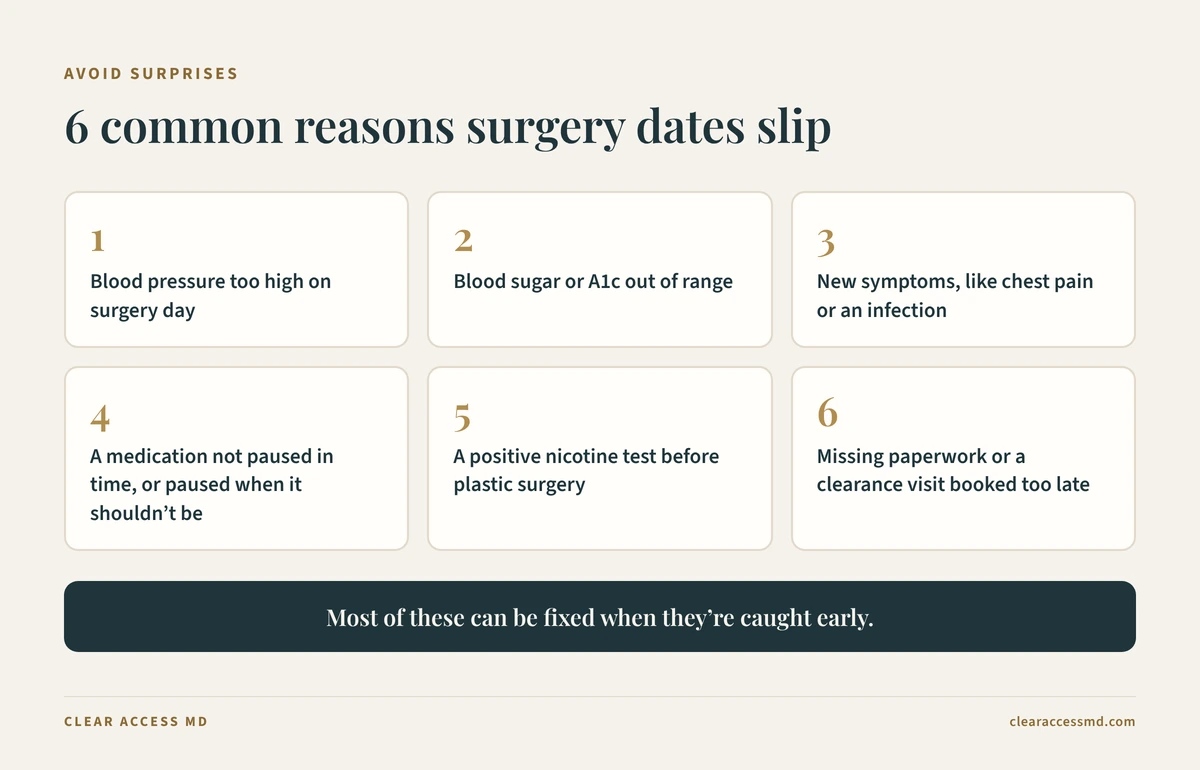
These are the most common reasons a surgery date slips:
- Blood pressure that’s too high on surgery day. (Here’s how to measure blood pressure correctly at home.)
- Blood sugar or A1c that’s out of range. (See Prediabetes: A1c Ranges, Symptoms, and How to Reverse It.)
- New symptoms, like chest pain, shortness of breath, or an infection
- A medication that wasn’t paused in time, or was paused when it shouldn’t have been
- A positive nicotine test before plastic surgery
- Missing paperwork, or a clearance visit booked too late to fit the 30-day window
The good news: almost all of these can be fixed if they’re caught early. That’s the real value of a careful pre-op visit.
How to get pre-op clearance when you’re short on time
You have a few options:
- Your own primary care doctor. Call as soon as you have a date and say it’s for pre-op clearance with a deadline.
- A pre-op clinic run by your hospital or surgeon’s practice, if they have one.
- A primary care practice that’s taking new patients and can see you quickly.
Can urgent care do pre-op clearance? Some urgent care centers will, but they don’t have your history, may not do every test your surgeon needs, and may not fill out surgeons’ forms. Call ahead and ask.
Why a doctor who already knows you makes it faster
When your doctor already has your records, your lab history, and your medication list, pre-op clearance is mostly a matter of updating what they know. There’s no starting from scratch, no chasing old records, and fewer surprises. It’s one of the quieter benefits of having a primary care doctor even when you feel healthy.
Pre-op clearance in Lakewood Ranch
At Clear Access MD, Dr. Bruna Jebelev, a board-certified internist, does pre-op clearance for adults across Lakewood Ranch, Sarasota, and Bradenton. She works with surgeons’ offices of every kind, plastic surgeons included.
- Labs drawn in our office and ECGs done in-house, so you don’t need separate trips
- About an hour for a typical pre-op visit in our office
- Your clearance goes to your surgeon the next day once all lab results, imaging, and outside records are in
- Members can usually be seen quickly, so surgery dates don’t slip
- Not a member? You can still get pre-op clearance by booking an annual physical visit
Have a surgery date coming up? Schedule a free intro visit to meet Dr. Bruna, or see how membership works. Curious what an internist does? Read Internal Medicine vs. Family Medicine.
📞 (941) 322-7202 · Book your free intro visit →
Clear Access MD serves adults 18+ in Lakewood Ranch, Bradenton and Sarasota, in English and Spanish.
Frequently asked questions
Who does pre-op clearance?
Usually your primary care doctor, often an internist or family physician. Some hospitals and surgical practices run their own pre-op clinics. If you have a heart or lung condition, your surgeon may also want input from your cardiologist or pulmonologist.
Can urgent care do pre-op clearance?
Some can, but not all. Urgent care centers don’t have your medical history, may not offer every test your surgeon requires, and may not complete surgeons’ forms. Call ahead and bring your surgeon’s form if you go that route.
How long does a pre-op appointment take?
A pre-op clearance visit at our office typically takes about an hour. If you need tests done elsewhere, such as imaging, plan for extra time. The hospital’s own pre-op appointment is separate and is often shorter.
Does pre-op blood work test for drugs?
Standard pre-op labs, like a blood count and metabolic panel, aren’t drug tests. A drug screen is a separate test that has to be ordered specifically. Still, tell your doctor and anesthesia team about alcohol, cannabis, nicotine, or any other substance use. It affects anesthesia and recovery, and they need to know to keep you safe.
What happens if I’m not cleared for surgery?
Usually, your surgery is postponed, not cancelled. Your doctor will explain what needs attention, such as getting blood pressure or blood sugar under better control or finishing an extra test, and help you get there so you can reschedule.
Can my primary care doctor clear me for plastic surgery?
Yes. Most plastic surgeons accept clearance from your primary care doctor, as long as it includes everything on their form. Bring the form to your visit so nothing is missed.
Sources
- Thompson A, Fleischmann KE, Smilowitz NR, et al. 2024 AHA/
ACC/ . Circulation / JACC, 2024.ACS/ ASNC/ HRS/ SCA/ SCCT/ SCMR/ SVM Guideline for Perioperative Cardiovascular Management for Noncardiac Surgery - American Heart Association. New guideline details how to manage CVD risk before, during and after noncardiac surgery. 2024.
- Kindel TL, et al. Multisociety clinical practice guidance for the safe use of GLP-1 receptor agonists in the perioperative period. 2024. Summary: American Gastroenterological Association.
- American College of Surgeons. Low-Value Preoperative Testing Can Be Reduced with Deimplementation Strategy. 2025.
- Choosing Wisely Canada. Anesthesiology recommendations. Updated 2025.
- Code of Federal Regulations. 42 CFR 482.51, Condition of participation: Surgical services.
- American Society of Plastic Surgeons. How nicotine sabotages plastic surgery.
- UW Medicine. Nicotine Use and Your Surgery.