
Internal Medicine vs. Family Medicine: What's the Difference, and Which Doctor Do You Need?
Medically reviewed by Bruna Jebelev, MD, board-certified in internal medicine · Updated November 27, 2026
On This Page
- Why this question comes up
- What is internal medicine?
- What is family medicine?
- Internal medicine vs. family medicine at a glance
- The key differences, explained
- Is internal medicine primary care?
- General internist vs. internal medicine subspecialist
- Physicians, Nurse Practitioners and Physician Assistants: How Their Training Differs
- How to choose: internist or family doctor?
- What matters as much as the specialty: time and access
- An internist in Lakewood Ranch
- Frequently asked questions
- Sources
Why this question comes up
When you start looking for a primary care doctor, the labels pile up fast. One practice says “family medicine.” Another says “internal medicine.” A directory lists someone as an “internist,” and an insurance card just says “PCP.”
To make it more confusing, a lot of people hear “internist” and think “intern,” a doctor still in training. That’s not what it means.
Here’s how the two specialties actually differ, what they have in common, and how to pick the right fit for you.
What is internal medicine?
Internal medicine is the medical specialty focused on preventing, diagnosing, and treating disease in adults. Doctors who practice it are called internists or internal medicine physicians.
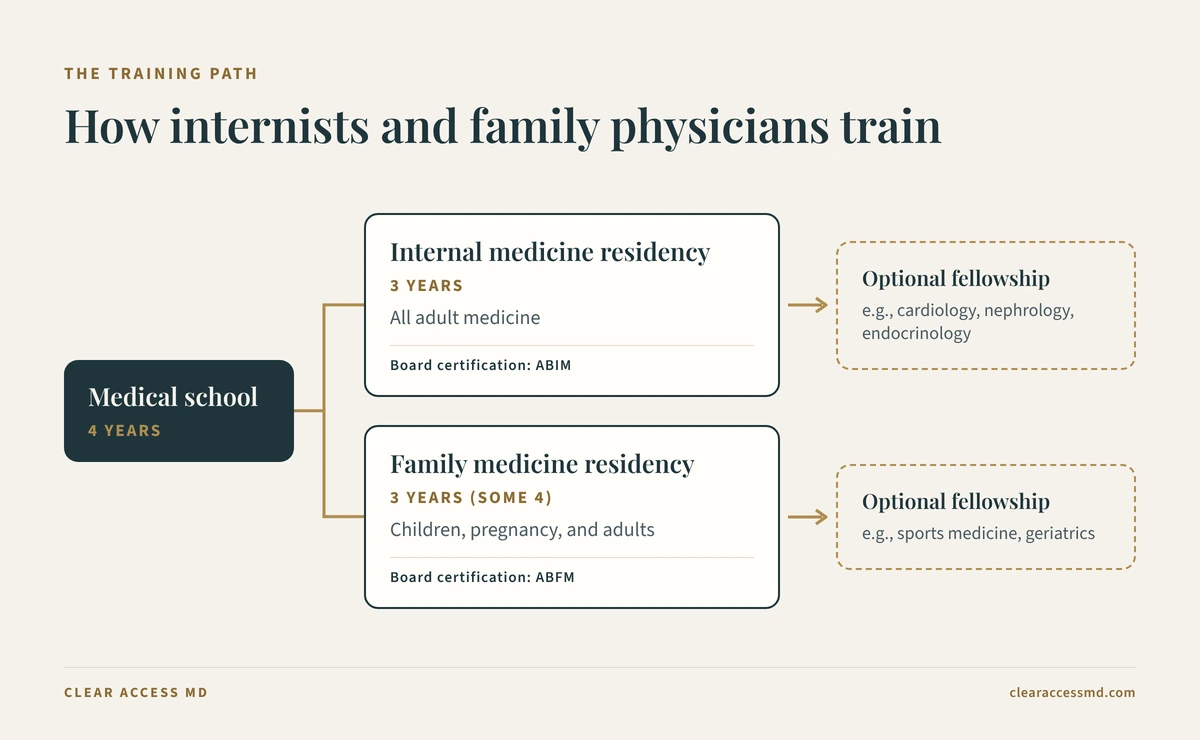
After four years of medical school, internists complete a three-year residency devoted entirely to adult medicine. Much of that training happens in the hospital, caring for adults with serious, complex, and overlapping illnesses. That’s where internists learn to sort out problems that don’t fit neatly into one organ system.
Internists who pass the American Board of Internal Medicine (ABIM) exam after residency are board-certified in internal medicine. Internists certified since 1990 have to keep that certification current over their careers.
What is an internist? (No, not an intern)
An intern is a doctor in the first year of residency, still in training.
An internist is a fully trained physician who has completed a residency in internal medicine. The word comes from internal medicine, not internship.
What does an internist do?
A primary care internist is the doctor you see for most of your adult health care:
- Prevention and annual physicals, including the screenings and lab work that fit your age and risk. (Here’s what a good annual physical should include.)
- Long-term conditions such as high blood pressure, prediabetes and diabetes, high cholesterol, thyroid problems, and changes in kidney function.
- Puzzling symptoms like ongoing fatigue, unexplained weight changes, or an abnormal lab result that needs a closer look.
- Medication management, especially for people taking several prescriptions that can interact.
- Everyday illnesses, like infections, flare-ups, and the problems that shouldn’t wait weeks for an appointment.
- Coordinating with specialists when you need one, and making sense of what they recommend.
What is family medicine?
Family medicine is primary care for every age. The American Academy of Family Physicians describes it as continuous, comprehensive health care for individuals, families, and communities across their entire lifespan.
Family physicians also complete a three-year residency after medical school (some programs add a fourth year). Their training is spread across the whole lifespan, including pediatrics, women’s health and obstetrics, and adult medicine. Many family physicians do well-child visits and childhood vaccines, and some deliver babies or perform minor procedures. In practice, though, each office sets its own policies, and some family practices don’t take newborns or very young children. If you’re choosing a doctor for a baby, ask first. Board certification comes from the American Board of Family Medicine (ABFM).
Family physicians also manage adult conditions like high blood pressure, diabetes, and heart disease. You don’t need to have a family to see one.
Internal medicine vs. family medicine at a glance
| Internal medicine | Family medicine | |
|---|---|---|
| Who they treat | Adults (18 and older) | All ages, from birth |
| Residency | 3 years, all adult medicine | 3 years (some 4), across all ages |
| Training emphasis | Depth in adult disease, with extensive hospital training | Breadth: children, women’s health, pregnancy, and adults |
| Children | No (except combined med-peds doctors) | Yes |
| Pregnancy care | Generally no | Sometimes |
| Board certification | ABIM | ABFM |
| Further specialty paths | Many, such as cardiology, nephrology, endocrinology, and gastroenterology | Fewer, such as sports medicine and geriatrics |
| Often the best fit for | Adults, especially those with or at risk for chronic or multiple conditions | Households that want one doctor for everyone |
The key differences, explained
Who they see
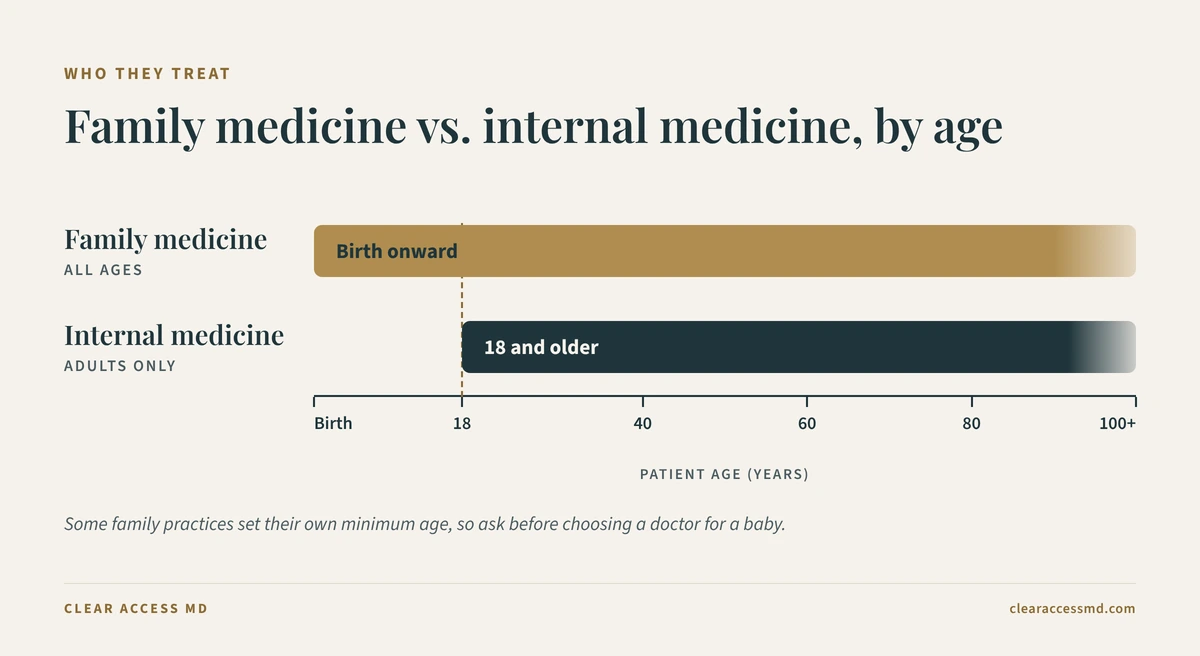
This is the biggest and simplest difference. Internists see adults. Family physicians see everyone, including babies, kids, and teens.
Depth vs. breadth
Every part of an internist’s residency is spent on adult medicine. A family physician’s training is divided among children, pregnancy, and adults. Neither approach is “better.” One goes deeper into adult health, and the other covers more ground.
Complex and overlapping conditions
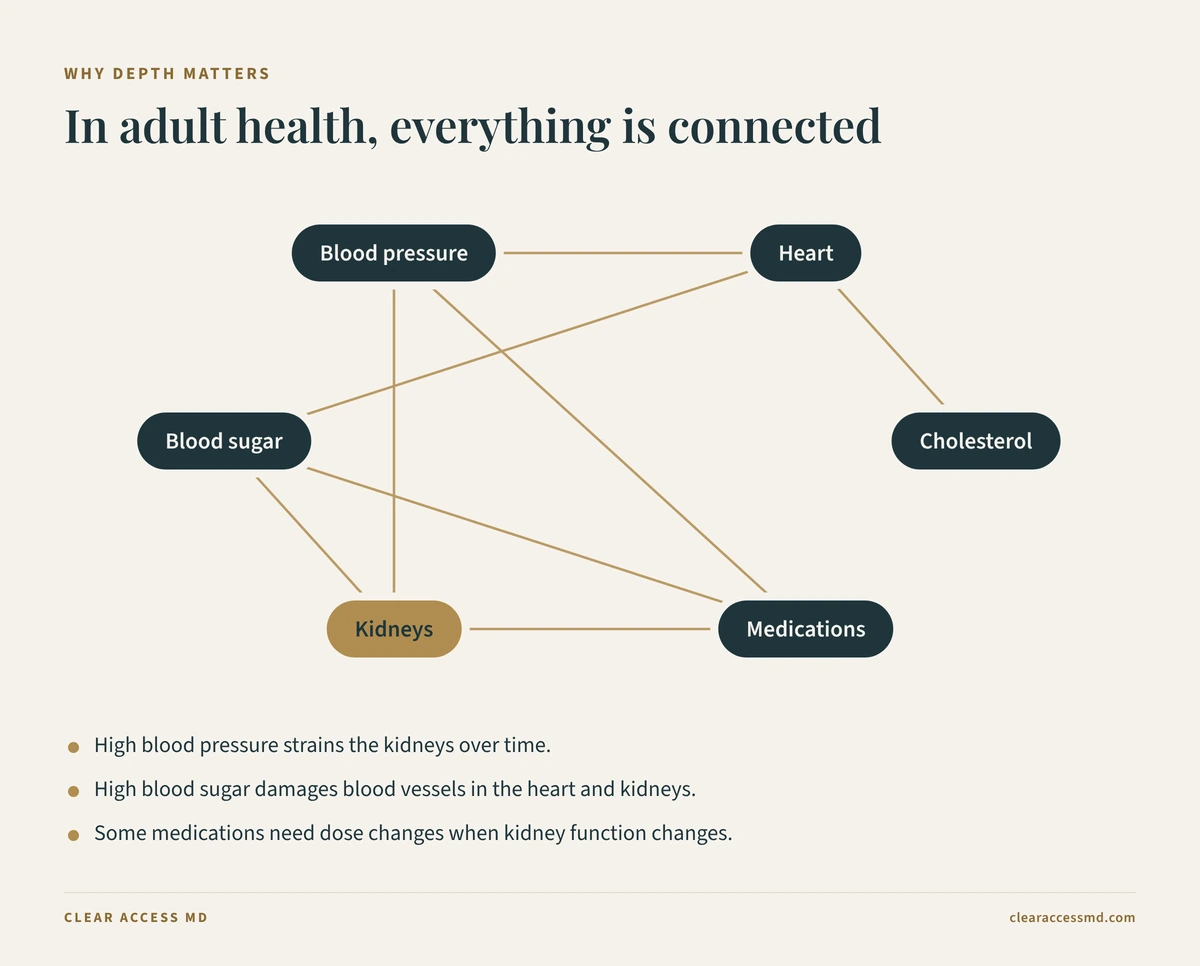
Adult health problems rarely stay in their own lane. Diabetes affects the kidneys and the heart. Blood pressure medicine can change lab results. A new prescription can interact with three old ones. Internists are trained specifically to manage these overlaps, which is why many adults with several conditions choose one.
Where they work
Internists can work in an office as primary care doctors, or in the hospital as hospitalists, who care only for patients admitted to the hospital. Family physicians mostly work in outpatient clinics, though some also work in hospitals, especially in rural areas.
What they have in common
Both are trained, board-certified primary care physicians. Both focus on prevention, manage long-term conditions, treat everyday illnesses, and refer you to specialists when needed. Both can be your doctor for years.
Is internal medicine primary care?
Yes. A general internist who sees patients in an office is a primary care physician. They fill the same role a family doctor does: your first call when something’s wrong, your partner in prevention, and the person who keeps track of the big picture.
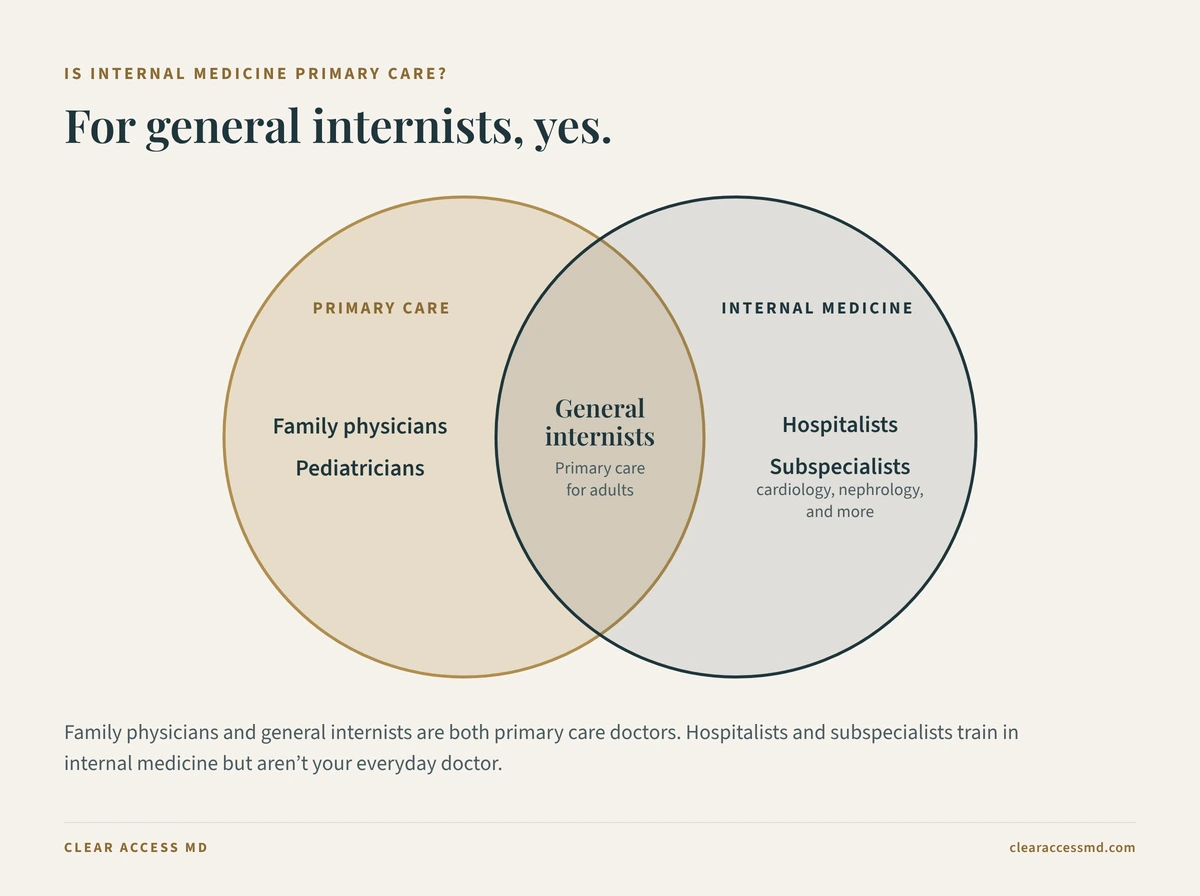
The confusion comes from two places:
- Not every internist practices primary care. Hospitalists and subspecialists (like cardiologists) are trained in internal medicine too, but they aren’t your everyday doctor.
- Labels vary. Directories, maps, and websites may list the same doctor as “internal medicine,” “internist,” or “primary care.”
Tip: When you search, try “internal medicine” or “internist” alongside “primary care doctor.” When you call, ask: “Does the doctor see patients for ongoing primary care?”
General internist vs. internal medicine subspecialist
After residency, some internists complete a fellowship, which means additional years of training in one area of adult medicine. Common examples include cardiology (heart), nephrology (kidneys), endocrinology (hormones and diabetes), gastroenterology (digestive system), and pulmonology (lungs).
Subspecialists usually see you by referral for a specific problem. A general internist looks after the whole adult patient.
Some primary care internists also have fellowship training. Dr. Bruna Jebelev, MD, for example, completed a nephrology (kidney) fellowship after her internal medicine residency. That background is especially useful in everyday primary care, because blood pressure, diabetes, medications, and kidney health are closely connected. It also helps her catch slow changes in kidney function early, when they’re easiest to address.
Physicians, Nurse Practitioners and Physician Assistants: How Their Training Differs
Many primary care offices are staffed by nurse practitioners (NPs) or physician assistants (PAs) as well as physicians. All three can provide good everyday care. What differs is the path and length of training.
- Physicians (MD or DO) complete four years of medical school and then a residency of at least three years in their specialty. Internal medicine and family medicine physicians can become board-certified by the American Board of Internal Medicine or the American Board of Family Medicine.
- Nurse practitioners are registered nurses who complete a graduate nursing degree (a master’s or doctorate) with supervised clinical training, and are certified by a nursing board.
- Physician assistants complete a master’s-level PA program with clinical rotations and are certified by a national PA commission.
For many visits the difference won’t matter much. It tends to matter more when you have several conditions at once, take many medications, or have symptoms that don’t have an obvious cause, which is the kind of care internal medicine physicians train for. Whoever you see, it’s reasonable to ask about their training and who you’ll see at each visit.
How to choose: internist or family doctor?
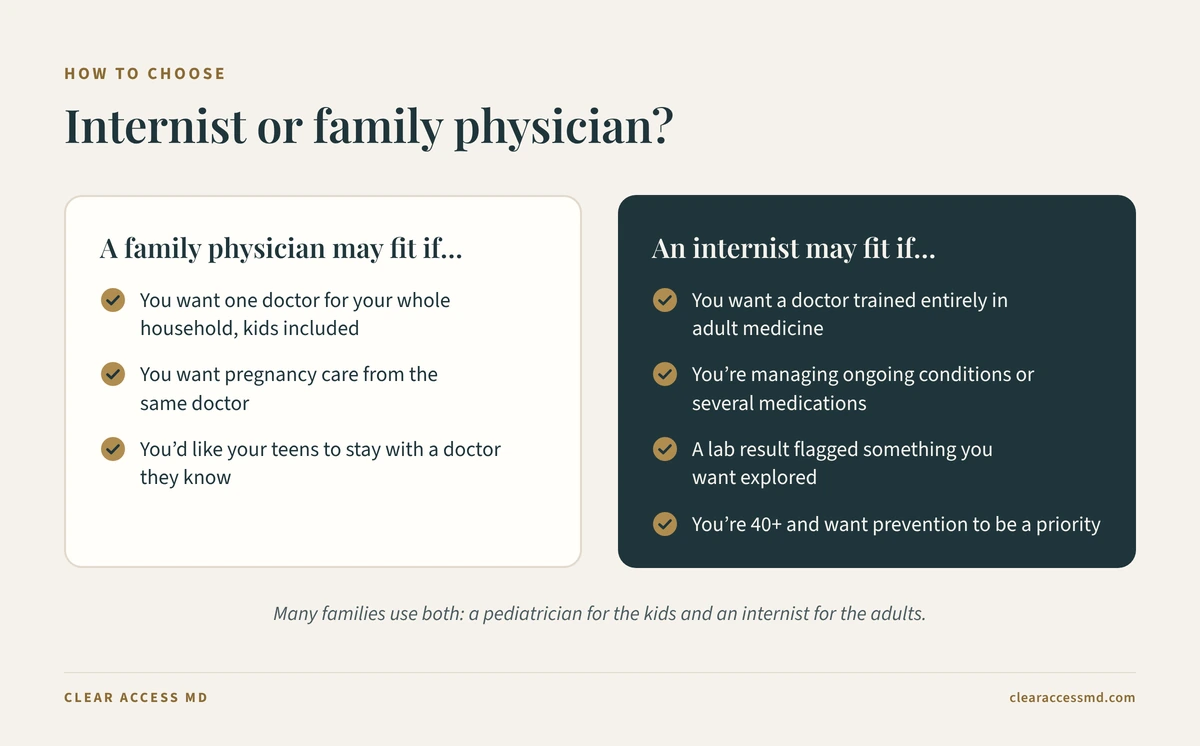
A family physician may fit better if:
- You want one doctor for your whole household, kids included
- You want prenatal or pregnancy care from the same doctor
- You’d like your teenagers to stay with the doctor they already know
An internist may fit better if:
- You’re an adult and want a doctor whose training is entirely in adult medicine
- You’re managing one or more long-term conditions, or taking several medications
- A lab result flagged something (blood sugar, cholesterol, kidney function) and you want someone to dig into it
- You’re in your 40s or beyond and want prevention to be a priority
Many families use both
A common setup: a pediatrician for the kids and an internist for the adults. Adult family members can all see the same internist, so one doctor still knows the household’s health history.
What matters as much as the specialty: time and access
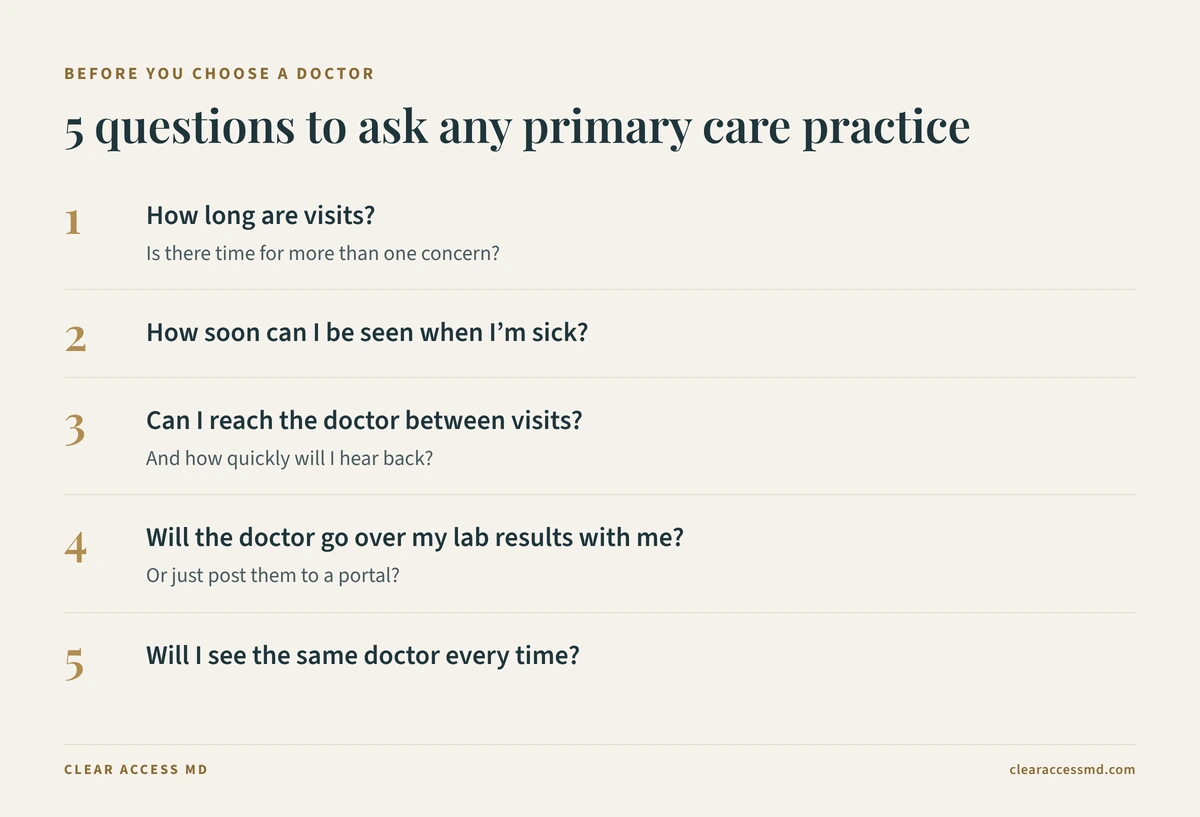
The best-trained doctor in the world can’t do much in a rushed visit you waited weeks to get. Whether you choose an internist or a family physician, ask any practice you’re considering:
- How long are visits? Is there enough time to cover more than one concern?
- How soon can I be seen when I’m sick?
- Can I reach the doctor between visits, and how quickly will I hear back?
- Will the doctor go over my lab results with me, or just post them to a portal?
- Will I see the same doctor every time?
These questions are why some people choose direct primary care, a membership model built around longer visits and direct access to your doctor. Learn more in What Is Direct Primary Care? and A Doctor Who Listens: Why Time With Your Doctor Matters.
An internist in Lakewood Ranch
At Clear Access MD, Dr. Bruna Jebelev is board-certified in internal medicine and fellowship-trained in nephrology. She cares for adults 18 and older, in English and Spanish, from her office in Lakewood Ranch near University Town Center. She serves patients across Lakewood Ranch, Bradenton, and Sarasota.
Members get unhurried visits, a yearly exam with a comprehensive lab panel that she reviews with you in person, and the ability to reach the office by text when something comes up.
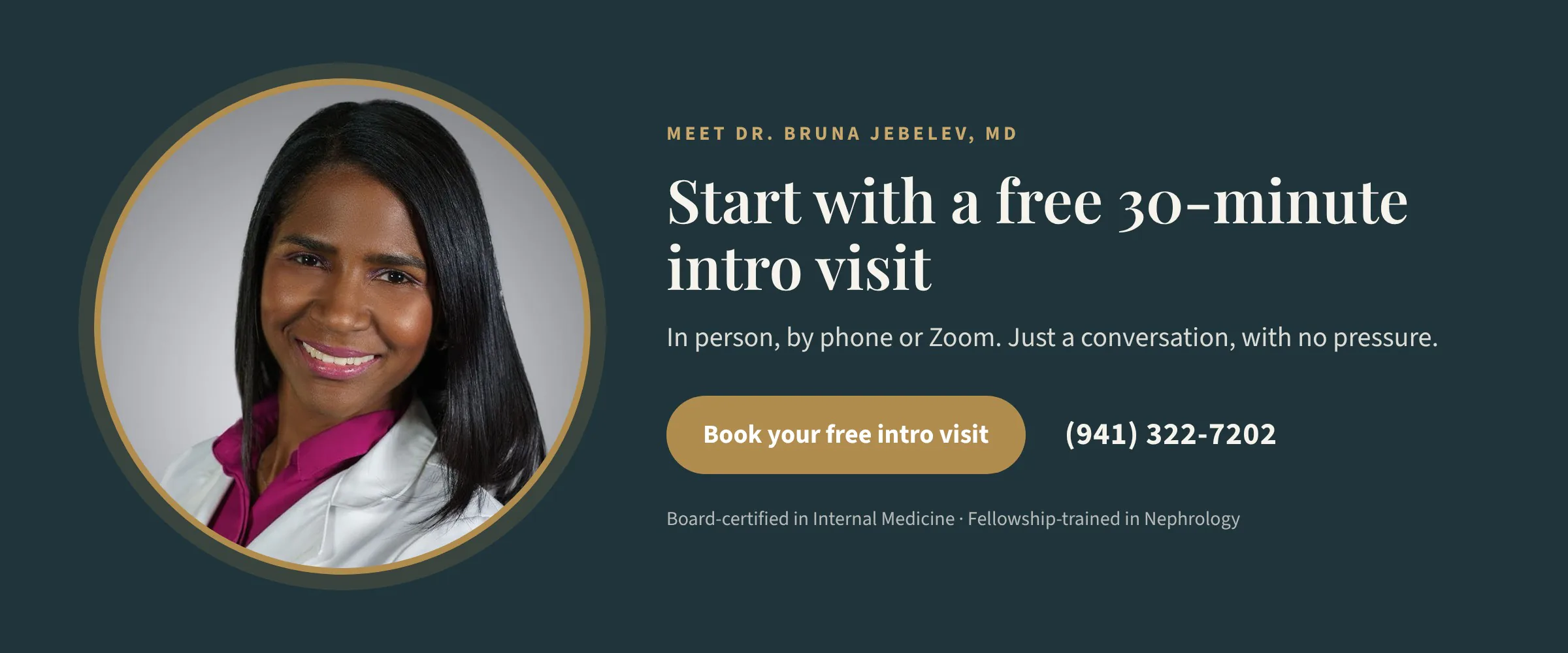
Not sure it’s the right fit? Schedule a free 30-minute intro visit, in person, by phone, or by video, to meet Dr. Bruna and ask your questions. You can also read more about Dr. Bruna or see how membership works.
📞 (941) 322-7202 · Book your free intro visit →
Clear Access MD serves adults 18+ in Lakewood Ranch, Bradenton and Sarasota, in English and Spanish.
Frequently asked questions
Is an internist a primary care physician?
Yes, if they practice general internal medicine in an office setting. General internists are one of the main types of primary care doctors, along with family physicians. Internists who work only in hospitals (hospitalists) or in a subspecialty are not usually primary care doctors.
Is an internist the same as an intern?
No. An intern is a doctor in the first year of residency training. An internist is a fully trained physician who has completed a residency in internal medicine.
Can an internist see children?
Generally no. Internal medicine training focuses on adults. The exception is doctors who complete combined internal medicine and pediatrics (“med-peds”) training. Clear Access MD cares for adults 18 and older.
Can a family doctor manage chronic conditions?
Yes. Family physicians are trained to manage conditions like high blood pressure, diabetes, and heart disease. Internists’ training goes deeper into adult disease, which some adults prefer when they’re managing several conditions at once.
How long is internal medicine residency?
Three years, after four years of medical school. Internists who go on to a subspecialty fellowship train for additional years beyond that.
Do internists do annual physicals?
Yes. Annual physicals and preventive screenings are a core part of primary care internal medicine. See what a complete annual physical should include.
Is a nurse practitioner the same as a doctor?
No. Nurse practitioners are advanced-practice nurses with a graduate nursing degree; physicians (MD or DO) complete medical school and a multi-year residency. Both can provide primary care, but their training is different.
Who will I see at Clear Access MD?
Dr. Bruna Jebelev, MD, a board-certified internal medicine physician. Every doctor’s visit is with her.
Sources
- American College of Physicians. Internal Medicine and Family Medicine: Differences and Similarities.
- American Academy of Family Physicians. Family Medicine, Definition of.
- American Academy of Family Physicians. Family Medicine Residency and Training Requirements.
- American Board of Internal Medicine. Policies and Procedures for Certification.
- Cleveland Clinic. Internal Medicine vs. Family Medicine.
- AdventHealth. Family Medicine vs. Internal Medicine.