
How Much Does Primary Care Really Cost Without Insurance?
On This Page
- Option one: pay as you go
- The costs that don’t show up on the receipt
- Option two: a membership with your own doctor
- A year side by side
- Beyond the numbers: what quick access is worth
- What membership doesn’t cover, stated plainly
- Often paying cash beats going through insurance
- Questions to ask any practice about cost
- The bottom line
- Frequently asked questions
You need a prescription refilled. A cough won’t go away. Your new employer wants a form signed, or a surgeon needs clearance before a procedure. And you realize you don’t have a doctor to call.
If you don’t have insurance, or you have a plan with a deductible so high it rarely kicks in, the next question comes fast: what is this going to cost me?
The honest answer is that it depends on how you pay. The price of a single visit is only part of the story. The better question is what a full year of care costs, and what you actually get for that money.
Below, we’ll walk through the two main ways to pay for primary care without insurance and compare them side by side, with real numbers.
Option one: pay as you go
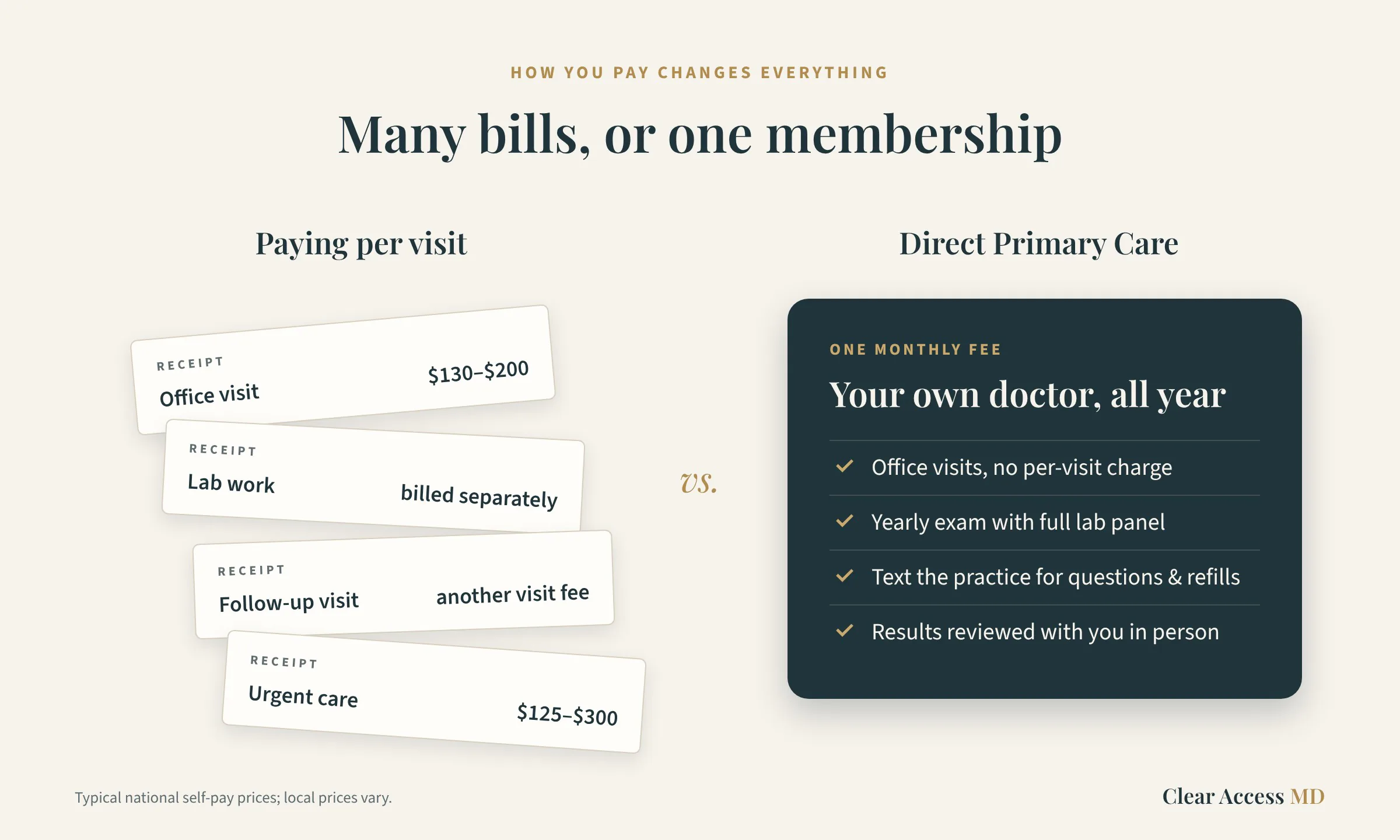
The most familiar route is to pay cash each time you need care. Here’s roughly what that costs today:
| Type of care | Typical self-pay price |
|---|---|
| Primary care office visit | About $130–$200 (national average around $160)¹ |
| Annual physical at a primary care office | About $150–$350+, with labs billed separately² |
| Urgent care visit | About $125–$300 (average around $180)³ |
| Routine blood work, e.g. a comprehensive metabolic panel | As little as $25 at a low-cost lab, up to $450 at a hospital outpatient lab⁴ |
| Emergency room visit | Averages over $2,700⁵ |
Prices vary by location and by what’s done during the visit. New-patient visits often cost more.
Paying per visit makes sense for a one-off need. The catch is how it shapes behavior. When every question costs $150, most people wait: they skip the follow-up, put off the lab work, and hope the problem goes away on its own.
The costs that don’t show up on the receipt
Paying per visit has costs beyond the listed price.
- Everything is billed separately. The visit is one charge, the labs are another, and the follow-up to go over results is a third.
- No one is keeping track. If you see whoever is available at urgent care, nobody compares this year’s blood pressure or blood sugar with last year’s. Many common health problems don’t show up in a single reading. They show up as a trend over time.
- Your time counts too. Waiting rooms, phone trees and repeating your history to a new clinician every visit all add up.
- Small problems get caught later. Blood pressure, blood sugar and kidney function usually change quietly, with no symptoms until they’ve been off for a while. Catching them early is usually simpler, and usually less expensive, than catching them late.
None of this means pay-per-visit care is bad care. It just isn’t built to know you over time.
Option two: a membership with your own doctor
Direct Primary Care (DPC) works differently. Instead of paying per visit, you pay one flat monthly fee for ongoing access to your own physician.
At Clear Access MD, membership includes:
- Your own doctor. Dr. Bruna Jebelev is board-certified in Internal Medicine and fellowship-trained in Nephrology (kidney medicine).
- A yearly exam with a comprehensive lab panel, including A1c.
- Office visits with no per-visit charge.
- Lab results reviewed with you in a follow-up appointment, not dropped into a portal for you to decode alone.
- Texting the practice. During the day, replies often come within minutes, weekends included. What we commit to: after-hours texts are checked and triaged, urgent ones are answered by the next morning, and everything else gets a reply within about 24 hours.
- Discounted lab pricing for any additional tests you need. See sample lab prices.
What it costs
Membership is priced by age, because care needs, and the physician time they take, tend to grow over the years:
| Age | Founding member rate |
|---|---|
| 18–39 | $99/month |
| 40–64 | $129/month |
| 65+ | $169/month |
Founding member pricing is still available, but it won’t last long. Founding members also get two extra benefits:
- A locked rate. It only changes when you move into the next age tier.
- No enrollment fee. The regular fee is $100.
A year side by side
These examples are illustrations, not quotes, and your own year will differ. They use the typical price ranges above.
Example A: a healthy 34-year-old
Needs an annual physical, basic labs and one urgent care visit for a sinus infection.
| Pay as you go | Membership (18–39) | |
|---|---|---|
| Annual physical | $150–$350 | Included |
| Basic labs | $75–$300 | Included in yearly panel |
| One sick visit | $125–$300 | Included |
| Year total | About $350–$950 | $1,188 |
For a healthy person who rarely needs care, paying per visit can cost less on paper. We’d rather be upfront about that.
What the membership buys at this stage is mostly access and a baseline:
- A doctor who already knows you when something does come up.
- A record of your numbers to compare against in future years.
- No hesitation before reaching out.
A single unexpected ER visit would cost more than two years of membership. And founding members who join in their 30s keep the $99 rate until they turn 40.
Example B: a 52-year-old with rising blood pressure and borderline A1c
Needs an annual physical, three rounds of labs to track progress, four follow-up visits to adjust treatment, and one urgent care visit.
| Pay as you go | Membership (40–64) | |
|---|---|---|
| Annual physical | $150–$350 | Included |
| Labs (initial + two rechecks) | $150–$450 | Yearly panel included; rechecks at member pricing |
| Four follow-up visits | $520–$800 | Included |
| One sick visit | $125–$300 | Included |
| Year total | About $945–$1,900 | $1,548 + discounted rechecks |
Once you’re managing something ongoing, the costs come out in the same range. The difference is what you get:
- One doctor tracking every number.
- Same-practice follow-up instead of starting over each time.
- Freedom to text a question instead of paying for a visit to ask it.
Beyond the numbers: what quick access is worth
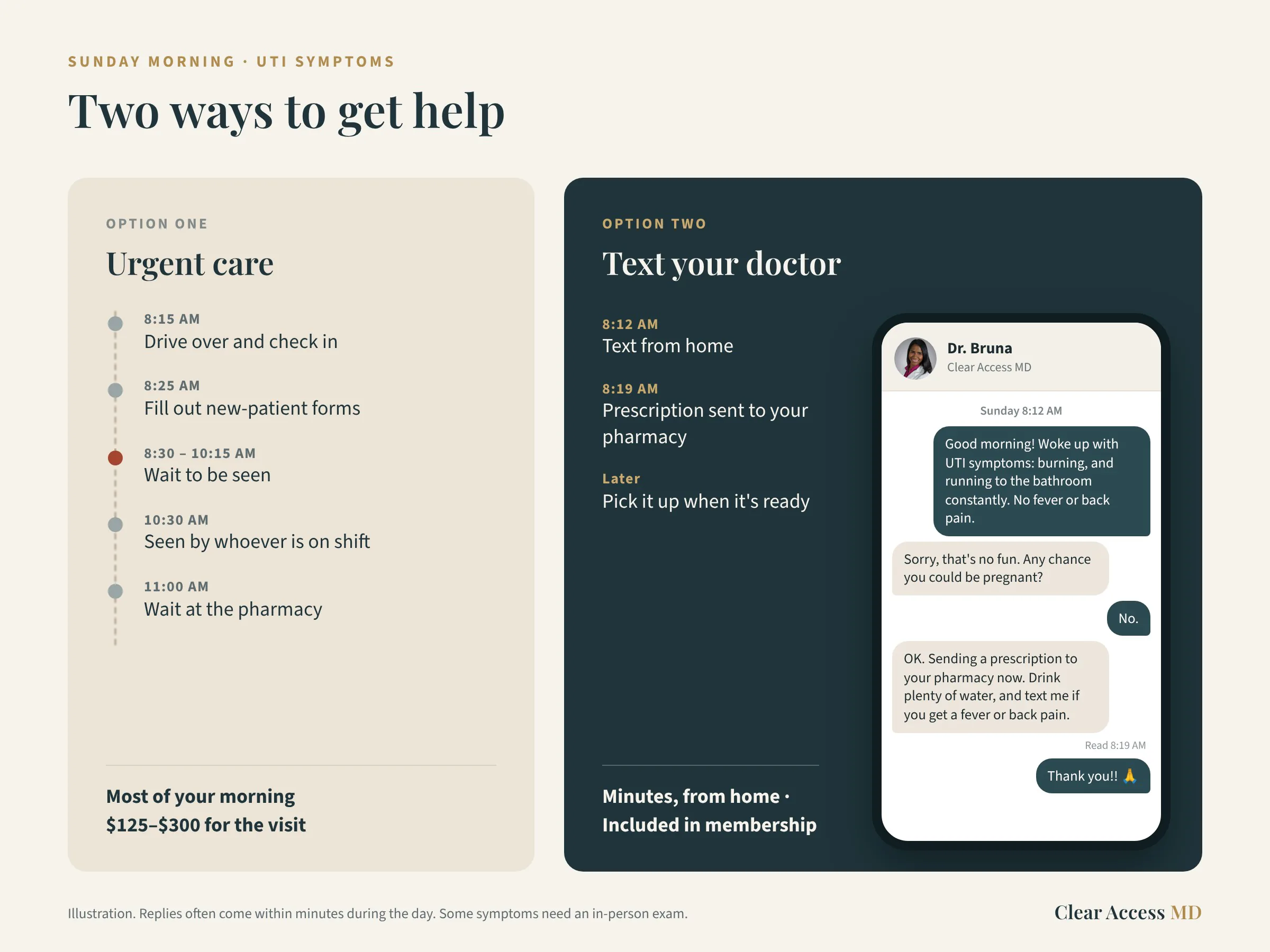
Picture this: it’s Sunday morning, and you wake up with the burning, can’t-stop-running-to-the-bathroom feeling of a urinary tract infection.
Option one: urgent care. You drive over, fill out forms, and wait to be seen by whoever is on shift. Between check-in, the wait and the pharmacy, it can easily take most of your morning. And you’ll pay $125–$300 for the visit before you even get to the prescription.
Option two: text your doctor. As a member, you text the practice and describe your symptoms. On a weekend morning, you’ll often hear back within minutes. Dr. Bruna already knows your history, your allergies and the medications you take. For a straightforward case, she can send a prescription straight to your pharmacy. You stay home until it’s ready to pick up, and there’s no extra charge.
It’s the same with everyday needs:
- A refill that’s about to run out
- A question about a new symptom
- Whether a rash or a cough needs to be looked at
These things shouldn’t cost you a co-pay, a cash fee or half a day.
When a text isn’t enough: some symptoms need an in-person exam. With a UTI, that includes fever, back or side pain, nausea or vomiting, or symptoms during pregnancy. Your doctor will tell you if you need to come in. For emergencies, call 911 or go to the nearest ER.
You won’t find this kind of value on a price list: being able to reach a doctor who already knows you, at the moment you actually need one.
What membership doesn’t cover, stated plainly
Primary care membership covers primary care. It doesn’t cover:
- Hospital stays
- Emergency room visits
- Specialist visits
- Imaging, such as MRIs and CT scans
- Surgery
That’s why many members pair their membership with coverage for big, unexpected events, like a catastrophic insurance plan or a healthshare plan. We can provide guidance on healthshare options as needed.
Direct Primary Care works with or without insurance. You don’t need insurance to join, and having insurance doesn’t stop you from joining.
Often paying cash beats going through insurance
This surprises a lot of people: for many tests, scans and procedures, the cash price is often lower than what you’d end up paying through insurance, especially if you haven’t met your deductible. Paying cash is often faster, too.
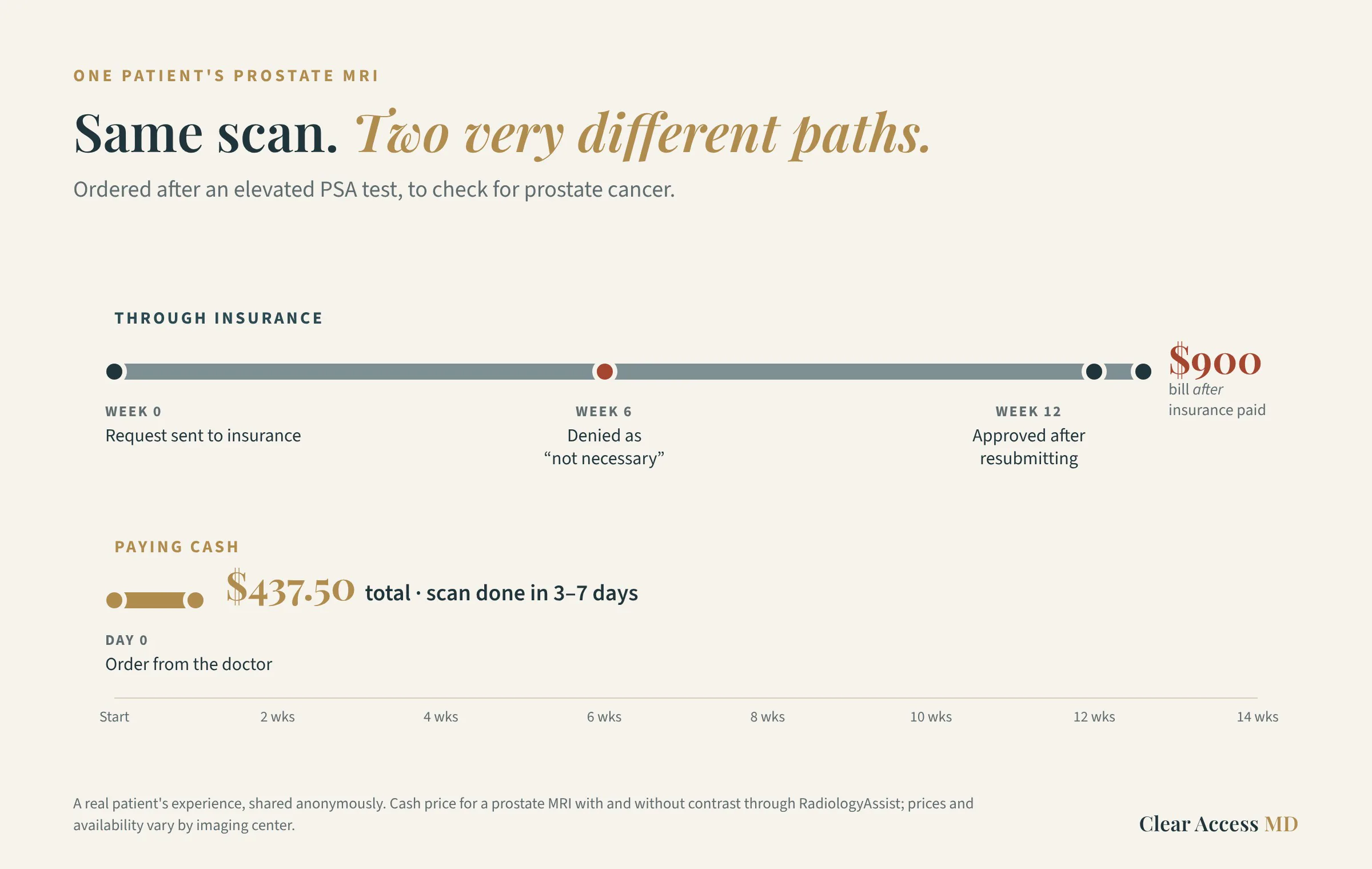
A real example from our practice. One of our patients has insurance through a major national carrier. After his PSA (a prostate blood test) came back elevated, his urologist ordered a prostate MRI to check for cancer.
- His insurance company took six weeks to respond, then denied the scan as “not necessary.”
- He resubmitted the request, this time adding his family history of prostate cancer. Another six weeks passed before it was approved.
- He finally had the scan. After insurance paid its share, he still received a bill for about $900.
That’s roughly three months of waiting on a cancer screening, with a $900 bill at the end.
The same scan, a prostate MRI with and without contrast, is available as a cash-pay service through programs like RadiologyAssist. The price is $437.50–$500 (depending on location), and the scan is typically scheduled within 3 to 7 days.⁶
It doesn’t always work out this way, and insurance has its place, especially for hospital stays, surgery and emergencies. But for routine tests and imaging, it’s worth asking for the cash price before assuming insurance is the cheaper or faster path.
Where having your own doctor helps: imaging requires a physician’s order. When you have a doctor who knows your history, someone can order the right test, help you weigh cash-pay options against your coverage, and go over the results with you afterward.
Questions to ask any practice about cost
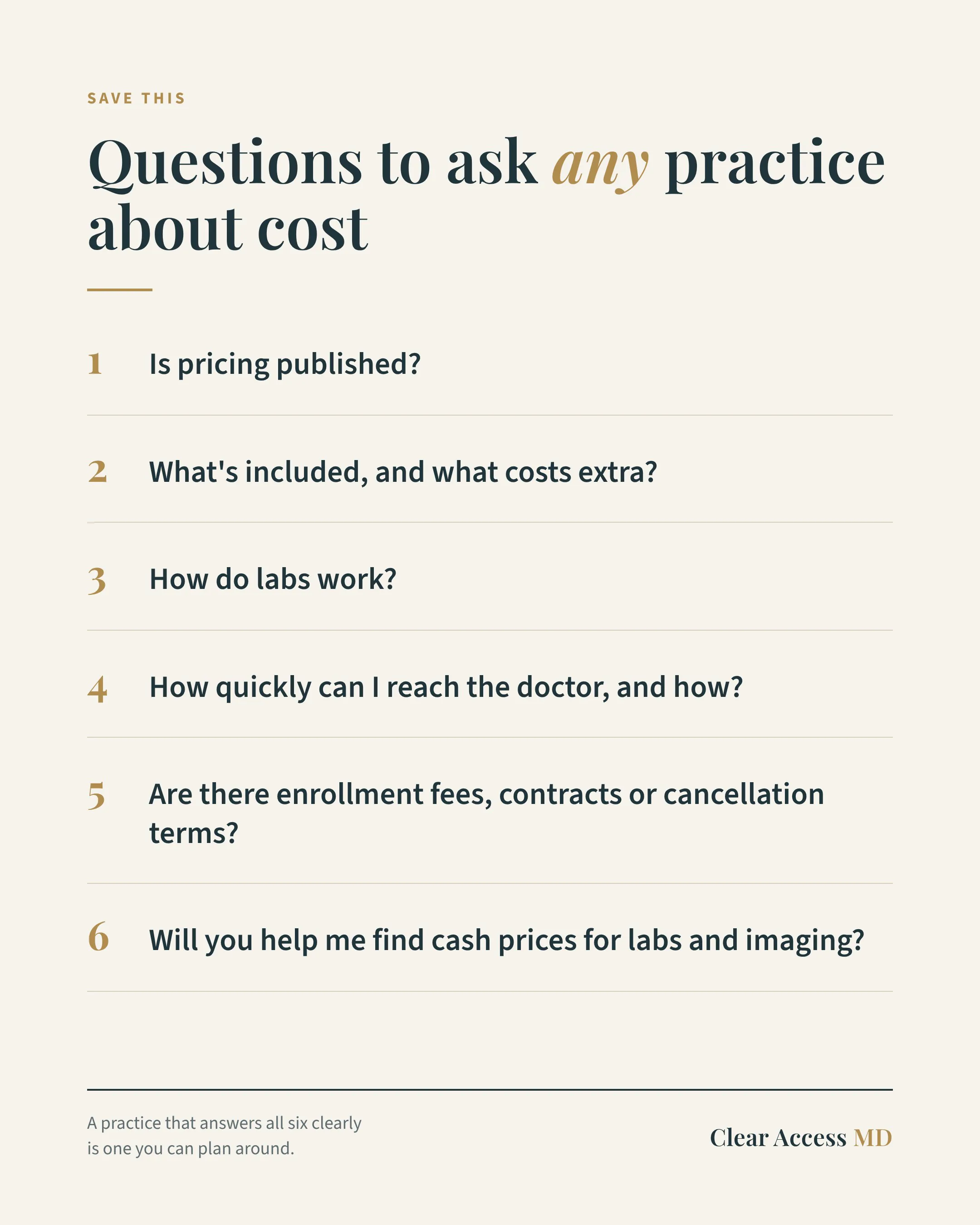
Whichever route you choose, these questions will tell you a lot:
- Is pricing published? Can you see it before you book?
- What’s included, and what costs extra?
- How do labs work? Are they included, discounted or billed separately?
- How quickly can I reach the doctor, and how? By phone, text or portal?
- Are there enrollment fees, contracts or cancellation terms?
- Will you help me find cash prices for labs and imaging?
A practice that answers all six clearly is one you can plan around.
The bottom line
Without insurance, primary care can cost a little or a lot, depending on how you pay for it.
- Paying per visit works for occasional, one-off needs.
- A membership gives you a predictable monthly cost and a doctor who knows your history. It also takes away the hesitation that keeps people from asking questions early, which is when answers are easiest.
Not sure which is right for you? Book a free 30-minute intro visit with Dr. Bruna, in person, by phone or by Zoom. It’s a conversation, not an appointment: we’ll answer your questions and you can decide from there, with no pressure.
📞 (941) 322-7202 · Schedule a Free Intro Visit
Clear Access MD serves adults 18+ in Lakewood Ranch, Bradenton and Sarasota, in English and Spanish.
Frequently asked questions
Can I see a doctor without insurance in Lakewood Ranch? Yes. You can pay cash per visit at many offices and urgent care centers, or join a Direct Primary Care practice like Clear Access MD for a flat monthly fee.
Is Direct Primary Care the same as concierge medicine? They’re similar: both give you more time and direct access to your doctor. Concierge practices often charge a membership fee on top of billing insurance for visits. DPC typically replaces per-visit billing with one transparent monthly fee.
Do I need insurance to join? No. Direct Primary Care works with or without insurance.
Can I text the doctor for a refill or a simple problem? Yes. Members can text the practice with questions, refill requests and new symptoms. For straightforward issues, Dr. Bruna can often send a prescription to your pharmacy without an office visit. If something needs an exam, she’ll tell you to come in.
Is paying cash ever cheaper than using insurance? Often, yes, especially for labs and imaging when you haven’t met your deductible. Cash-pay programs can also skip the prior-authorization wait. It’s always worth asking for the self-pay price first.
Are labs included or extra? Your yearly exam includes a comprehensive lab panel. Additional tests are available at discounted member pricing, and Dr. Bruna reviews your results with you in a follow-up appointment.
Sources
- Solv Health, How much does a doctor’s visit cost without insurance? (updated June 2026)
- Solv Health, How much does an annual physical cost without insurance?
- GoodRx, as cited by TeleDirectMD, What Care Costs Without Insurance
- CoveredUSA, CMP test cost (2026)
- Zocdoc, How Much Is a Primary Care Visit Without Insurance? (2026), citing Mira
- RadiologyAssist, cash-pay imaging program (price and scheduling as of November 2026; prices vary by study and imaging center; not available to Medicare or Medicaid participants)