When to Contact Your Primary Care Doctor vs. Go to Urgent Care or the ER.
On This Page
- 1. Choosing the Right Level of Care
- 2. Start With Primary Care for Most Non-Emergency Problems
- 3. Why Direct Access to Primary Care Matters
- 4. What Your Primary Care Doctor May Be Able to Handle
- 5. When Urgent Care Makes Sense
- 6. When to Go Directly to the ER or Call 911
- 7. What If You Are Not Sure?
- 8. One Advantage of Having a Doctor Who Knows You
- 9. After Urgent Care or the ER, Primary Care Still Matters
- 10. A Simple Guide: Where Should You Go?
- 11. Better Access Can Help You Get Care Earlier
1. Choosing the Right Level of Care
You wake up feeling sick, develop a new symptom, or get injured. Should you contact your primary care doctor, go to urgent care, or head to the emergency room?
The right choice depends on several things: how severe your symptoms are, how quickly you need to be evaluated, and what type of testing or treatment may be necessary.
For many non-emergency health concerns, your primary care physician is a good place to start. Your doctor can evaluate what is happening, recommend the next step, and help determine whether you need an office visit, testing, urgent care, or emergency evaluation.
For Clear Access MD members, there is an added advantage: you can call or text our practice about most non-emergency concerns. Because we already know your medical history, medications, prior test results, and ongoing health issues, we may be able to help you decide what level of care is appropriate without automatically sending you to urgent care or the emergency room.
If you are not an established Clear Access MD patient, please contact your own primary care clinician for medical guidance or seek care through an appropriate urgent care or emergency department.
Most importantly, some situations should not wait.
If you believe you are experiencing a medical emergency, call 911 or go to the nearest emergency department. Do not delay emergency care while waiting to hear back from a medical office.
The goal is simple: to help you get the right level of care, in the right place, at the right time.
2. Start With Primary Care for Most Non-Emergency Problems
For many new symptoms and everyday health concerns, primary care is the best place to start.
You do not need to know exactly what is wrong before reaching out. In fact, one of the most important roles of a primary care physician is helping determine whether a problem can be managed routinely, needs prompt evaluation, or requires a higher level of care.
Common reasons to contact your primary care doctor include:
- cough, cold, flu, sore throat, or sinus symptoms
- urinary symptoms or a possible UTI
- mild nausea, vomiting, or diarrhea
- rashes or other skin concerns
- back, neck, muscle, or joint pain
- headaches without emergency warning signs
- medication side effects or medication questions
- blood pressure readings that are higher or lower than usual
- blood sugar concerns
- fatigue, weakness, or dizziness
- mild abdominal discomfort
- swelling
- changes in a chronic condition
- new symptoms that concern you but do not appear to be an emergency
Primary care is especially valuable because the physician can look at the new problem in the context of your overall health. Your medical history, medications, previous lab results, recent symptoms, and chronic conditions can all influence what a new symptom may mean and what should happen next.
For Clear Access MD members, most non-emergency concerns can begin with a call or text to the practice. Depending on the situation, Dr. Bruna may recommend home care, a telehealth visit, an in-office evaluation, laboratory testing, imaging, a medication adjustment, urgent care, or emergency evaluation.
This direct access can help members get guidance earlier, rather than waiting until a problem becomes more severe or automatically turning to urgent care simply because a primary care appointment is difficult to obtain.
The important distinction is that primary care is the starting point for many non-emergency concerns—not a substitute for emergency care. If symptoms are severe, rapidly worsening, or suggest a potentially life-threatening condition, emergency evaluation may be necessary.
3. Why Direct Access to Primary Care Matters
One of the biggest advantages of Direct Primary Care is not just having a doctor—it is being able to reach that doctor when a problem first starts.
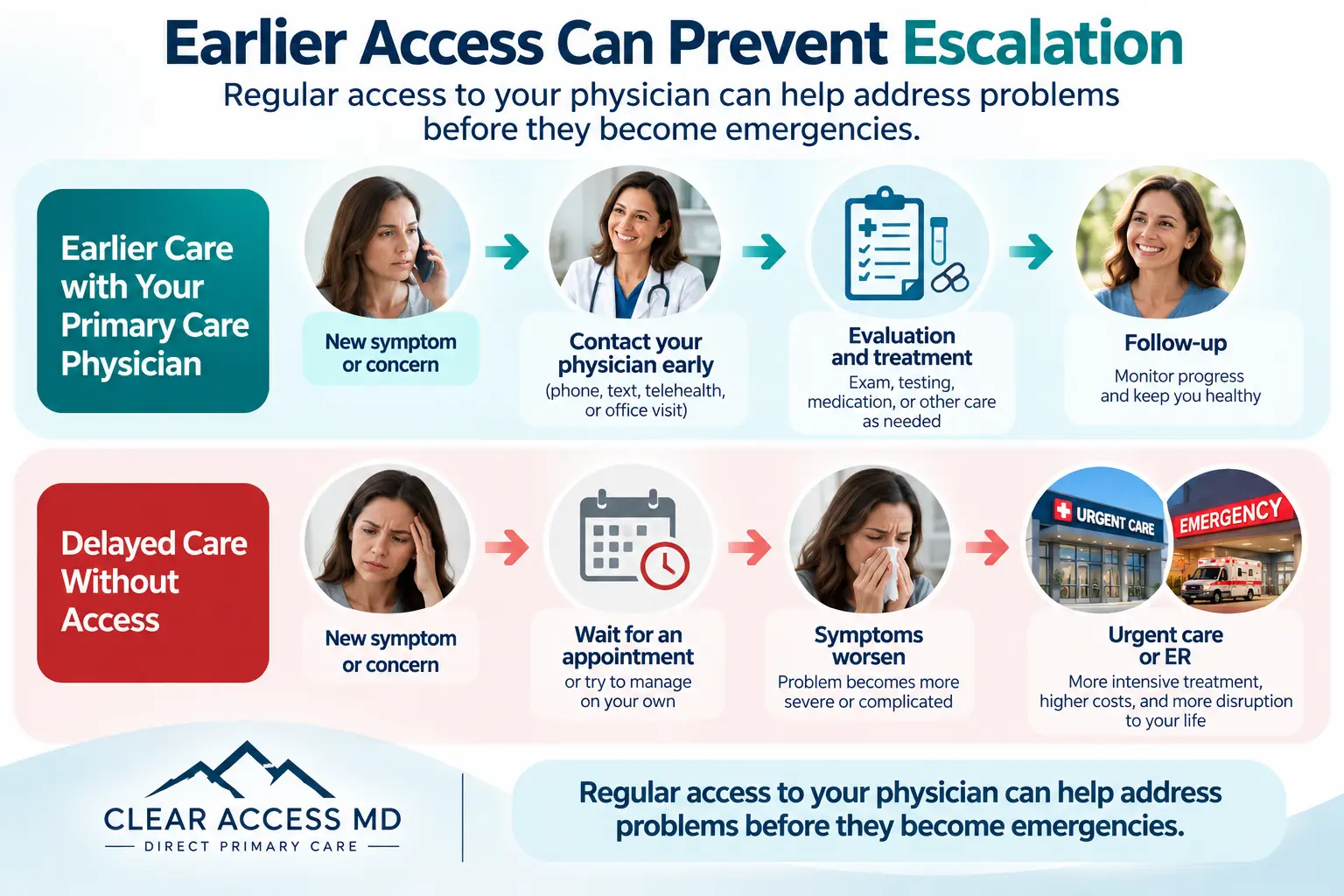
In a traditional healthcare setting, patients may sometimes wait days or weeks for a primary care appointment. When symptoms appear in the meantime, they may delay care, try to manage the problem on their own, or go directly to urgent care or the emergency room simply because they cannot access their regular physician quickly enough.
Direct Primary Care changes that dynamic.
For Clear Access MD members, new concerns can often be addressed earlier through a call, text, telehealth visit, or office visit. That earlier access gives the physician an opportunity to assess what is happening, recommend treatment, order testing, adjust medications, or arrange follow-up before a problem becomes more difficult to manage.
For example, a member may reach out when urinary symptoms first begin, when blood pressure readings start trending higher, when a cough is getting worse, or when a medication is causing unexpected side effects. Addressing those concerns early may prevent some problems from progressing to the point where urgent care or emergency evaluation becomes necessary.
That does not mean Direct Primary Care prevents emergencies, nor does it replace emergency care. Serious illnesses and injuries can occur even with excellent primary care access.
The benefit is that regular access to a physician can reduce the chance that a manageable problem becomes an avoidable urgent-care or emergency-room visit simply because care was not available early enough.
In many cases, the difference is not more medicine. It is earlier guidance, better continuity, and having a physician available to help determine what should happen next.
4. What Your Primary Care Doctor May Be Able to Handle
Primary care can manage far more than annual checkups and routine follow-up visits.
Many common illnesses, symptoms, and changes in your health can be evaluated and treated in a primary care setting. Depending on the situation, your doctor may be able to diagnose the problem, begin treatment, order testing, adjust medications, or decide whether a higher level of care is needed.
Examples of concerns that may be handled through primary care include:
- respiratory illnesses such as cough, sore throat, sinus symptoms, or flu-like illness
- urinary symptoms and uncomplicated urinary tract infections
- mild gastrointestinal illnesses
- rashes and other common skin conditions
- headaches without emergency warning signs
- back, neck, muscle, and joint pain
- medication side effects or medication adjustments
- changes in blood pressure or blood sugar
- worsening of chronic conditions
- fatigue, dizziness, or other new symptoms that are not immediately severe
- follow-up after an urgent care or emergency-room visit
Primary care can also help determine when additional testing is needed. Depending on the practice, this may include laboratory testing, EKGs, rapid tests, imaging orders, or referral to a specialist.
For Clear Access MD members, many of these concerns can be evaluated directly through the practice. Depending on the situation, care may begin with a phone call or text and continue with a telehealth or in-office visit if needed. We can also arrange laboratory testing, perform certain in-office testing, order imaging, adjust medications, and coordinate specialist care.
Just as importantly, your primary care physician can recognize when a problem cannot or should not be managed in the office.
Sometimes the most valuable part of primary care is not treating the problem directly, but identifying the right next step—whether that means monitoring at home, coming into the office, getting testing, going to urgent care, or seeking emergency evaluation.
That ability to guide patients to the appropriate level of care is one of the reasons having an accessible primary care physician can be so valuable.
5. When Urgent Care Makes Sense
Urgent care can be useful when a problem needs prompt attention but does not appear to be life-threatening, especially when your primary care office is unavailable or the situation requires services that may not be available in a typical primary care setting.
Examples may include:
- a cut that may need stitches
- a minor burn
- a sprain or certain minor injuries
- a possible uncomplicated fracture
- an acute illness that should be evaluated promptly when your primary care clinician is unavailable
- certain after-hours concerns that should not wait until the next business day
Urgent care can often provide on-site services such as X-rays, wound care, splinting, or other minor procedures.
For Clear Access MD members, if the situation is not an obvious emergency and you are unsure whether urgent care is necessary, you may contact the practice for guidance. In some cases, we may be able to evaluate the problem directly, arrange appropriate testing, or help determine whether urgent care is the better option.
However, some injuries and symptoms belong in the emergency room rather than urgent care. Major trauma, obvious deformity, uncontrolled bleeding, loss of sensation or circulation, severe pain after significant injury, or other concerning symptoms may require emergency evaluation.
The goal is not to avoid urgent care when it is appropriate. It is to use it when it is the right level of care.
6. When to Go Directly to the ER or Call 911
Some symptoms should not wait for a primary care appointment, a callback, or an urgent care visit.
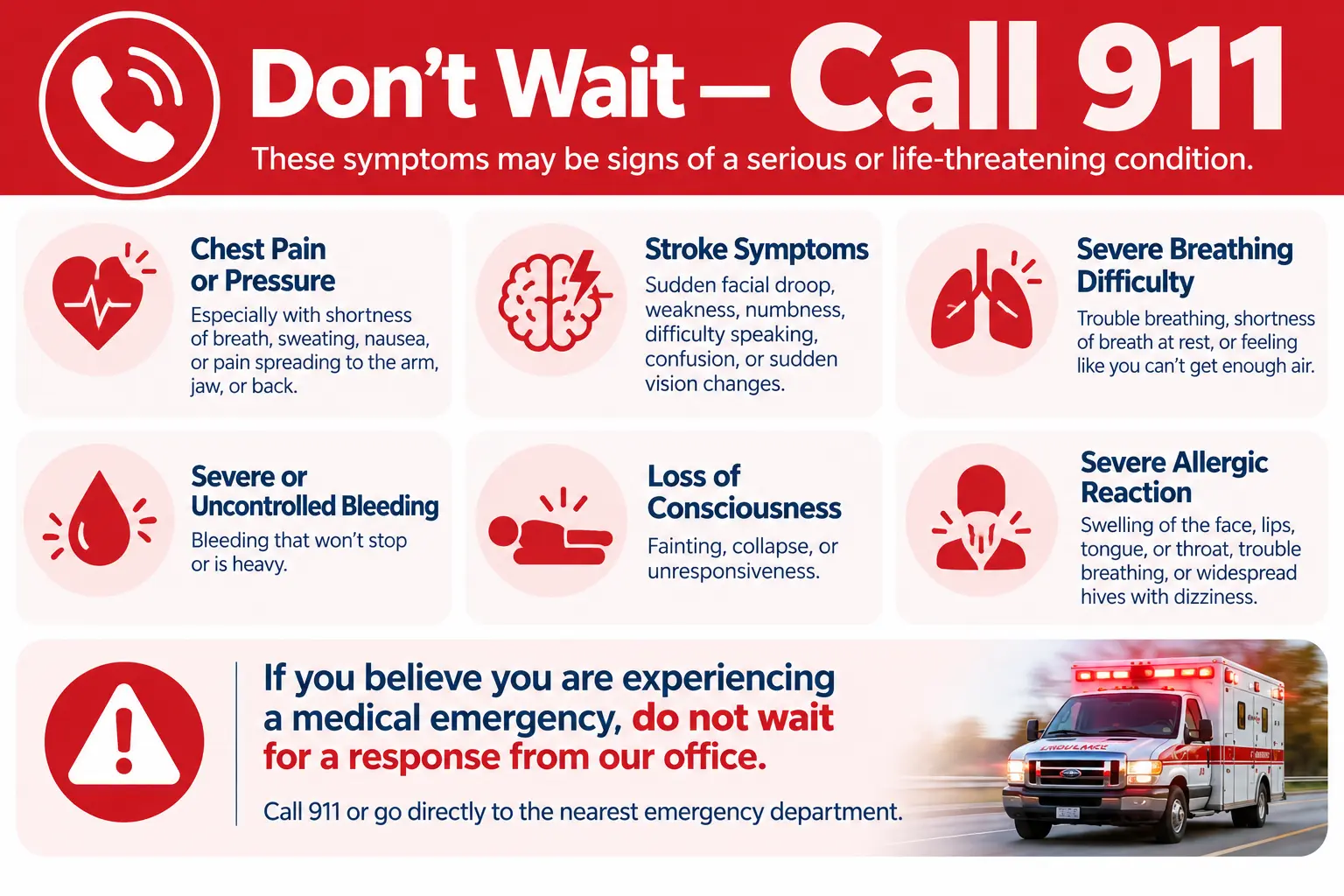
Call 911 or go to the nearest emergency department for symptoms that may represent a serious or life-threatening condition.
Examples include:
- chest pain or pressure, especially when accompanied by shortness of breath, sweating, nausea, or pain spreading to the arm, jaw, or back
- severe difficulty breathing
- signs of stroke, such as sudden facial droop, weakness, numbness, difficulty speaking, or confusion
- loss of consciousness
- severe or rapidly worsening confusion
- severe allergic reaction with difficulty breathing or swelling of the tongue or throat
- uncontrolled or significant bleeding
- major trauma or serious injury
- severe burns
- a first-time seizure or a prolonged seizure
- a sudden, severe headache unlike previous headaches
- severe or rapidly worsening abdominal pain
- vomiting blood or significant gastrointestinal bleeding
- suspected poisoning or overdose
- immediate danger of self-harm
This list is not exhaustive. If something feels immediately dangerous or potentially life-threatening, emergency care is the appropriate choice.
If you believe you are experiencing a medical emergency, do not delay care while waiting for a response from a primary care office. Call 911 or seek emergency evaluation immediately.
This applies equally to Clear Access MD members and to the general public.
7. What If You Are Not Sure?
Many situations are not obviously routine, urgent, or emergent.
You may find yourself wondering:
- “My blood pressure is much higher than usual. Does this need the ER?”
- “I have been vomiting since yesterday. Can this wait?”
- “My heart feels like it is beating faster than normal.”
- “I twisted my ankle and now it is swollen.”
- “I have abdominal discomfort, but I am not sure how serious it is.”
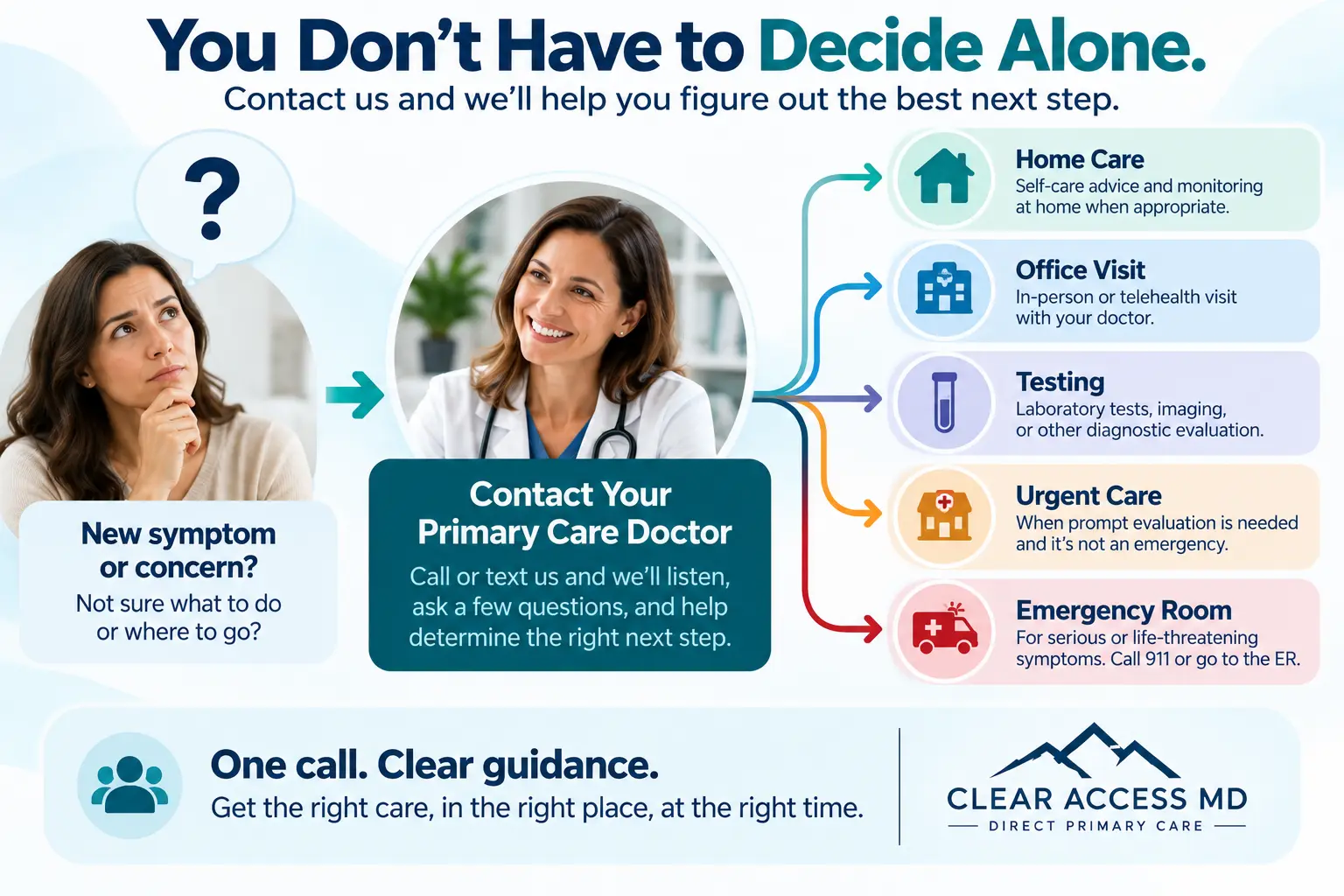
In these situations, you do not necessarily have to make the decision on your own.
If there are no obvious emergency warning signs, contacting your own primary care clinician can often help determine the appropriate next step. Depending on the situation, that may mean home care, an office visit, testing, urgent care, or emergency evaluation.
For Clear Access MD members, this is one of the practical benefits of having direct access to your physician. Members can call or text the practice about non-emergency concerns and get guidance about what should happen next.
The key distinction is important: direct primary care access is helpful when the situation is uncertain but not clearly dangerous. It should never delay emergency care when serious warning signs are present.
8. One Advantage of Having a Doctor Who Knows You
A new symptom does not happen in isolation.
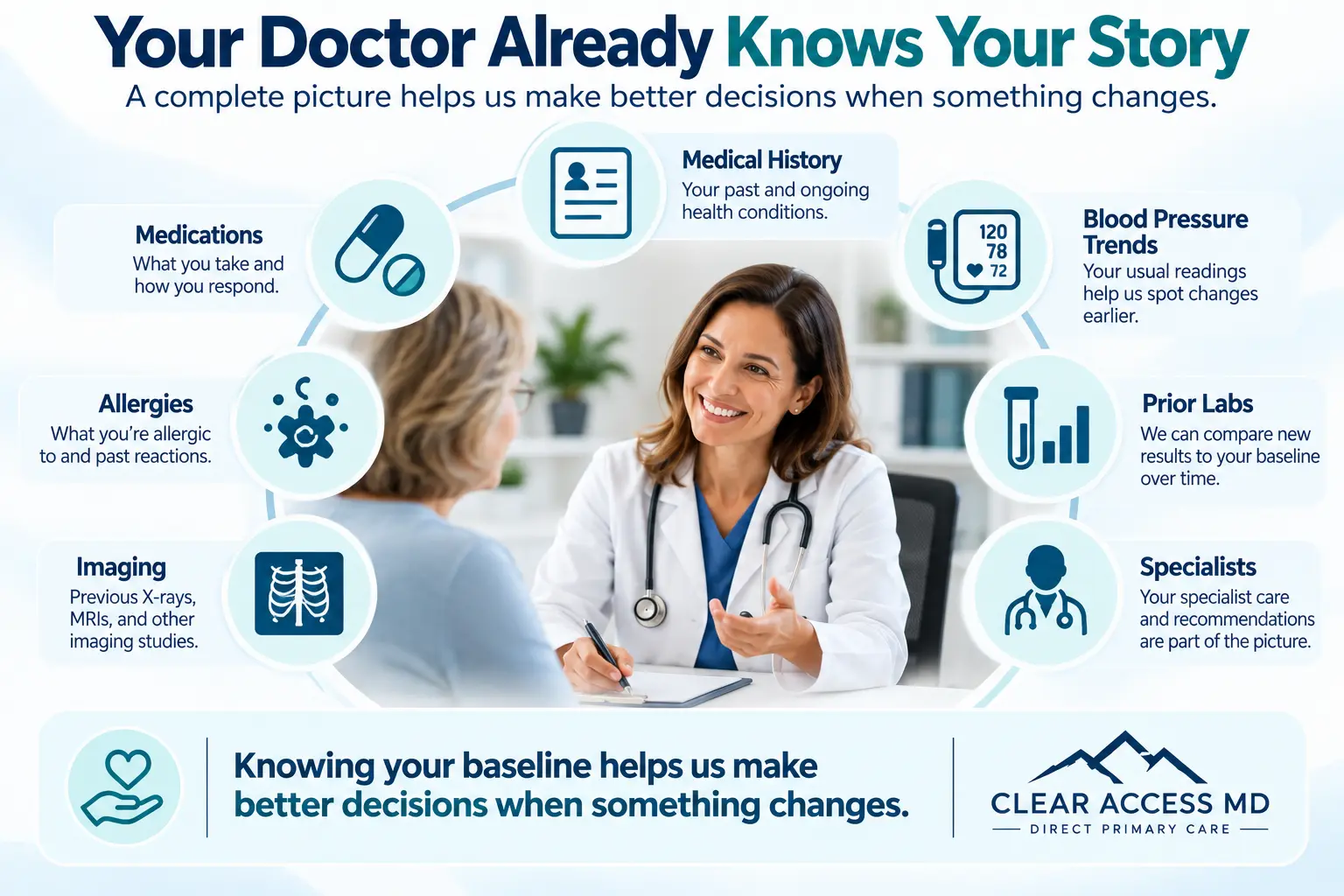
Its significance may depend on your age, medical history, medications, previous laboratory results, usual blood pressure, kidney function, recent illnesses, prior imaging, and other health conditions.
A physician who already knows your history has context that may help make better decisions when something changes.
For example, a blood pressure reading that is unusual for one person may be typical for another. A new medication side effect may make more sense when viewed alongside the rest of a patient’s medication list. A change in kidney function or blood sugar may be more meaningful when compared with previous results.
This continuity is one of the advantages of an ongoing primary care relationship.
For Clear Access MD members, that relationship becomes especially useful when a new problem appears because the physician is not starting from scratch.
Sometimes knowing what is normal for you is just as important as recognizing what is abnormal.
That context can help determine whether a symptom can be monitored, needs an office evaluation, requires additional testing, or should be evaluated elsewhere.
9. After Urgent Care or the ER, Primary Care Still Matters
Even when urgent care or emergency care was absolutely the right choice, the story often does not end when you leave.
You may still need:
- review of your diagnosis
- review of laboratory or imaging results
- medication reconciliation
- follow-up of new prescriptions
- repeat testing
- monitoring to make sure symptoms are improving
- referral to a specialist
- coordination with other clinicians
- ongoing treatment of the underlying condition
This is where primary care becomes important again.
Urgent care and emergency departments are designed to address the immediate problem. Your primary care physician can help connect that episode of care with your broader medical history and long-term health.
For Clear Access MD members, let the practice know if you have been seen in urgent care or the emergency room. We can review what happened, help coordinate follow-up, and make sure important next steps are not missed.
Emergency care treats the immediate problem. Primary care helps manage what happens next.
10. A Simple Guide: Where Should You Go?
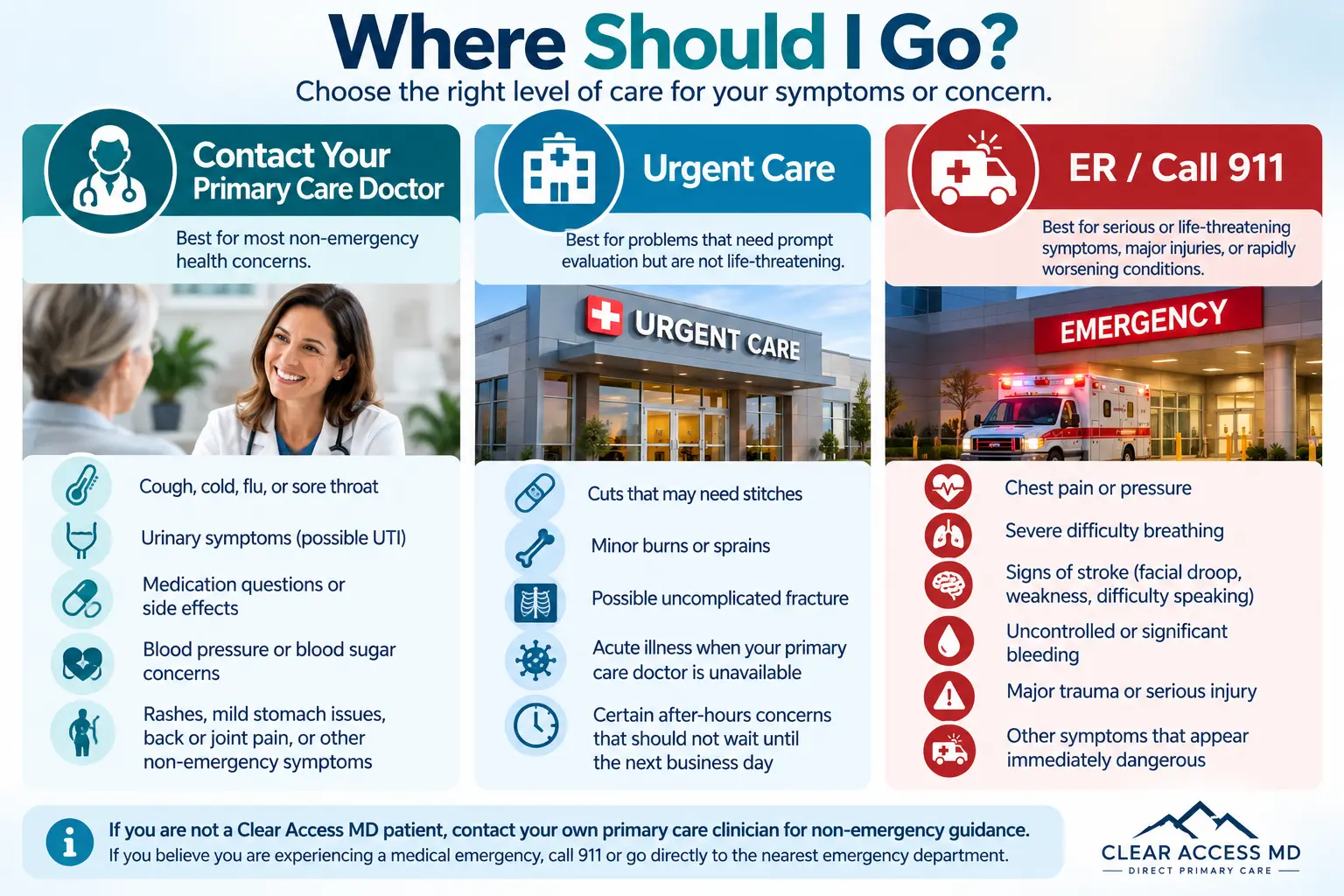
When you are trying to decide where to seek care, this general framework may help:
PRIMARY CARE
Best for most non-emergency illnesses, symptoms, medication questions, and changes in chronic conditions.
Examples include:
- respiratory symptoms
- urinary symptoms
- medication concerns
- mild gastrointestinal symptoms
- blood pressure or blood sugar concerns
- rashes
- headaches without emergency warning signs
- worsening of chronic conditions
Clear Access MD members: Call or text the practice for most non-emergency concerns.
URGENT CARE
Best for problems that need prompt evaluation but do not appear to be life-threatening and cannot reasonably wait for primary care.
Examples may include:
- cuts that may need stitches
- minor burns
- sprains or certain minor injuries
- some possible uncomplicated fractures
- acute illness when primary care is unavailable
ER / 911
Best for potentially life-threatening symptoms, major injuries, or rapidly worsening serious illness.
Examples include:
- chest pain
- severe difficulty breathing
- stroke symptoms
- major trauma
- severe bleeding
- severe allergic reaction
- loss of consciousness
- other symptoms that appear immediately dangerous
If you are not a Clear Access MD patient, contact your own primary care clinician for non-emergency guidance.
If you believe you are experiencing a medical emergency, call 911 or go directly to the emergency department.
11. Better Access Can Help You Get Care Earlier
Knowing where to seek care can help you get the right level of attention without unnecessary delays.
For most non-emergency problems, primary care is a good place to start. Urgent care is useful when prompt evaluation is needed and primary care is not available. The emergency room is there for serious and potentially life-threatening situations.
Direct Primary Care adds another important advantage: access.
For Clear Access MD members, a new concern does not necessarily have to wait until the next available appointment. Members can reach out earlier, ask questions, and get guidance while a problem may still be relatively manageable.
That earlier access may allow some conditions to be evaluated, treated, or monitored before they worsen. It may also help avoid some urgent-care or emergency-room visits that happen simply because timely primary care was not available.
Direct Primary Care does not replace emergency medicine, and it does not prevent every emergency.
It does, however, make it easier to involve your physician earlier.
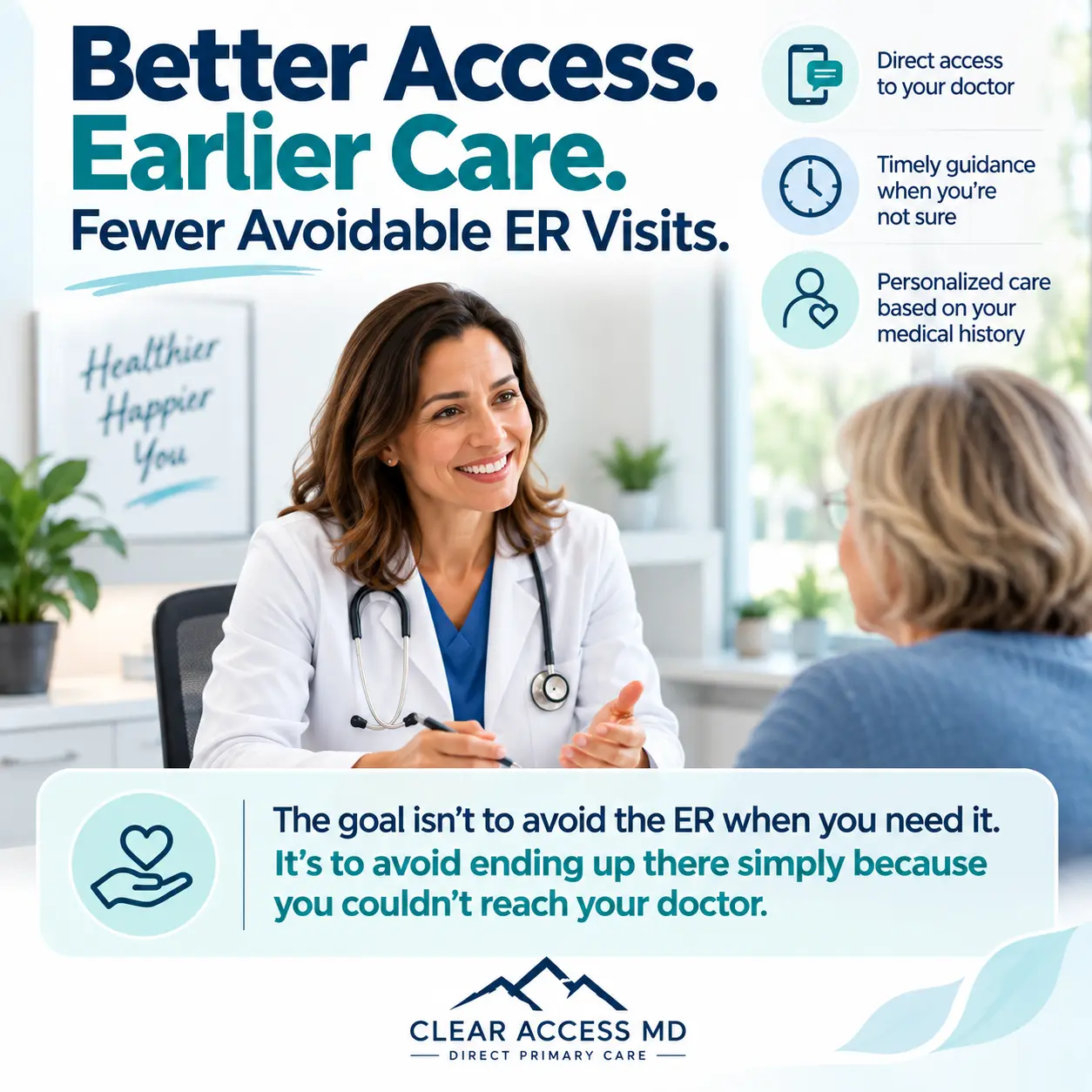
The goal is not to avoid the emergency room when you truly need it. The goal is to have access to your doctor early enough that a manageable problem does not become an avoidable emergency.
Clear Access MD members: If you have a non-emergency medical concern, call or text the practice. If you are experiencing a medical emergency, call 911 or go directly to the nearest emergency department.