
Direct Primary Care vs. Traditional Primary Care: A Simpler Way to Get Healthcare
On This Page
- What Is Direct Primary Care?
- Why Traditional Insurance-Based Primary Care Is So Complex
- How DPC Changes the Relationship
- The Major Benefits of Direct Primary Care
- More Than a List of Perks
- DPC vs. Insurance-Based Primary Care: Side-by-Side Comparison
- Who Might Benefit Most From DPC?
- Ultimately, DPC Is About What You Value in Primary Care
- Common Questions About Direct Primary Care
- Returning Primary Care to Its Original Purpose
- Is Direct Primary Care Right for You?
For many patients, getting basic medical care has become surprisingly frustrating.
It often starts with something simple—a new symptom, a lingering concern, or a question that should take a few minutes to address. Instead, patients may find themselves waiting weeks for an appointment. When the visit finally arrives, it can feel short and rushed, with limited time to fully explain what’s going on or ask follow-up questions.
Even after the appointment is over, the experience is rarely straightforward. Reaching the physician directly can be difficult, with messages filtered through phone trees, portals, or staff. A simple question may take days to answer. And instead of clarity, patients are often left navigating copays, deductibles, and unexpected bills that arrive long after the visit.
On top of that, insurance requirements can shape nearly every part of care. Prior authorizations may delay treatments or tests. Coverage rules can limit options. And decisions that feel medical in nature are sometimes influenced by what an insurance plan will approve rather than what a patient and doctor decide together.
Behind the scenes, physicians are also under pressure. A significant portion of their time is spent not with patients, but on paperwork—documenting visits, entering billing codes, responding to insurance requests, and meeting regulatory requirements. Each of these tasks is important in isolation, but together they reduce the time available for direct patient care.
Most of these systems exist for understandable reasons. Health insurance helps protect people from large and unpredictable medical costs. Regulations help ensure safety and accountability. Administrative processes allow large healthcare systems to function at scale.
But when all of these layers are placed on top of routine primary care, the result can feel disconnected. The relationship between patient and physician—the core of primary care—can become harder to access and maintain.
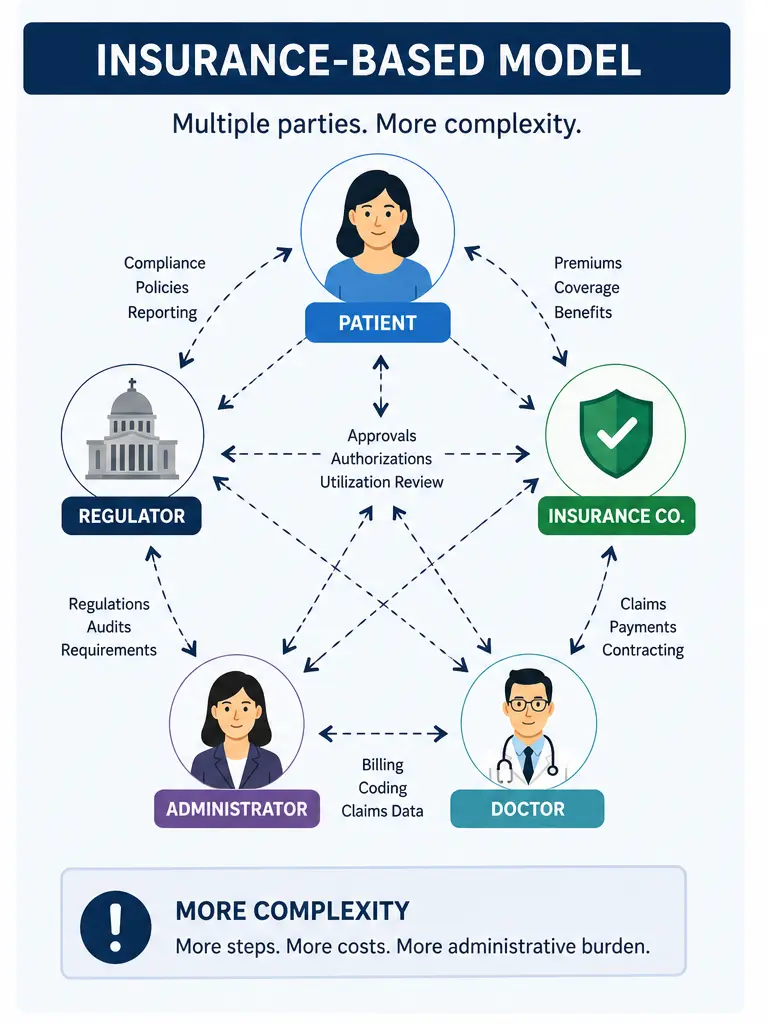
At Clear Access MD, we offer a different structure.
Instead of routing everyday primary care through insurance billing and administrative intermediaries, we build a direct relationship between you and your physician. You pay a predictable membership fee, and we don’t bill insurance for the primary care services included in your membership.
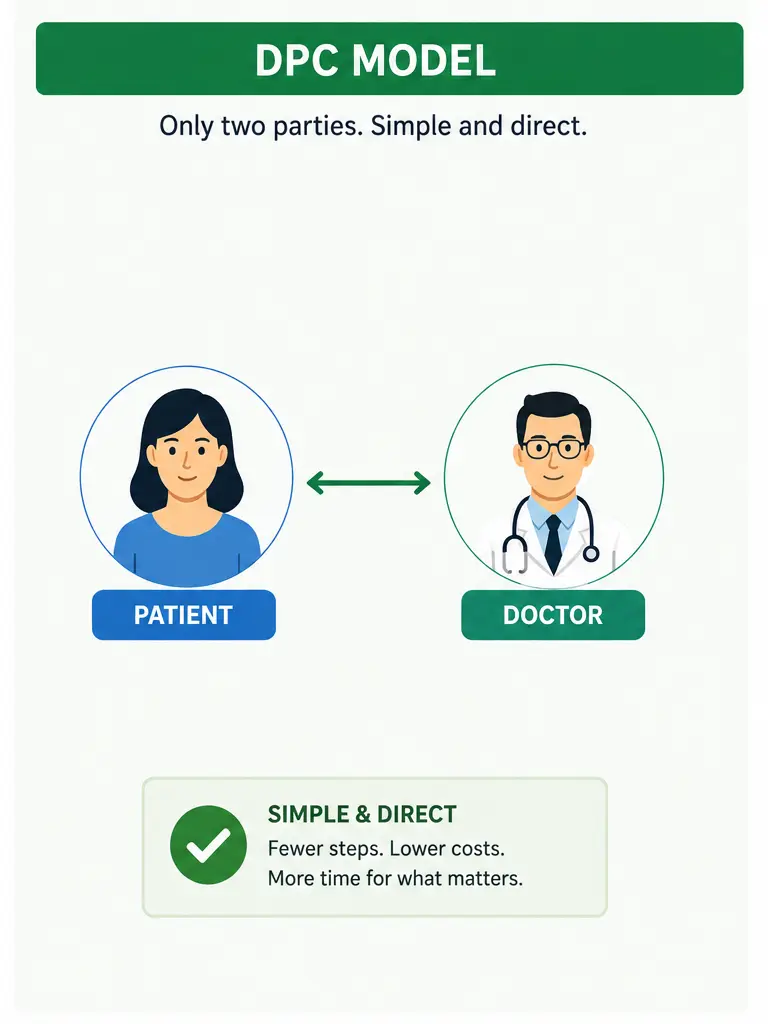
Our goal isn’t just to change payment mechanics. It’s to remove unnecessary complexity from everyday care so that primary care feels personal again.
This simpler model reshapes the experience of care in meaningful ways. Appointments are easier to schedule. Visits are longer and unhurried. Communication with your physician is direct. And we follow your care more closely over time, without the administrative friction that slows traditional practices down.
By removing the layers between you and your physician, we’re restoring what primary care was always meant to be: accessible, continuous, and centered on a real relationship.
What Is Direct Primary Care?
Direct Primary Care (DPC) is a healthcare model built around a simple idea: patients should be able to have an ongoing relationship with their primary care physician without insurance standing in the middle of every routine interaction.
Instead of billing an insurance company for each office visit, phone call, or other covered primary care service, we charge a predictable monthly membership fee. In return, you get broad access to the primary care services included in your membership.
At our practice, this includes routine and preventive care, management of chronic conditions, sick visits, annual physicals, medication management, and communication with your physician between appointments. We also offer longer appointments, same-day or next-day availability, virtual visits, in-office blood draws, and access to discounted laboratory testing.
The key difference is how routine primary care is paid for.
In a traditional insurance-based practice, each visit may generate an insurance claim, billing codes, copays, deductibles, and administrative work. In our practice, your membership covers the primary care services included in your agreement, so we don’t submit an insurance claim every time you need care.
This creates a much simpler relationship:
Patient → Primary Care Physician
rather than routing routine care through multiple financial and administrative intermediaries.
How DPC differs from concierge medicine: The two are often confused, but concierge medicine typically layers a membership fee on top of your existing insurance billing, and tends to cost significantly more. We replace the insurance billing relationship for primary care altogether, which is part of why membership with us is more affordable.
Why Traditional Insurance-Based Primary Care Is So Complex
Traditional primary care may look like a simple interaction between a patient and a doctor, but behind that visit is a much larger system.
In an insurance-based model, the relationship often looks less like:
Patient → Doctor
and more like:
Patient → Insurance Company → Administrative Processes → Rules & Authorizations → Doctor
Each layer serves a purpose, but together they can make even routine medical care surprisingly complicated.
Every Visit Becomes a Financial Transaction
When a traditional practice sees an insured patient, the visit usually generates an insurance claim. The physician must document the encounter according to specific requirements, assign the appropriate billing and diagnostic codes, and submit the claim for payment.
The insurance company then determines how much of the service is covered, how much the practice will be paid, and how much the patient may owe through a copay, deductible, or coinsurance.
This means that something as straightforward as an office visit can involve numerous steps before the financial side of the encounter is finally resolved.
Coding and Documentation Requirements Add Another Layer
Physicians need to document medical care regardless of how they are paid. Good documentation is an important part of practicing medicine.
Insurance billing, however, adds another purpose to that documentation: it must also support the codes submitted for reimbursement.
Practices therefore spend considerable time translating medical care into billing codes, documenting services in ways that meet payer requirements, responding to claim questions, and correcting claims that are rejected or denied.
None of this directly improves the conversation taking place between the patient and physician, but it is necessary for the traditional payment system to function.
Prior Authorization Can Put Another Decision-Maker in the Process
For certain medications, imaging studies, procedures, or treatments, an insurance company may require prior authorization before agreeing to cover the service.
The physician may recommend a particular course of action, but the practice must then submit additional information to the insurer and wait for approval.
Sometimes that process is straightforward. Other times it requires additional documentation, phone calls, appeals, or alternative treatments before coverage is granted.
The result is another layer between the clinical decision made by the patient and physician and the care that is ultimately delivered.
Network Rules Influence Where Patients Receive Care
Insurance plans also establish networks of physicians, laboratories, imaging centers, hospitals, pharmacies, and specialists.
These networks can help insurers negotiate prices, but they can also influence where patients receive care. A physician may prefer one specialist or facility based on clinical experience, while the patient’s insurance plan may provide better coverage somewhere else.
Patients can also face very different costs depending on whether a service is considered in-network or out-of-network.
As a result, choosing where to receive care is not always based solely on what the physician and patient believe is best.
Patients May Not Know the Cost Until After Care Is Delivered
Insurance can also make the actual price of routine healthcare difficult to understand.
A patient may know the amount of a copay but still not know whether a test, procedure, or laboratory service will be subject to a deductible or coinsurance. The final amount owed may depend on the specific insurance plan, negotiated rates, coding, network status, and how the insurer processes the claim.
In many cases, the patient receives the final bill only after the service has already been performed.
This makes healthcare very different from most other purchases, where the price is known before a decision is made.
All of This Requires Administrative Infrastructure
Managing claims, coding, authorizations, insurance verification, billing questions, denials, collections, compliance requirements, and other administrative tasks requires people and resources.
Larger healthcare organizations have entire departments dedicated to these functions. Smaller practices still need staff, outside billing companies, software, and physician time to keep the system operating.
Those administrative costs ultimately become part of the cost of delivering healthcare.
And perhaps more importantly, administrative work competes for one of the most limited resources in medicine: the physician’s time.
The Problem Is Not Insurance Itself
None of this means that health insurance is inherently bad or unnecessary.
Insurance serves an extremely important purpose. A hospitalization, major surgery, serious accident, cancer treatment, or other unexpected medical event can cost tens or even hundreds of thousands of dollars. Insurance helps protect patients from these large and unpredictable financial risks.
The question is whether that same complex system needs to sit in the middle of every routine primary care interaction.
Using insurance to protect against a major hospitalization makes intuitive sense. Using the same claims-based infrastructure for a routine office visit, a blood pressure follow-up, or a conversation with your primary care physician can introduce considerable administrative complexity into care that could otherwise be relatively simple.
That is one of the fundamental ideas behind our practice.
Rather than eliminating insurance altogether, we separate routine primary care from the insurance billing system. You and your physician manage everyday healthcare directly, while insurance remains available for the larger and less predictable medical expenses it is designed to protect against.
The result is a much simpler structure—and that simplicity is what lets us deliver primary care differently.
How DPC Changes the Relationship
At Clear Access MD, we bring the relationship back to its most basic form:
Patient ↔ Doctor
Because we don’t submit an insurance claim for every covered visit or interaction, much of the transactional machinery surrounding routine primary care disappears.
We don’t need to structure each encounter around billing codes, claim submission, copay collection, reimbursement rules, or insurance-specific documentation requirements. That means we spend less time managing the payment process and more time focusing on you.
That difference may sound administrative, but its effect is much broader.
Because we’re not dependent on generating a claim every time you need care, your physician can interact with you in ways that are difficult to fit into a traditional fee-for-service model. We can handle a question by secure message or phone call. We can do a follow-up virtually when appropriate. And we can make an appointment longer when you have several concerns that need thoughtful discussion.
Your relationship with us becomes less centered around individual billable encounters and more centered around ongoing access and continuity of care.
More Time for the Patient
Traditional practices often need to see a high volume of patients each day to support the costs of the insurance-based model. We operate differently: we keep a smaller patient panel and build more physician time into every relationship.
That gives us longer, unhurried appointments and more opportunity to understand your medical history, goals, concerns, and preferences.
Instead of trying to address one issue as quickly as possible, your physician has time to look at the broader picture.
Easier Communication Between Visits
Healthcare does not happen only during scheduled office appointments.
Patients develop symptoms, start new medications, receive test results, or simply think of questions after they leave the office. In a traditional system, getting an answer may require another appointment, a message routed through several staff members, or a lengthy wait for a response.
We designed our practice to make communication easier.
As a member, you can reach your physician through secure messaging, phone, email, or virtual visits. That direct access makes it easier to address smaller concerns before they become larger ones and to make timely adjustments to your treatment plan.
Care Becomes More Continuous
A claims-based system naturally organizes healthcare around individual encounters: you have a visit, the visit is coded and billed, and the transaction is completed.
We structure care around the ongoing relationship instead.
Your physician isn’t simply treating the problem that brought you into the office that day. Over time, we follow changes in your blood pressure, laboratory results, medications, symptoms, lifestyle, and risk factors, building a deeper understanding of your overall health.
That continuity is especially valuable for preventive care and chronic conditions, where the most important work happens through small adjustments and regular follow-up rather than a single office visit.
The Incentives Are Different
In traditional fee-for-service medicine, revenue is generally tied to billable services and encounters.
We receive a predictable membership fee for being available to provide the primary care included in your membership. That creates a different incentive: rather than maximizing the number of billable visits, we can focus on keeping you well, responding efficiently, and maintaining a strong long-term relationship.
You don’t need to wonder whether every question will generate another office charge, and we don’t need to create a separate insurance claim for every routine interaction.
That makes primary care feel less transactional and more personal.
Removing the layers between us changes not only how primary care is paid for—it changes how we deliver it.
And those structural differences lead directly to the benefits you’ll notice most: faster appointments, longer visits, direct physician access, transparent costs, and more time devoted to preventive and ongoing care.
The Major Benefits of Direct Primary Care
The advantages go beyond a different way of paying for an office visit. Because we keep a smaller patient panel, rely on predictable membership revenue, and carry fewer insurance-related administrative demands, we structure your care around access, time, continuity, and communication.
Here’s what that looks like day to day.
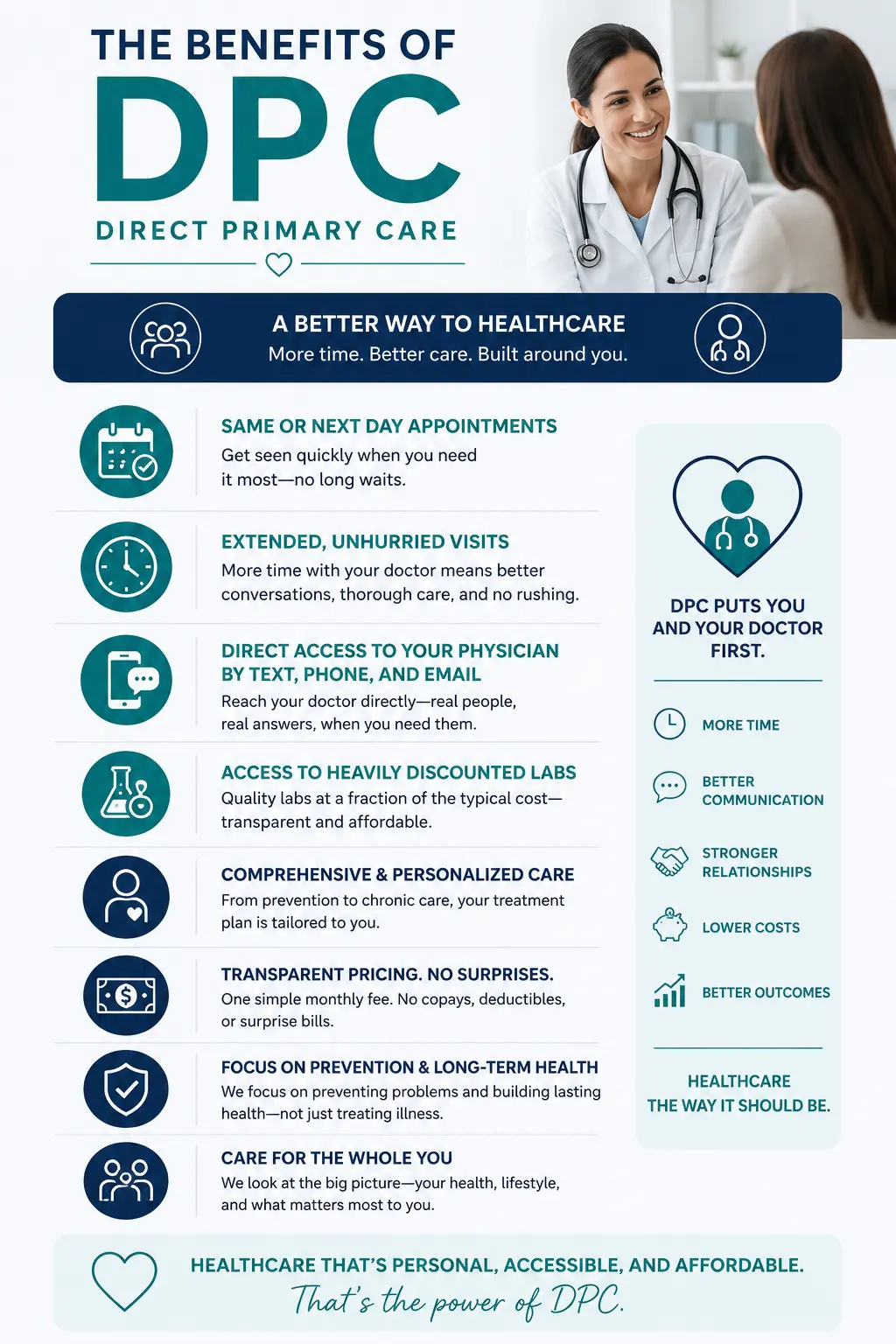
Same-Day or Next-Day Appointments
One of the benefits you’ll notice first is easier access to appointments.
Traditional primary care practices often care for very large patient panels, making it difficult to accommodate urgent concerns quickly. Patients there can wait days or even weeks for an available appointment.
We keep a smaller patient panel. Because your physician is responsible for fewer patients overall, there’s more flexibility in the schedule.
That means we can usually offer same-day or next-day appointments for acute concerns.
Instead of waiting until a problem becomes more serious—or turning to urgent care simply because we had no availability—you can see the physician who already knows your medical history.
Longer, Unhurried Visits
Access matters, but so does what happens once your appointment begins.
In many traditional practices, physicians work within tightly scheduled appointment slots and need to move quickly from one patient to the next. Even an excellent physician can struggle to address several concerns thoroughly when time is limited.
We schedule longer visits, giving us time to:
- Review multiple concerns
- Understand your medical history in greater detail
- Discuss treatment options and their advantages and disadvantages
- Review your medications carefully
- Explain laboratory and imaging results
- Answer your questions
- Discuss preventive care and your long-term health goals
Longer appointments are especially valuable when health issues overlap. Fatigue, weight changes, blood pressure, sleep, medications, stress, and laboratory abnormalities are often connected. Having time to look at the entire picture leads to a more thoughtful approach than addressing each issue in isolation.
Just as importantly, you’ll feel more comfortable asking questions when you don’t feel like your physician is already trying to get to the next appointment.
Direct Access to Your Physician
There’s an important difference between having access to a medical practice and having access to the physician who knows you.
In many healthcare systems, communication passes through several layers. You call a central number, leave a message with staff, wait for the message to be routed, and may eventually hear back from someone who has never personally cared for you.
We designed our practice to make communication direct.
As our patient, you can reach your physician through:
- Secure text messaging
- Phone calls
- Secure patient messaging
- Email, when appropriate
- Virtual visits
Not every concern can or should be handled remotely. Some symptoms require a physical examination, testing, or emergency evaluation.
But we can address many everyday questions quickly without a separate office visit.
For example, if you have a question about a new medication, a home blood-pressure reading, a minor symptom, or a recent laboratory result, direct communication with us helps determine whether we can manage it remotely or whether you need an in-person evaluation.
That kind of access makes primary care feel much more responsive.
A Stronger Doctor-Patient Relationship
Good primary care is built over time.
The more your physician understands your history, medications, family history, preferences, lifestyle, previous treatments, and health goals, the more context we have when new medical decisions arise.
Continuity lets that knowledge accumulate.
Over months and years, we recognize subtle changes that would be difficult to appreciate in a single encounter. We know which treatments have worked for you before, which medications caused side effects, what concerns matter most to you, and how your different medical conditions fit together.
That’s particularly valuable when medical decisions aren’t straightforward.
Two patients with the same diagnosis may reasonably choose different treatment approaches based on their individual risks, preferences, lifestyle, and goals. A strong long-term relationship makes those conversations easier.
We built our practice to support that continuity by making the relationship—not simply the individual appointment—the center of your care.
More Focus on Prevention
Traditional primary care physicians absolutely provide preventive care. The challenge is usually finding enough time to address prevention while also managing the immediate reason for the visit.
If you come in with back pain, a respiratory infection, or a medication problem, a short appointment can easily be consumed by the urgent issue.
Our longer visits and easier follow-up give us more opportunities to look beyond today’s complaint and ask a broader question:
What can we do now to reduce your health risks in the future?
Preventive care with us includes attention to:
- Blood pressure
- Cholesterol
- Diabetes risk
- Cancer screening
- Weight and nutrition
- Exercise
- Sleep
- Tobacco and alcohol use
- Vaccinations
- Medication optimization
- Family history and individual risk factors
Prevention is rarely one dramatic intervention. More often, it means identifying small risks early and addressing them consistently over time.
That’s exactly the kind of work our relationship-based approach is built to support.
Better Management of Chronic Conditions
Many chronic conditions aren’t best managed through occasional isolated appointments.
Conditions such as:
- Hypertension
- Diabetes
- High cholesterol
- Thyroid disease
- Obesity
- Kidney disease
often require repeated monitoring and gradual adjustment.
If we change your medication, we may want to review your blood-pressure readings two weeks later. If you’re starting diabetes treatment, you may need follow-up after laboratory testing. If you’re working on weight management, you may benefit from several smaller adjustments rather than waiting months for the next scheduled appointment.
Because contacting us and arranging follow-up is easy, those adjustments happen more naturally.
Instead of the cycle being:
Appointment → treatment change → wait several months → next appointment
it becomes:
Treatment change → brief follow-up → adjustment → continued monitoring
That tighter feedback loop helps us identify what’s working, what isn’t, and where we should modify your treatment.
Transparent and Predictable Costs
Healthcare pricing is often difficult to understand.
Even with insurance, the amount you ultimately owe for a service can depend on deductibles, copays, coinsurance, network status, negotiated rates, and how the claim is processed.
We approach routine primary care differently.
You know your membership price in advance, and you know which primary care services are included. That makes the cost of accessing your physician considerably more predictable.
For many patients, this also changes the psychology of seeking care.
If you’re unsure whether a routine question or follow-up appointment will result in another bill, you might postpone care. Our membership model removes that hesitation for services included in your membership.
That said, membership with us does not make all healthcare expenses disappear.
You can still have costs for medications, specialist care, imaging, hospitalization, procedures, and other services outside our practice. The benefit is greater transparency and predictability for the primary care portion of your healthcare.
Deeply Discounted Laboratory Testing
Laboratory testing is one of the most tangible examples of how we reduce the cost of routine care.
We negotiate direct cash pricing with laboratories and pass those rates on to you. Because the transaction doesn’t need to pass through the traditional insurance billing process, the price for common tests can be substantially lower than typical retail charges.
Examples include:
- Complete blood count (CBC)
- Comprehensive metabolic panel
- Lipid panel
- Hemoglobin A1C
- Thyroid testing
- Vitamin levels
- Urinalysis
- Other commonly ordered blood tests
If you need periodic monitoring, the difference becomes meaningful.
If you have diabetes, thyroid disease, high cholesterol, or another chronic condition, you may need laboratory testing several times each year. Our lower laboratory costs make appropriate monitoring more affordable and predictable.
Pricing varies by test, but discounted labs are a practical benefit of membership with us.
In-Office Blood Draws
Getting lab work done traditionally means an extra stop: a separate trip to an outside lab, another appointment to schedule, more time out of your day.
We draw blood right here in our office. If your annual physical or another visit calls for lab work, we take the sample on the spot and send it out to a lab for testing — you don’t need to visit a separate lab to get your blood drawn.
That saves you a trip and turns what could be two appointments into one.
Easier Coordination of Care
Direct Primary Care doesn’t mean your physician tries to provide every type of medical service personally.
Your primary care with us still serves as your home base within the larger healthcare system.
Your physician can:
- Order X-rays, ultrasounds, CT scans, MRIs, and other imaging
- Refer you to specialists
- Review specialist recommendations
- Review hospital and emergency department records
- Coordinate prescriptions and medication changes
- Order and interpret laboratory testing
- Follow up with you after hospitalization
- Help you decide where to seek additional care
- Help you navigate the broader healthcare system
This distinction matters because DPC is sometimes misunderstood as a separate or isolated healthcare system.
It isn’t.
We still work with specialists, hospitals, pharmacies, laboratories, imaging centers, and other healthcare professionals whenever those services are needed.
The difference is that your primary care physician remains a consistent point of contact throughout that process.
When several specialists are involved, medications change, or you’re discharged from the hospital, having one physician who knows your overall story is extremely valuable.
More Than a List of Perks
Same-day appointments, longer visits, direct messaging, and discounted labs are easy benefits to describe—and they matter.
But they’re really consequences of a larger structural difference.
Because we’ve removed the administrative layers between you and your physician, your physician has more time, you have better access, and the relationship becomes more continuous.
That’s ultimately what makes our practice different.
The biggest benefit isn’t any single service. It’s creating a primary care environment where your physician has the time and accessibility to actually practice primary care the way it was meant to work.
DPC vs. Insurance-Based Primary Care: Side-by-Side Comparison
The differences between traditional insurance-based primary care and our practice become much easier to see when placed side by side.
| Traditional Insurance-Based Primary Care | Our Practice (Direct Primary Care) |
|---|---|
| Insurance billing is involved in routine care | Direct patient-practice financial relationship |
| Copays, deductibles, and coinsurance may apply | Predictable monthly membership fee |
| Appointment availability may be more limited | Same-day or next-day appointments may be available |
| Visits are often shorter | Longer, less-rushed appointments |
| Communication may be routed through staff or a patient portal | More direct access to the physician |
| Practices may manage larger patient panels | We maintain a smaller patient panel |
| Each visit may generate a separate claim or charge | Many routine primary care services are included in membership |
| Lab pricing may be difficult to predict | Discounted cash laboratory pricing is available |
| Blood work often requires a separate trip to an outside lab | Blood draws are done in-office and sent out for testing |
| Insurance network rules may influence care options | Routine primary care is not dependent on insurance network participation |
| Care can become centered around individual billable visits | Care is structured around an ongoing physician-patient relationship |
| Administrative requirements can consume significant practice resources | Less insurance-related administrative work for covered primary care |
| Follow-up may require another scheduled, billable encounter | Follow-up can often be handled more flexibly when clinically appropriate |
Neither model eliminates the need for the broader healthcare system. Patients may still need specialists, imaging, medications, hospital care, or emergency services.
The main difference is where insurance sits in the primary care relationship.
In traditional primary care, insurance is often involved in nearly every routine encounter. With us, routine primary care is handled directly between you and our practice, while insurance or other appropriate coverage remains available for larger and less predictable medical expenses.
That simpler structure is what lets us offer greater access, longer visits, more direct communication, and a stronger focus on continuity of care.
Who Might Benefit Most From DPC?
Our practice isn’t necessarily the best fit for everyone. Some people are satisfied with their current primary care arrangement, while others have insurance plans or healthcare needs that make a traditional model work well for them.
We tend to be especially attractive to people who place a high value on access, continuity, time with their physician, and predictable primary care costs.
People Who Want Easier Access to Their Physician
For some patients, the biggest frustration with traditional primary care is simply getting in touch with the doctor.
They can reach the office, but not necessarily the physician who knows their history.
Our practice is especially appealing to patients who want:
- Faster appointment availability
- More direct communication
- Easier follow-up after a visit
- The ability to ask routine questions without navigating multiple administrative layers
If you value responsiveness and continuity, that access is one of the most meaningful benefits of membership with us.
Patients With Chronic Medical Conditions
If you’re managing an ongoing condition, you often need more than an occasional office visit.
Conditions such as hypertension, diabetes, thyroid disease, high cholesterol, obesity, or kidney disease require regular laboratory testing, medication adjustments, home monitoring, and follow-up.
We make that process easier because you have more opportunities to communicate with your physician between formal visits.
Instead of waiting several months to revisit your treatment plan, we can make smaller adjustments and monitor your progress more closely.
People With High-Deductible Health Plans
If you have high-deductible insurance, you may technically have coverage but still pay a substantial amount out of pocket before it begins covering routine services.
For patients in this position, using insurance for every primary care visit doesn’t always feel like much of a financial benefit.
A predictable membership with us gives you regular access to primary care while your insurance stays in place for larger medical expenses.
This combination is especially attractive if you want to use insurance primarily as protection against expensive, unpredictable events rather than as the payment mechanism for every routine interaction.
Self-Employed Individuals
If you’re self-employed, you often purchase your own health coverage and may choose plans with higher deductibles or narrower networks to manage premiums.
We give you a predictable way to access primary care regardless of how often you need to see your physician.
We also provide continuity when your insurance plan or network changes from year to year.
Small-Business Owners and Their Employees
We’re also a good fit for small businesses looking to improve access to primary care for employees.
Membership with us gives employees easier access to a physician, faster appointments, and more predictable routine-care costs.
As an employer, you can use it as a standalone healthcare benefit or, depending on your situation, to complement other forms of health coverage.
If you struggle with the cost and complexity of traditional employee benefits, you may find the simplicity of a fixed monthly primary care membership particularly attractive.
Patients Who Want More Preventive Care
Some people seek medical care mainly when something is wrong.
Others want a more proactive relationship with their physician.
We’re a good fit if you want time to discuss:
- Blood pressure and cardiovascular risk
- Cholesterol
- Diabetes prevention
- Cancer screening
- Weight and nutrition
- Exercise
- Sleep
- Medication optimization
- Family history
- Long-term health goals
Because our appointments are longer and follow-up is easier, we have more opportunity to address these topics before they become urgent problems.
People Frustrated by Rushed Appointments
If you have several concerns, a short appointment can be difficult.
You may have to choose which problem to discuss first, leave questions unanswered, or schedule another visit for something that could have been addressed with more time.
We’re especially valuable if you want the opportunity to explain what’s happening, ask questions, understand your options, and participate more fully in your medical decisions.
For many of our patients, the ability to have an unhurried conversation with their physician is one of the clearest differences they notice.
Patients Who Want Predictable Primary Care Costs
Healthcare bills can be difficult to anticipate, even for insured patients.
Membership with us makes the cost of routine primary care much easier to understand. You know your monthly membership fee and can see which services are included before you need care.
You may still have additional expenses for medications, laboratory testing, imaging, specialists, hospital care, and other outside services, but the primary care component itself is predictable.
That transparency is particularly valuable if you prefer to budget for healthcare expenses in advance.
People Without Traditional Health Insurance
We also provide an accessible way to get primary care if you don’t currently have traditional health insurance.
A membership with us gives you an ongoing relationship with a physician rather than relying solely on urgent care or episodic visits when something goes wrong.
That said, this distinction remains important:
A membership with us is not health insurance.
If you don’t have traditional insurance, you may still face significant financial exposure if you need hospitalization, emergency care, surgery, specialty treatment, or other expensive medical services. You should consider appropriate coverage for those risks separately.
Ultimately, DPC Is About What You Value in Primary Care
The best way to think about our practice is not that it’s universally “better” than every other model.
It’s a different way of organizing primary care.
If you’re comfortable with occasional short visits and already have excellent access through a traditional practice, the advantages may be less significant for you.
But if you value easy physician access, longer appointments, continuity, preventive care, and predictable costs, we can offer a very different healthcare experience.
The right question isn’t simply, “Is DPC better?”
It’s:
“Is this the kind of relationship I want to have with my primary care physician?”
Common Questions About Direct Primary Care
Because our practice works differently from traditional insurance-based medicine, patients often have questions about what membership includes, how it works with insurance, and what happens when they need care outside our practice.
Here are answers to the questions we hear most.
Can I Have DPC and Health Insurance?
Yes. Many of our patients have both.
Direct Primary Care and health insurance serve different purposes.
Your membership with us provides access to your primary care physician and the routine primary care services included in your membership. Health insurance can remain in place to help protect against larger medical expenses such as hospitalization, emergency care, surgery, specialty procedures, or expensive treatments.
For most patients, the two work well together.
Does DPC Replace Health Insurance?
No. Membership with us is not health insurance.
Your membership covers the primary care services we provide. It doesn’t provide comprehensive financial protection against major medical expenses.
For example, it wouldn’t pay the hospital bill if you were admitted for surgery or cover the cost of treatment from an outside specialist.
For that reason, you should generally maintain health insurance or another appropriate form of coverage for major and unpredictable healthcare expenses.
Think of the two as serving different roles:
We help you access the healthcare you use regularly. Insurance helps protect you financially from healthcare expenses you hope you rarely need.
Can I Use an HSA to Pay for DPC?
Beginning in 2026, federal law allows Health Savings Account (HSA) funds to be used tax-free to pay membership fees for qualifying Direct Primary Care arrangements, including ours.
The rules around staying eligible to contribute to an HSA while enrolled in DPC are more specific and depend on the structure and cost of the arrangement.
Because HSA rules depend on your individual health plan and circumstances, confirm your eligibility with your HSA administrator or tax professional.
Can Your Doctors Prescribe Medications?
Yes.
Our physicians are licensed medical doctors and can prescribe medications just as a physician in a traditional practice can.
For imaging and other outside services, you can choose to use your insurance when appropriate or, in some cases, use negotiated or self-pay pricing.
Can Your Doctors Refer Patients to Specialists?
Yes.
When you need specialty care, we refer you to cardiologists, gastroenterologists, dermatologists, surgeons, orthopedists, and other specialists.
We also help determine whether a specialist is actually needed, which specialty is appropriate, and what evaluation to complete before the specialist visit.
Afterward, we review the specialist’s recommendations and help incorporate them into your overall care plan.
Insurance network and referral requirements may still apply to care provided outside our practice.
What Happens If I Need to Go to the Hospital?
If you develop a serious illness or emergency, use the emergency department or hospital just as you normally would.
We don’t replace hospital or emergency care.
Your physician still plays an important role before and after hospitalization by:
- Providing relevant medical history
- Reviewing hospital records
- Helping explain discharge instructions
- Reviewing medication changes
- Coordinating follow-up care
- Helping arrange specialist appointments
One of the advantages of your ongoing relationship with us is having a physician who helps put all of those pieces back together after you leave the hospital.
Is DPC Only for Healthy People?
Not at all.
Healthy patients benefit from easier access and preventive care, but we’re particularly useful if you’re managing a chronic medical condition.
If you have hypertension, diabetes, high cholesterol, a thyroid disorder, obesity, or kidney disease, you’ll benefit from regular monitoring and easier follow-up.
Chronic disease management rarely depends on one major appointment. It’s usually a series of smaller decisions—reviewing laboratory results, adjusting medication, checking home readings, discussing side effects, and monitoring progress.
The easier those conversations are to have, the easier it is to manage a condition over time.
Can I Still Use My Insurance for Care Outside Your Practice?
Yes.
Your membership with us doesn’t prevent you from using health insurance elsewhere.
You can still use your insurance for services such as:
- Hospital care
- Emergency care
- Specialist visits
- Imaging
- Surgery
- Prescription medications
- Outside laboratory services
Whether a particular service is covered depends on the terms of your individual insurance plan.
The primary difference is that we generally don’t bill your insurance for the routine primary care services included in your membership.
Do I Still Pay a Copay Every Time I See My Doctor?
No.
One of the defining features of our practice is that we provide covered primary care services through your membership rather than billing them as separate insurance claims.
That means you don’t pay a traditional insurance copay every time you schedule an included visit with us.
Are All Medical Services Included in the Membership?
No.
Your membership with us includes a broad range of primary care services, but that doesn’t mean every healthcare service is free.
Services performed by outside organizations—such as hospitals, specialists, imaging centers, pharmacies, and many laboratories—may carry separate charges.
We also charge separately for certain supplies, procedures, medications, vaccines, or laboratory testing.
We’ll clearly explain what’s included and what may involve an additional cost.
Can I See My Doctor Even When I’m Not Sick?
Absolutely.
One of the advantages of our practice is that primary care doesn’t have to revolve exclusively around illness.
You can use your relationship with your physician to discuss preventive health, laboratory results, nutrition, weight, exercise, sleep, cardiovascular risk, cancer screening, medications, and other long-term health concerns.
In many ways, this is when primary care provides the greatest value: before a medical problem becomes an emergency.
What If I Need Care While Traveling?
This depends on where you’re traveling.
We can help established patients with certain concerns through phone calls, secure messaging, or telehealth when medically and legally appropriate.
However, some conditions require an in-person examination, and medical licensing rules can affect where we’re permitted to provide telemedicine.
For emergencies or serious symptoms while traveling, always seek appropriate local medical care.
Can DPC Help Me Save Money on Healthcare?
It can, but we can’t guarantee lower total healthcare spending for every patient.
We help reduce certain costs through predictable primary care pricing, discounted laboratory testing, fewer unnecessary urgent-care visits, lower-cost medication options, and more proactive management of medical problems.
You’ll still need to factor in the cost of your membership along with insurance premiums, prescriptions, specialist care, imaging, hospitalization, and other healthcare expenses.
For many of our patients, the value isn’t simply about spending less. It’s also about knowing what primary care costs, getting easier access to a physician, and receiving more time and attention when care is needed.
Returning Primary Care to Its Original Purpose
At its best, primary care is not simply a place to go when you are sick.
It is an ongoing relationship with a physician who knows your history, understands your risks, follows changes over time, and helps you make better healthcare decisions before small problems become larger ones.
That kind of care requires something that has become increasingly scarce in modern medicine: time.
Time to listen carefully. Time to ask the next question. Time to review the full picture instead of only the immediate complaint. Time to explain options and help patients understand their choices. Time to follow up after a medication change, a new diagnosis, or an abnormal test result.
It also requires access.
A strong primary care relationship is much more useful when patients can reach their physician when questions arise, rather than waiting weeks for the next available appointment or navigating multiple layers of communication.
This is where the broader value of our practice becomes clear.
We’re often described in terms of practical benefits: same-day appointments, longer visits, direct messaging, predictable membership fees, and discounted laboratory testing. Those benefits matter, but they’re not the central idea.
The deeper advantage is that we create a structure that gives you and your physician more opportunity to build a meaningful, continuous relationship.
Over time, that continuity matters.
When your physician knows you well, we recognize when something has changed. We notice a pattern in blood-pressure readings, laboratory results, medications, weight, sleep, or symptoms that would be easy to miss in a series of disconnected visits.
We also understand your preferences, concerns, family history, previous treatments, and long-term goals.
That context makes medical decisions more thoughtful and more personal.
Primary care works best when it’s proactive rather than reactive—when the goal isn’t only to treat illness, but also to prevent disease, identify problems early, and help you stay healthier over time.
That’s ultimately what we’re trying to restore: a simpler system where your physician has the time and accessibility to truly know you.
The value isn’t simply that we make primary care more convenient or more affordable.
It’s that we let primary care function the way it was always meant to: as a long-term partnership between you and your physician.
Is Direct Primary Care Right for You?
If the Direct Primary Care model sounds like the kind of relationship you would like to have with your physician, the next step can be simple.
If you would like to learn more first, you can schedule a complimentary introductory visit. We can explain how membership works, what is included, and answer any questions you may have.
If you are ready to become a patient, you can schedule a New Patient Appointment. Your first visit is a full-hour appointment designed to give us time to understand your medical history, discuss your current concerns and health goals, and begin developing a personalized plan for your care.
There’s no pressure to decide before you understand the model. Our goal is simply to help you determine whether Direct Primary Care with us is the right fit for the kind of primary care experience you’re looking for.