
Urgent Care vs. ER vs. Your Primary Care Doctor: Where Should You Go?
Medically reviewed by Bruna Jebelev, MD, board-certified in internal medicine · Updated November 23, 2026
On This Page
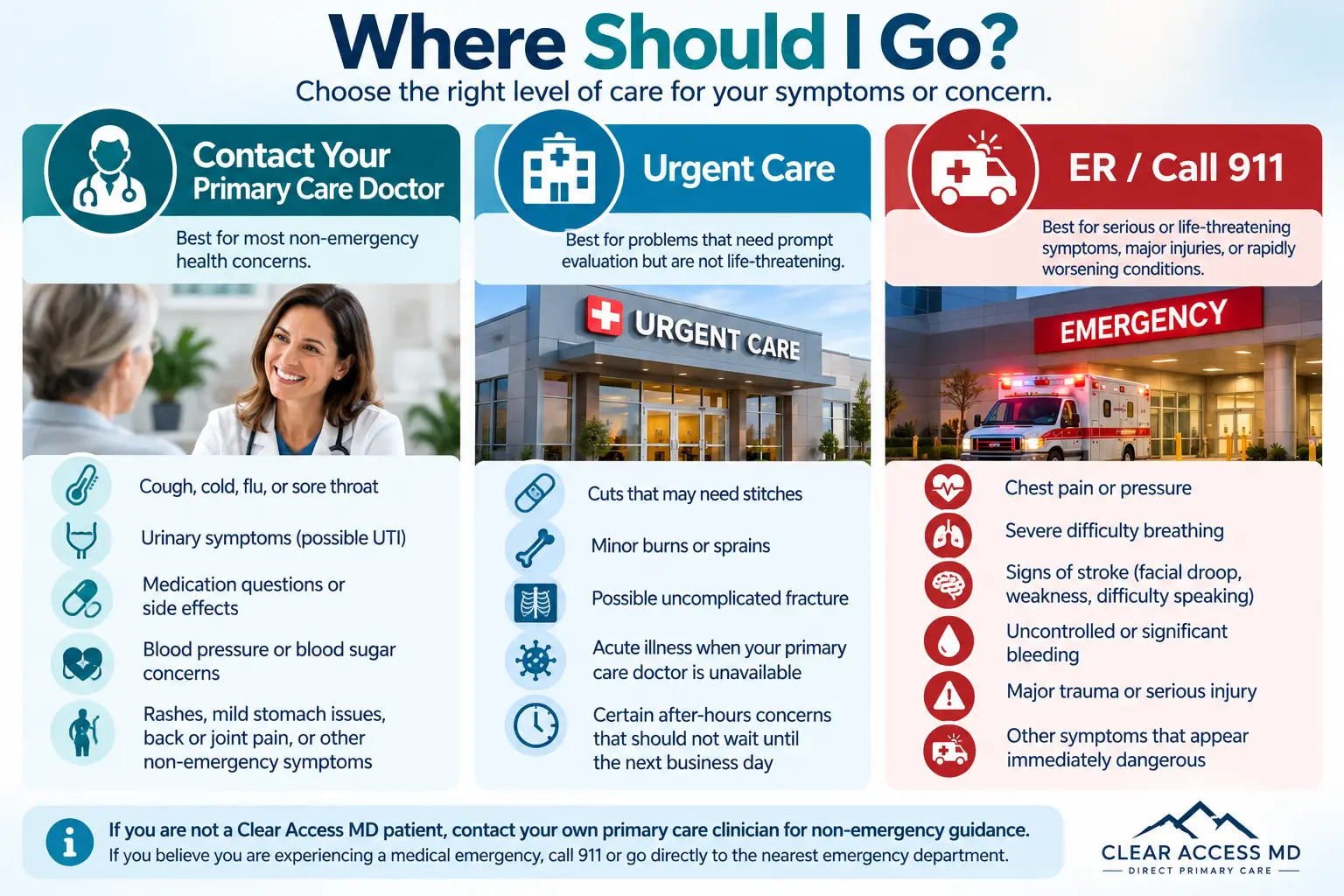
- Choosing the right level of care
- Urgent care vs. ER vs. primary care at a glance
- When to go to the ER or call 911
- When to go to urgent care
- Urgent care in Lakewood Ranch, Bradenton and Sarasota
- Urgent care vs. primary care: start with your doctor for most problems
- Urgent care or ER? A symptom-by-symptom guide
- Is urgent care cheaper than the ER?
- What if you’re not sure?
- Why a doctor who knows you makes these calls easier
- After urgent care or the ER, primary care still matters
- Better access can help you get care earlier
- Frequently asked questions
- Sources
Choosing the right level of care
You wake up feeling sick, develop a new symptom, or get injured. Should you contact your primary care doctor, go to urgent care, or head to the emergency room?
The right choice depends on several things: how severe your symptoms are, how quickly you need to be evaluated, and what type of testing or treatment may be necessary.
For many non-emergency health concerns, your primary care physician is a good place to start. Your doctor can evaluate what is happening, recommend the next step, and help determine whether you need an office visit, testing, urgent care, or emergency evaluation.
For Clear Access MD members, there is an added advantage: you can call or text our practice about most non-emergency concerns. Because we already know your medical history, medications, prior test results, and ongoing health issues, we may be able to help you decide what level of care is appropriate without automatically sending you to urgent care or the emergency room.
If you are not an established Clear Access MD patient, please contact your own primary care clinician for medical guidance or seek care through an appropriate urgent care or emergency department.
Most importantly, some situations should not wait.
If you believe you are experiencing a medical emergency, call 911 or go to the nearest emergency department. Do not delay emergency care while waiting to hear back from a medical office.
The goal is simple: to help you get the right level of care, in the right place, at the right time.
Urgent care vs. ER vs. primary care at a glance
| Primary care doctor | Urgent care | ER / 911 | |
|---|---|---|---|
| Best for | Most non-emergency illnesses, medication questions and changes in chronic conditions | Problems that need prompt care, aren’t life-threatening and can’t wait for your doctor | Anything that could be life-threatening, major injuries and serious illness that’s getting worse fast |
| Examples | Cough or cold, possible UTI, rash, mild stomach bug, blood pressure or blood sugar changes | Cuts that may need stitches, minor burns, sprains, possible simple fractures | Chest pain, severe trouble breathing, stroke signs, major trauma, severe bleeding, severe allergic reaction |
| Testing | Labs, EKG and rapid tests; can order imaging and refer to specialists | Often X-rays, wound care, splinting and minor procedures | Full imaging such as CT and ultrasound, labs, specialists and hospital admission |
| Knows your history | Yes | Usually not | Usually not |
| Typical self-pay cost | About $130–$200 a visit, or a flat monthly membership | About $125–$300 | Averages over $2,700 |
| When it’s open | Office hours; Clear Access MD members can call or text | Extended hours, walk-in | 24/7 |
Costs are typical U.S. self-pay prices (see sources). If you think it’s an emergency, don’t stop to compare: call 911.
When to go to the ER or call 911
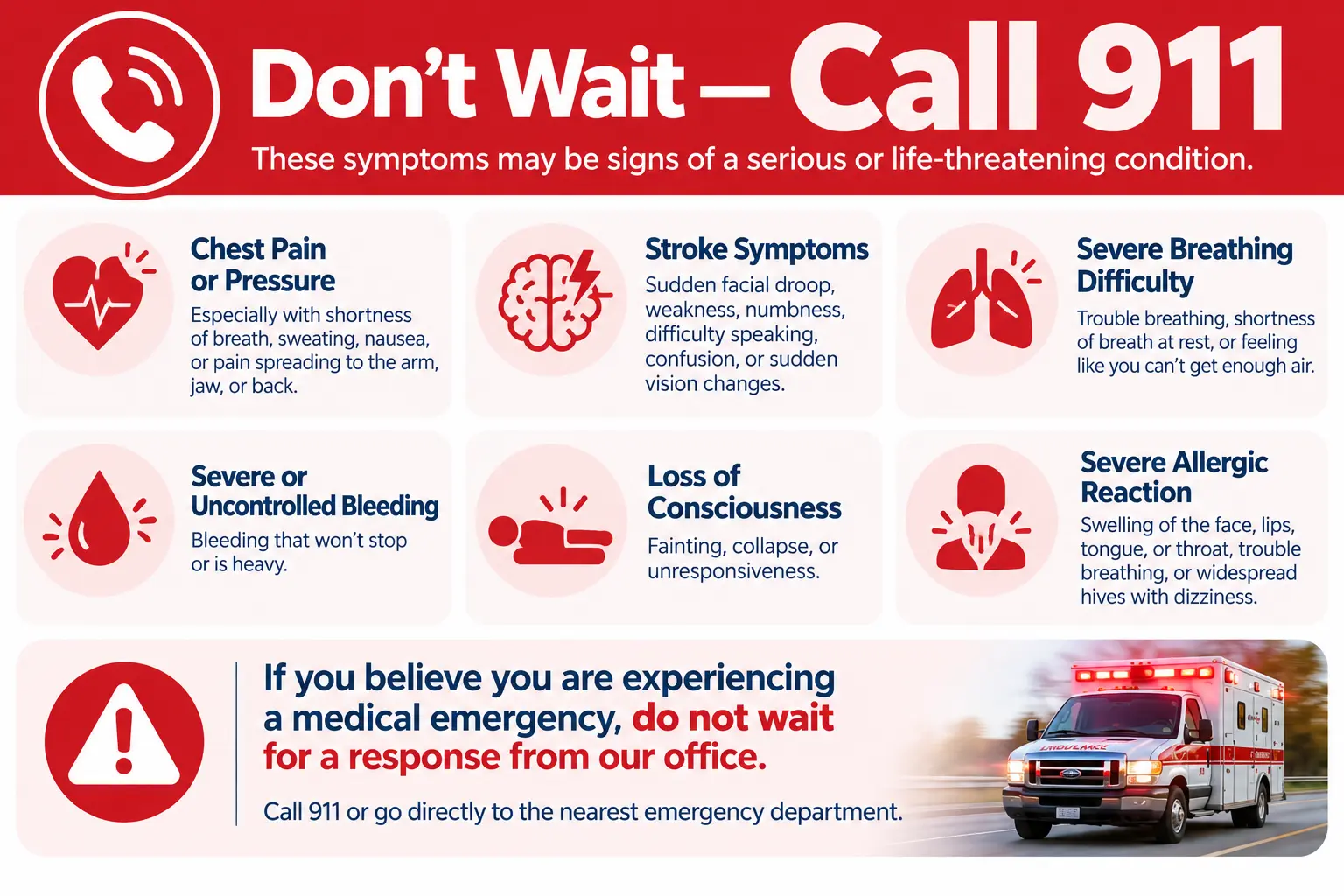
Some symptoms should not wait for a primary care appointment, a callback, or an urgent care visit.
Call 911 or go to the nearest emergency department for symptoms that may represent a serious or life-threatening condition.
Examples include:
- chest pain or pressure, especially when accompanied by shortness of breath, sweating, nausea, or pain spreading to the arm, jaw, or back
- severe difficulty breathing
- signs of stroke, such as sudden facial droop, weakness, numbness, difficulty speaking, or confusion
- loss of consciousness
- severe or rapidly worsening confusion
- severe allergic reaction with difficulty breathing or swelling of the tongue or throat
- uncontrolled or significant bleeding
- major trauma or serious injury
- severe burns
- a first-time seizure or a prolonged seizure
- a sudden, severe headache unlike previous headaches
- severe or rapidly worsening abdominal pain
- vomiting blood or significant gastrointestinal bleeding
- suspected poisoning or overdose
- immediate danger of self-harm
This list is not exhaustive. If something feels immediately dangerous or potentially life-threatening, emergency care is the appropriate choice.
If you believe you are experiencing a medical emergency, do not delay care while waiting for a response from a primary care office. Call 911 or seek emergency evaluation immediately.
This applies equally to Clear Access MD members and to the general public.
When to go to urgent care
Urgent care can be useful when a problem needs prompt attention but does not appear to be life-threatening, especially when your primary care office is unavailable or the situation requires services that may not be available in a typical primary care setting.
Examples may include:
- a cut that may need stitches
- a minor burn
- a sprain or certain minor injuries
- a possible uncomplicated fracture
- an acute illness that should be evaluated promptly when your primary care clinician is unavailable
- certain after-hours concerns that should not wait until the next business day
Urgent care can often provide on-site services such as X-rays, wound care, splinting, or other minor procedures.
For Clear Access MD members, if the situation is not an obvious emergency and you are unsure whether urgent care is necessary, you may contact the practice for guidance. In some cases, we may be able to evaluate the problem directly, arrange appropriate testing, or help determine whether urgent care is the better option.
However, some injuries and symptoms belong in the emergency room rather than urgent care. Major trauma, obvious deformity, uncontrolled bleeding, loss of sensation or circulation, severe pain after significant injury, or other concerning symptoms may require emergency evaluation.
The goal is not to avoid urgent care when it is appropriate. It is to use it when it is the right level of care.
Can urgent care do X-rays?
Many urgent care centers have X-ray machines on site, which is why they’re a good fit for sprains and possible simple fractures. Not all of them do, so call ahead or check the center’s website. CT scans and MRIs aren’t available at urgent care, and most don’t offer ultrasound; if you need those urgently, that’s usually an ER visit.
Freestanding ERs are not urgent care
Some emergency rooms aren’t attached to a hospital. These freestanding ERs can look like urgent care centers from the outside, but they’re emergency departments and are generally billed like one, so a visit can cost far more than urgent care for the same problem. If the sign says “Emergency,” expect ER-level care and ER-level bills.
Urgent care in Lakewood Ranch, Bradenton and Sarasota
If you decide urgent care is the right call, these walk-in urgent care centers serve our area. Hours and services change, so call ahead or check the provider’s website before you go. For anything that could be an emergency, call 911 or go to the nearest ER.
Lakewood Ranch
| Urgent care | Address |
|---|---|
| AFC Urgent Care Lakewood Ranch | 5925 Lakewood Ranch Blvd, Bradenton, FL 34211 |
| MD Now Urgent Care – South Lakewood Ranch | 7337 University Pkwy, Lakewood Ranch, FL 34202 |
Bradenton
| Urgent care | Address |
|---|---|
| MD Now Urgent Care – East Bradenton | 10735 State Road 64 E, Bradenton, FL 34212 |
| MD Now Urgent Care – West Bradenton | 4332 Cortez Rd W, Bradenton, FL 34210 |
| PrimeHealth Urgent Care – Bradenton | 3018 53rd Ave E, Bradenton, FL 34203 |
| PrimeHealth Urgent Care – West Bradenton | 4647 Manatee Ave W, Bradenton, FL 34209 |
| Sarasota Memorial Urgent Care Center at Heritage Harbour | 1040 River Heritage Blvd, Bradenton, FL 34212 |
Sarasota
| Urgent care | Address |
|---|---|
| MD Now Urgent Care – Fruitville | 3110 Fruitville Commons Blvd, Sarasota, FL 34240 |
| PrimeHealth Urgent Care – Sarasota | 5221 Clark Rd, Sarasota, FL 34233 |
| Sarasota Memorial Urgent Care Center at Bee Ridge | 5590 Bee Ridge Rd, Sarasota, FL 34233 |
| Sarasota Memorial Urgent Care Center at St. Armands | 500 John Ringling Blvd, Sarasota, FL 34236 |
| Sarasota Memorial Urgent Care Center at Stickney Point | 6331 S Tamiami Trail, Sarasota, FL 34231 |
| Sarasota Memorial Urgent Care Center at University Parkway | 5360 University Pkwy, Sarasota, FL 34243 |
Listed alphabetically. Clear Access MD isn’t affiliated with these providers, and this list isn’t an endorsement. Locations checked November 2026.
Urgent care vs. primary care: start with your doctor for most problems
Urgent care is built for one-time problems: it treats what’s in front of it, usually without your history or past results. Your primary care doctor can often handle the same problems, plus the follow-up, and knows what’s normal for you. For most non-emergency issues, that makes your own doctor the best place to start, as long as you can reach them.
You do not need to know exactly what is wrong before reaching out. One of the most important roles of a primary care physician is helping determine whether a problem can be managed routinely, needs prompt evaluation, or requires a higher level of care.
Common reasons to contact your primary care doctor include:
- cough, cold, flu or flu-like illness, sore throat, or sinus symptoms
- urinary symptoms, a possible UTI, or an uncomplicated urinary tract infection
- mild nausea, vomiting, diarrhea, or other mild gastrointestinal illness
- rashes and other common skin concerns
- back, neck, muscle, or joint pain
- headaches without emergency warning signs
- medication side effects, medication questions, or medication adjustments
- blood pressure readings that are higher or lower than usual
- blood sugar concerns
- fatigue, weakness, or dizziness
- mild abdominal discomfort
- swelling
- changes in or worsening of a chronic condition
- new symptoms that concern you but do not appear to be an emergency
- follow-up after an urgent care or emergency-room visit
For Clear Access MD members, most non-emergency concerns can begin with a call or text to the practice. Depending on the situation, Dr. Bruna may recommend home care, a telehealth visit, or an in-office evaluation; arrange laboratory testing; perform in-office tests such as EKGs and rapid tests; order imaging; adjust medications; coordinate specialist care; or send you to urgent care or the emergency room. Just as importantly, your primary care physician can recognize when a problem cannot or should not be managed in the office.
The important distinction is that primary care is the starting point for many non-emergency concerns—not a substitute for emergency care. If symptoms are severe, rapidly worsening, or suggest a potentially life-threatening condition, emergency evaluation may be necessary.
Members in Lakewood Ranch, Sarasota and Bradenton can start with a call or text. See how membership works.
Urgent care or ER? A symptom-by-symptom guide
| Symptom | Start with | Go to the ER or call 911 if… |
|---|---|---|
| Chest pain or pressure | ER / 911 | Always. Don’t drive yourself. |
| A cut | Urgent care, if it may need stitches | Bleeding won’t stop with firm pressure, or the wound is very deep or from a serious injury |
| Possible broken bone | Urgent care, for a possible simple fracture | The limb is visibly out of place, or you lose feeling or circulation below the injury |
| Sprain | Urgent care or your doctor | You have severe pain after a significant injury |
| Stomach pain | Your doctor, for mild discomfort | The pain is severe or getting worse quickly, or you’re vomiting blood |
| Back pain | Your doctor | It follows a major injury, or comes with new leg weakness or loss of bladder or bowel control |
| Possible UTI | Your doctor; you may need an in-person exam if you have fever, back or side pain, or vomiting | You’re very confused or can’t stay awake |
| High blood pressure reading | Your doctor, especially if it’s much higher than usual for you | It comes with chest pain, a sudden severe headache, confusion, weakness, or trouble seeing or speaking |
| Fever, cough or cold | Your doctor | You have trouble breathing, chest pain or new confusion |
| Vomiting or diarrhea | Your doctor | You show signs of severe dehydration, or you’re vomiting blood |
| Allergic reaction | Your doctor, for a mild rash or itching | You have any trouble breathing, or swelling of the tongue or throat |
| Headache | Your doctor | It’s sudden and severe, unlike any headache before, or comes with stroke signs |
This guide isn’t complete. If something feels like an emergency, treat it as one.
Is urgent care cheaper than the ER?
For the same non-emergency problem, usually yes, by a wide margin. Without insurance, an urgent care visit typically costs about $125 to $300, while an ER visit averages over $2,700. With insurance, an ER visit usually means a higher copay or more of your deductible. A primary care visit typically runs about $130 to $200 self-pay. For a full breakdown, see how much a doctor visit costs without insurance.
Cost should never keep you from emergency care. Under federal law, emergency rooms must screen and stabilize anyone with an emergency condition, whether or not they can pay.
Prices checked November 2026.
What if you’re not sure?
Many situations are not obviously routine, urgent, or emergent.
You may find yourself wondering:
- “My blood pressure is much higher than usual. Does this need the ER?”
- “I have been vomiting since yesterday. Can this wait?”
- “My heart feels like it is beating faster than normal.”
- “I twisted my ankle and now it is swollen.”
- “I have abdominal discomfort, but I am not sure how serious it is.”
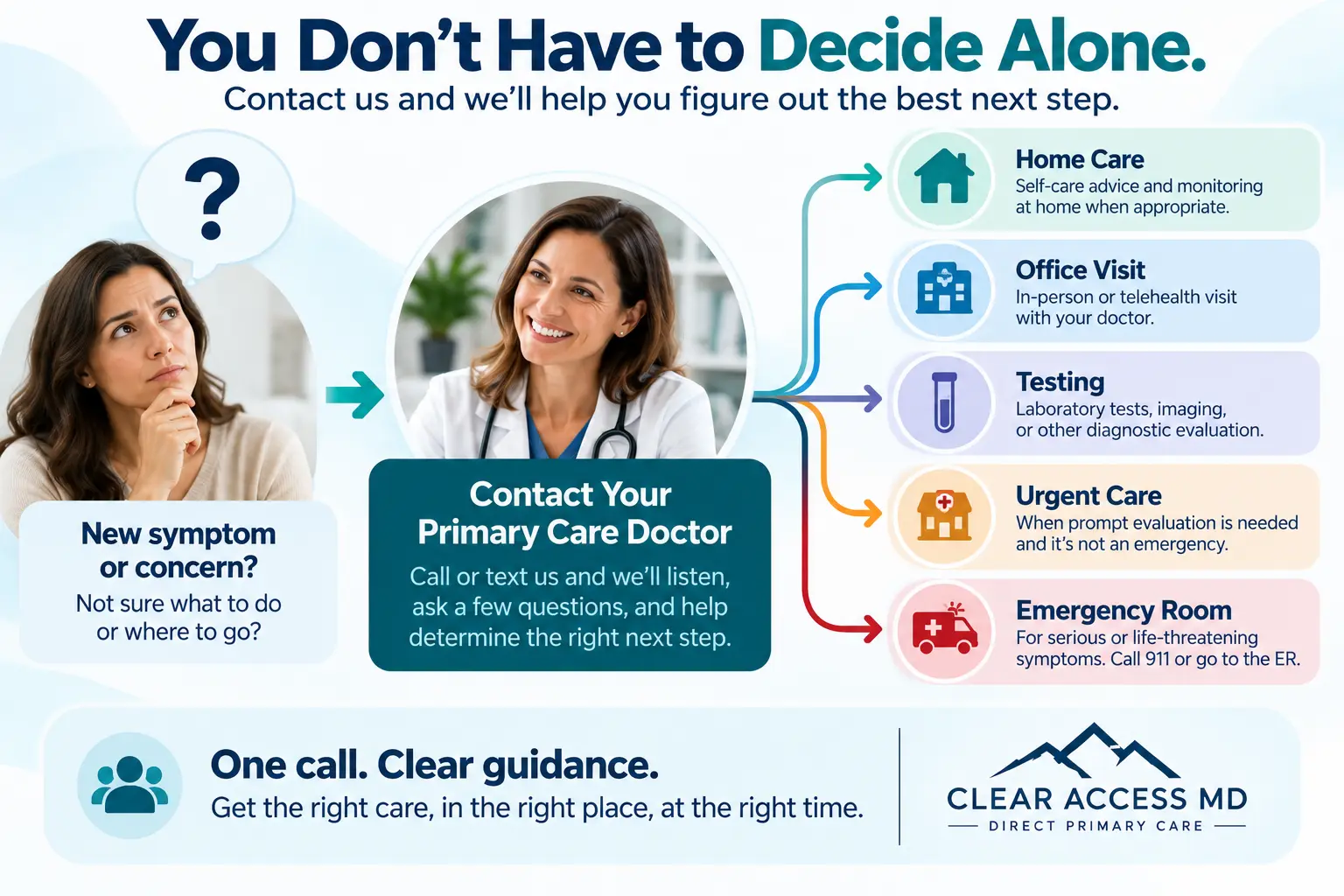
In these situations, you do not necessarily have to make the decision on your own.
If there are no obvious emergency warning signs, contacting your own primary care clinician can often help determine the appropriate next step. Depending on the situation, that may mean home care, an office visit, testing, urgent care, or emergency evaluation.
For Clear Access MD members, this is one of the practical benefits of having direct access to your physician. Members can call or text the practice about non-emergency concerns and get guidance about what should happen next.
The key distinction is important: direct primary care access is helpful when the situation is uncertain but not clearly dangerous. It should never delay emergency care when serious warning signs are present.
Why a doctor who knows you makes these calls easier
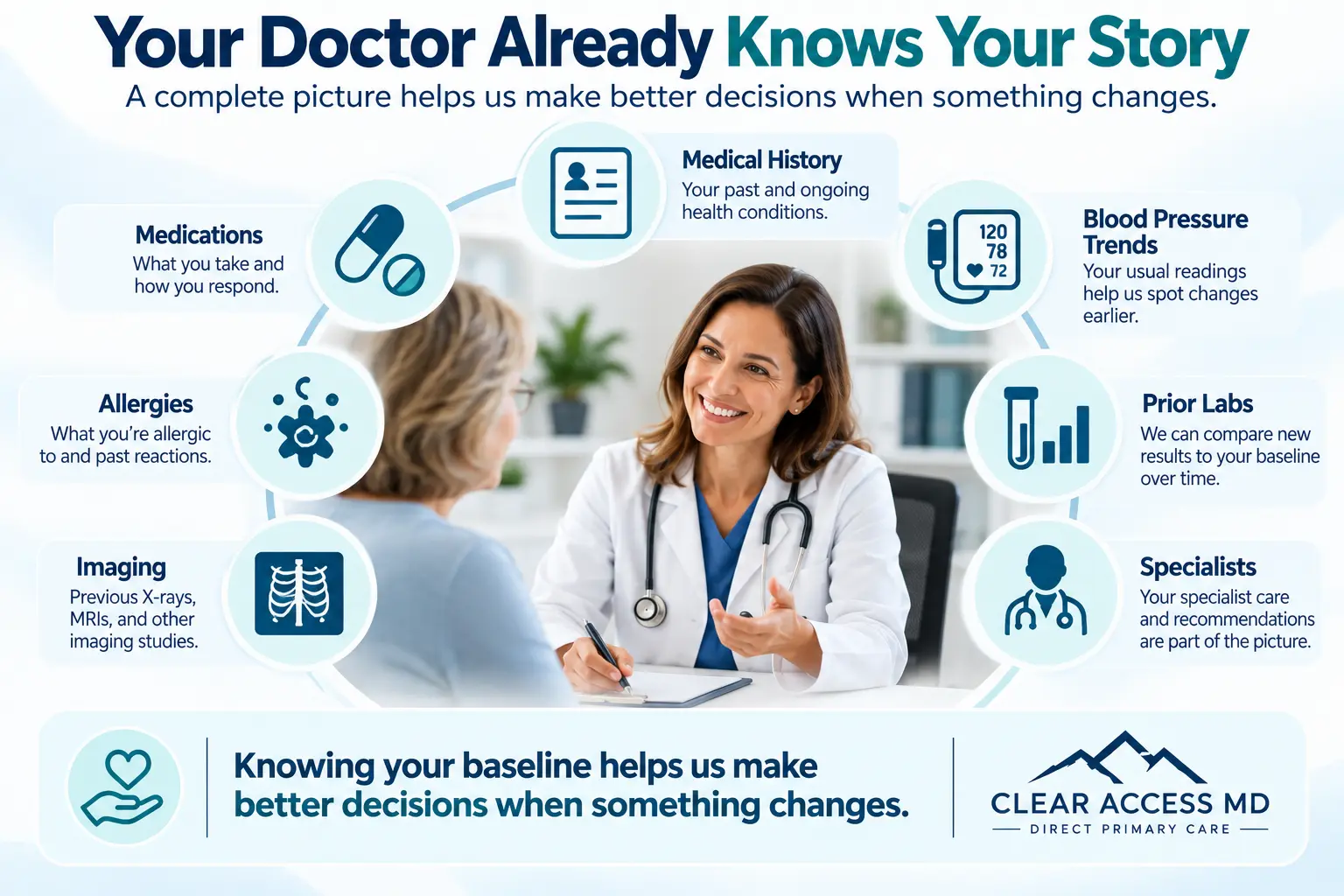
A new symptom does not happen in isolation. Its significance may depend on your age, medical history, medications, previous laboratory results, usual blood pressure, kidney function, recent illnesses, prior imaging, and other health conditions.
A physician who already knows your history has context that may help make better decisions when something changes. For example, a blood pressure reading that is unusual for one person may be typical for another. A new medication side effect may make more sense when viewed alongside the rest of a patient’s medication list. A change in kidney function or blood sugar may be more meaningful when compared with previous results.
Sometimes knowing what is normal for you is just as important as recognizing what is abnormal.
Access matters too. In a traditional healthcare setting, patients may wait days or weeks for a primary care appointment. When symptoms appear in the meantime, they may delay care, try to manage the problem on their own, or go directly to urgent care or the emergency room simply because they cannot reach their regular physician quickly enough.
For Clear Access MD members, a new concern can often be addressed early. A member may reach out when urinary symptoms first begin, when blood pressure readings start trending higher, when a cough is getting worse, or when a medication is causing unexpected side effects. Addressing those concerns early may prevent some problems from progressing to the point where urgent care or emergency evaluation becomes necessary.
That does not mean Direct Primary Care prevents emergencies, nor does it replace emergency care. Serious illnesses and injuries can occur even with excellent primary care access.
After urgent care or the ER, primary care still matters
Even when urgent care or emergency care was absolutely the right choice, the story often does not end when you leave.
You may still need:
- review of your diagnosis
- review of laboratory or imaging results
- medication reconciliation
- follow-up of new prescriptions
- repeat testing
- monitoring to make sure symptoms are improving
- referral to a specialist
- coordination with other clinicians
- ongoing treatment of the underlying condition
This is where primary care becomes important again.
Urgent care and emergency departments are designed to address the immediate problem. Your primary care physician can help connect that episode of care with your broader medical history and long-term health.
For Clear Access MD members, let the practice know if you have been seen in urgent care or the emergency room. We can review what happened, help coordinate follow-up, and make sure important next steps are not missed.
Emergency care treats the immediate problem. Primary care helps manage what happens next.
Better access can help you get care earlier
Knowing where to seek care can help you get the right level of attention without unnecessary delays.
For most non-emergency problems, primary care is a good place to start. Urgent care is useful when prompt evaluation is needed and primary care is not available. The emergency room is there for serious and potentially life-threatening situations.
Direct Primary Care adds another important advantage: access.
For Clear Access MD members, a new concern does not necessarily have to wait until the next available appointment. Members can reach out earlier, ask questions, and get guidance while a problem may still be relatively manageable.
That earlier access may allow some conditions to be evaluated, treated, or monitored before they worsen. It may also help avoid some urgent-care or emergency-room visits that happen simply because timely primary care was not available.
Direct Primary Care does not replace emergency medicine, and it does not prevent every emergency.
It does, however, make it easier to involve your physician earlier.
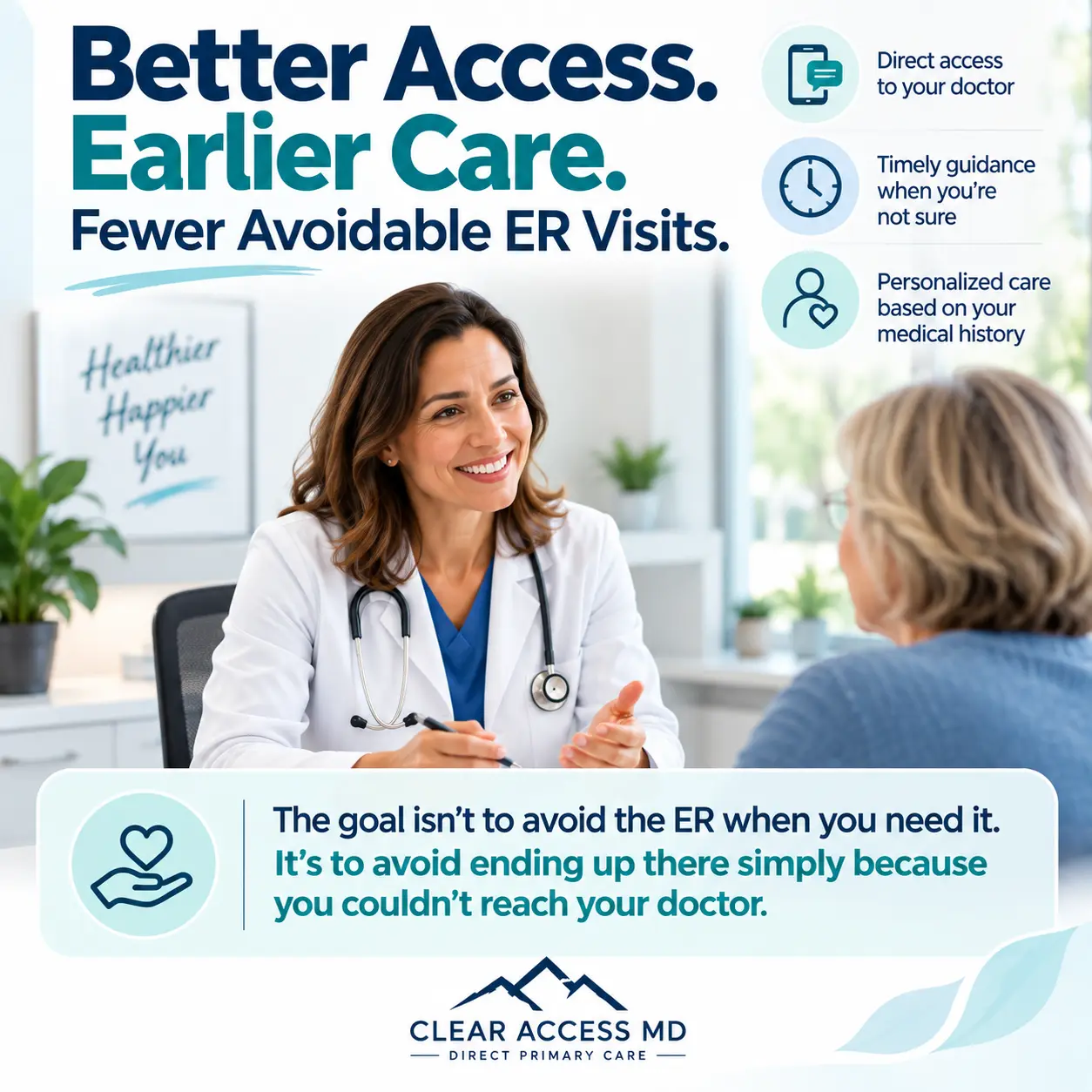
The goal is not to avoid the emergency room when you truly need it. The goal is to have access to your doctor early enough that a manageable problem does not become an avoidable emergency.
Clear Access MD members: If you have a non-emergency medical concern, call or text the practice. If you are experiencing a medical emergency, call 911 or go directly to the nearest emergency department.
Frequently asked questions
What’s the difference between urgent care and the emergency room?
Urgent care treats problems that need prompt attention but aren’t life-threatening, like minor injuries and common illnesses. The ER is for emergencies, anything that could threaten your life, a limb or your vision, and it’s open 24/7 with full hospital resources.
Can urgent care do X-rays?
Many urgent care centers can, which makes them a good fit for sprains and possible simple fractures. Call ahead to check. CT scans and MRIs need an ER or an imaging center.
Should I go to urgent care or the ER for chest pain?
The ER. Call 911 for chest pain or pressure, especially with shortness of breath, sweating, nausea, or pain that spreads to your arm, jaw or back.
Should I go to urgent care or the ER for stitches?
Urgent care can usually handle cuts that need stitches. Go to the ER if bleeding won’t stop with firm pressure, the wound is very deep, or it came from a serious injury.
Is urgent care cheaper than the ER?
Usually, by a wide margin. Self-pay urgent care visits typically run about $125 to $300, while ER visits average over $2,700.
Should I go to urgent care or call my doctor first?
For most non-emergency problems, start with your doctor if you can reach them. They know your history and can often handle it, or tell you when urgent care is the better choice. Clear Access MD members can call or text. If it might be an emergency, call 911.
Sources
- American College of Emergency Physicians, Know When to Go
- American Stroke Association, Stroke Symptoms and Warning Signs
- Centers for Medicare & Medicaid Services, Emergency Medical Treatment & Labor Act (EMTALA)
- Solv Health, How much does a doctor’s visit cost without insurance? (supports primary care visit prices)
- GoodRx, as cited by TeleDirectMD, What Care Costs Without Insurance (supports urgent care prices)
- Zocdoc, How Much Is a Primary Care Visit Without Insurance? (2026), citing Mira (supports ER average)