Health Insurance Open Enrollment: Why Direct Primary Care Deserves a Place in Your 2027 Healthcare Plan
On This Page
- 2027 Open Enrollment: The Dates and Decisions That Matter
- Having Health Insurance Doesn’t Always Mean Having Easy Access to a Doctor
- What Is Direct Primary Care?
- Why Insurance and DPC Can Work Well Together
- Could DPC Make Sense With a Higher-Deductible Insurance Plan?
- What About Health Shares? Another Option Worth Understanding
- What About Health Savings Accounts and DPC?
- Five Questions to Ask Before You Enroll
- Your Healthcare Plan Should Include More Than an Insurance Card
Every fall, open enrollment brings a familiar set of questions: How much will my health insurance cost next year? Should I choose a lower monthly premium or a lower deductible? Will my doctors and prescriptions still be covered?
Those are important questions. But there is another one that often gets overlooked: When I need medical advice, will I be able to reach a doctor who knows me and has time for me?
Health insurance and access to primary care are related, but they are not the same thing. Some people also consider medical cost-sharing communities, often called health shares, alongside DPC. As you review your options for 2027, it is worth understanding the differences.
2027 Open Enrollment: The Dates and Decisions That Matter
In Florida, most people who purchase individual or family health insurance through the Affordable Care Act (ACA) Marketplace use HealthCare.gov.
For 2027 Marketplace coverage, the key dates are:
- November 1, 2026: Open enrollment begins.
- December 15, 2026: Last day to enroll or change plans for coverage beginning January 1, 2027.
- January 15, 2027: Open enrollment ends. Those who enroll from December 16 through January 15 generally begin coverage February 1, after paying their first premium.
After open enrollment, you generally need a qualifying life event to enroll in or change a Marketplace plan. Employer-sponsored insurance and Medicare have different enrollment rules.
As you compare plans, look beyond the premium. Review the deductible, copays and coinsurance, annual out-of-pocket maximum, prescription coverage, and whether your preferred hospitals and specialists are in-network. Check whether you qualify for a premium tax credit or, if eligible, additional cost-sharing savings through a Silver plan.
The lowest-premium plan is not always the least expensive plan once you need care.
Having Health Insurance Doesn’t Always Mean Having Easy Access to a Doctor
Insurance can be essential when you face a hospitalization, surgery, serious illness, or expensive treatment. But a health insurance card does not necessarily guarantee a convenient primary care appointment.
Many patients know the frustrations: waiting to be seen, squeezing several questions into a short visit, trying to reach the office about a new symptom, or wondering who is coordinating recommendations from multiple specialists.
These problems are not universal—many insurance-based practices deliver excellent care. Still, the way your care is delivered matters just as much as how it is paid for.
That is one reason some people choose to add Direct Primary Care to their healthcare plan.
What Is Direct Primary Care?
Direct Primary Care (DPC) is a model in which patients pay a predictable monthly membership fee directly to a primary care practice rather than having the practice bill insurance for included primary care services.
The goal is a more accessible, ongoing relationship between patient and physician. Depending on the practice, membership may include routine visits, preventive care, management of chronic conditions, and easier communication between appointments.
At Clear Access MD in Lakewood Ranch, Florida, our adult patients benefit from:
- Same- or next-day appointment availability.
- Longer, unhurried visits with Dr. Bruna Jebelev.
- Direct communication by phone, text, and email.
- Preventive care, annual physicals, and chronic condition management.
- Help coordinating specialist care, imaging, and laboratory testing.
The membership covers the services described in our agreement; some tests, medications, specialist visits, and other outside services carry additional costs.
DPC is not health insurance. It does not replace major medical coverage for hospital care, emergency treatment, surgery, or other significant medical expenses.
Why Insurance and DPC Can Work Well Together
It is useful to think of insurance and DPC as serving different—but complementary—purposes.
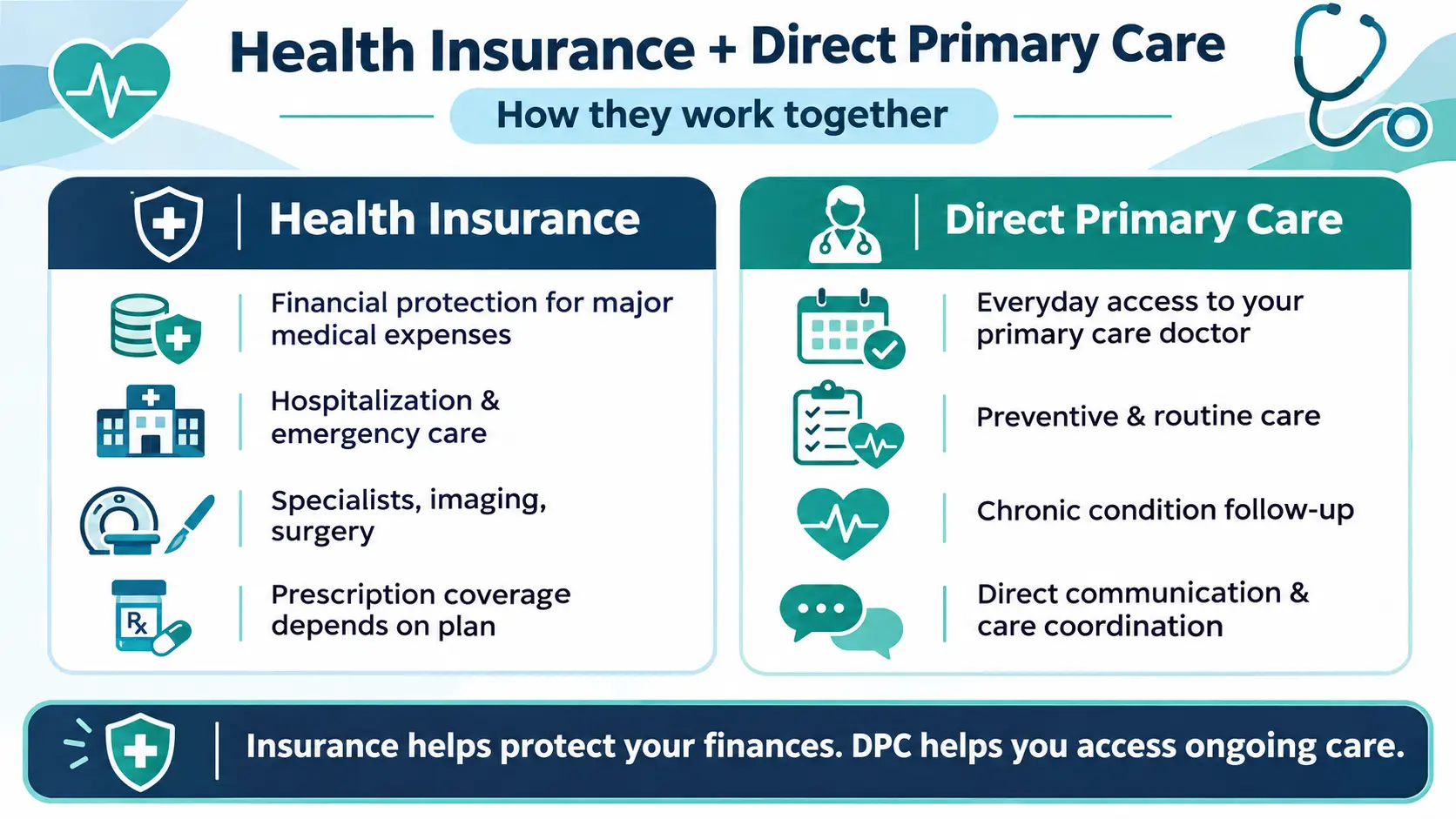
| Health insurance helps with… | Direct Primary Care helps with… |
|---|---|
| Financial protection for covered hospital and emergency care | Timely access to your regular primary care physician |
| Covered surgery, specialist treatment, and major procedures | Routine visits and ongoing preventive care |
| Covered prescriptions and other benefits, subject to plan rules | Medication reviews, guidance, and chronic condition follow-up |
| Covered testing and treatment, subject to deductibles and networks | Help deciding what testing or specialist evaluation may be appropriate |
For example, if you develop a new health concern, having a doctor who knows your history can make it easier to decide what to do next. If you need an MRI, specialist consultation, or hospital treatment, your insurance may help pay for those services according to your plan’s rules.
It is important to check those rules. Your insurance plan may require specific in-network providers, prior authorization, or a referral from a plan-designated primary care physician. A DPC membership does not override insurance requirements, and DPC membership fees generally do not count toward your insurance deductible or out-of-pocket maximum.
Could DPC Make Sense With a Higher-Deductible Insurance Plan?
For some people, especially those buying their own coverage, a combination of DPC and a lower-premium plan with a higher deductible deserves consideration.
The idea is straightforward: use DPC for ongoing primary care while keeping major medical insurance for expensive or unexpected needs.
But this combination is not automatically cheaper. A higher deductible can mean much greater expenses if you need hospital services, specialist treatment, costly medications, or advanced imaging. And depending on your household income, a subsidized Silver plan with cost-sharing reductions may provide better overall value than a Bronze plan.
Consider a hypothetical couple comparing two options:
| Option A | Option B | |
|---|---|---|
| Monthly insurance premium | $1,100 | $850 |
| Monthly DPC memberships for two adults | — | $260 |
| Combined monthly cost before other medical expenses | $1,100 | $1,110 |
In this example, adding DPC alongside the lower-premium plan costs $10 more per month. Whether that is worthwhile depends on the value the couple places on accessible primary care—and on the two insurance plans’ deductibles, networks, prescription coverage, and other out-of-pocket costs. These figures are illustrative, not insurance quotes or Clear Access MD pricing.
The better question is not simply Which premium is lowest? It is Which combination gives me the protection, access, and overall value I need?
What About Health Shares? Another Option Worth Understanding
If traditional health insurance premiums stretch your budget, you may also encounter health shares—membership-based communities in which participants contribute money to help one another with eligible medical expenses. For some relatively healthy people who are comfortable with a different approach to financial risk, a health share paired with DPC can be worth exploring.
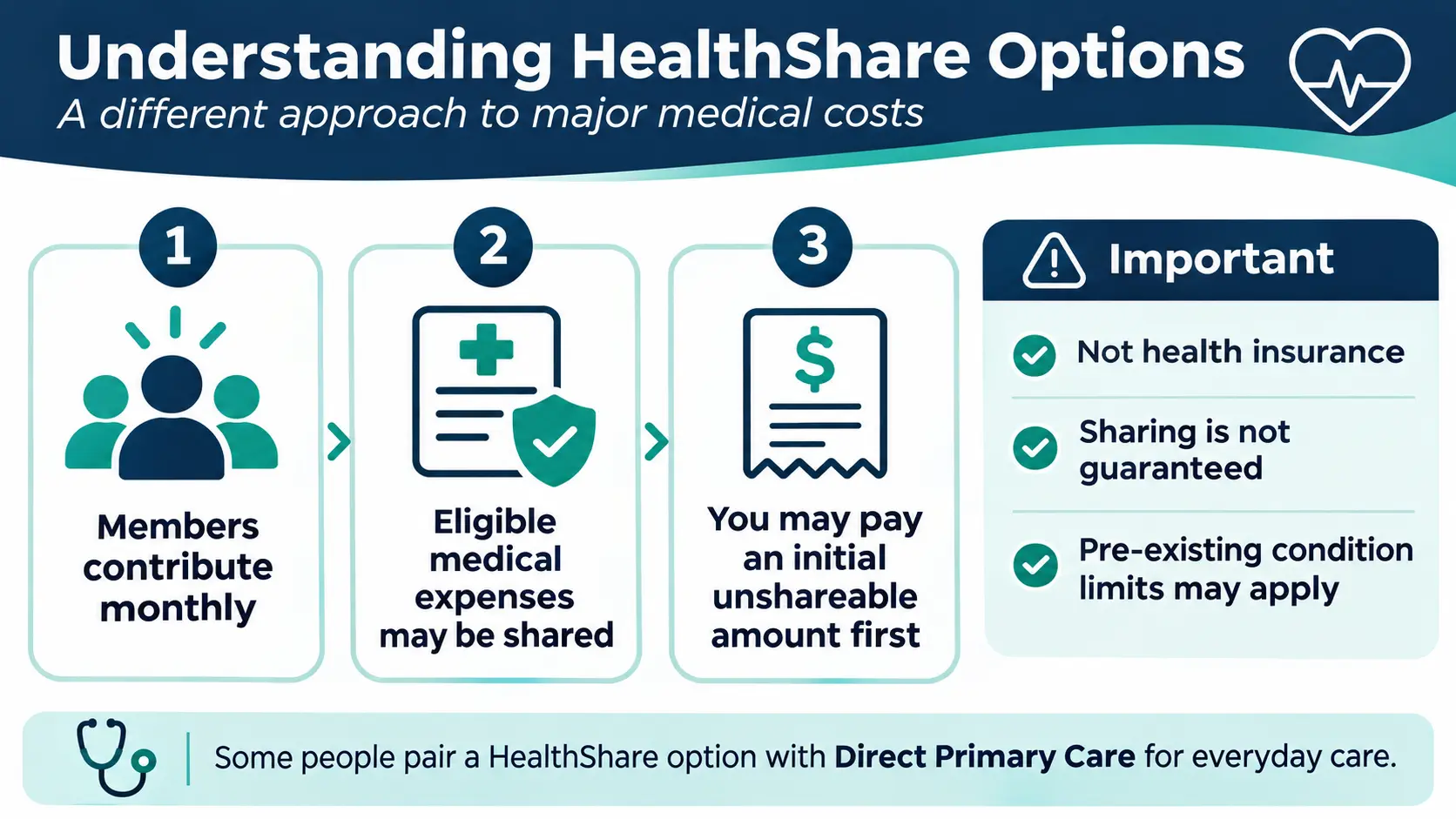
One example is Zion HealthShare, a nonprofit medical cost-sharing community that explicitly encourages members to pair its services with Direct Primary Care. The idea is similar to the insurance-plus-DPC approach: your DPC physician handles everyday primary care, while the health share may help with eligible larger medical expenses. Zion says members can choose their healthcare providers without a network, it welcomes members regardless of religious affiliation, and its enrollment is open year-round rather than limited to the ACA Marketplace’s open enrollment period. Monthly contributions may be lower than some traditional insurance premiums, potentially leaving room in the budget for a separate DPC membership; the financial risks, however, are not equivalent.
However, a health share is not health insurance. Monthly contributions are not insurance premiums, eligible expenses are shared under the organization’s guidelines rather than under an insurance contract, and payment of medical bills is not guaranteed. Health shares do not offer the same legal protections as ACA-compliant insurance. You remain responsible for bills that are not shared, and health share participation does not qualify you for ACA premium tax credits.
For example, under Zion HealthShare’s 2026 Member Guidelines:
- Members select an Initial Unshareable Amount (IUA) of $1,250, $2,500, or $5,000 before eligible expenses related to a medical need can be shared. This is not the same as an insurance deductible or an annual out-of-pocket maximum.
- Pre-membership medical conditions generally have a one-year waiting period, followed by limits on sharing that increase in later membership years. Certain conditions may qualify for exceptions under the guidelines.
- Individual members generally must be under age 65 to join, and medical expenses incurred at age 65 or older are not eligible for sharing under those guidelines.
- DPC membership fees are not eligible for sharing through Zion, so a household would budget separately for its DPC membership and health share contributions.
Health sharing may appeal to people who value provider choice, use relatively little medical care, and can absorb costs that are excluded or not shared. It may be less suitable for those who need dependable coverage for ongoing treatment, costly medications, or major medical conditions. Compare the complete guidelines—not just the monthly contribution—and think carefully about a worst-case medical bill. The National Association of Insurance Commissioners explains additional consumer protections to consider when evaluating arrangements that are not insurance.
Bottom line: Health shares can be an option worth researching, but they are a different risk arrangement, not an interchangeable replacement for comprehensive health insurance. DPC can complement either model; it cannot eliminate the financial exposure of a major medical event.
What About Health Savings Accounts and DPC?
A federal change effective January 1, 2026, made certain qualifying Direct Primary Care arrangements compatible with Health Savings Account (HSA) rules. This can be useful for people pairing DPC with an HSA-eligible health plan.
For 2027, a qualifying DPC arrangement generally does not interfere with eligibility to contribute to an HSA when total DPC fees are no more than $150 per month for one individual, or $300 per month for an arrangement covering more than one individual, and the arrangement meets the other IRS requirements.
Qualifying DPC membership fees may also be paid or reimbursed from HSA funds. An important distinction: under IRS guidance, a qualifying DPC arrangement that exceeds the monthly fee limit may still be payable from an HSA, but it can prevent the enrolled person from making new HSA contributions during the months of coverage.
Also beginning in 2026, Bronze and Catastrophic plans available through the ACA Marketplace are generally treated as HSA-compatible plans, although other eligibility conditions still apply.
A health share membership by itself is not an HSA-eligible health insurance plan and does not independently establish eligibility to contribute to an HSA. Because eligibility depends on the exact insurance coverage, the terms of the DPC arrangement, and individual circumstances, check with your HSA administrator or tax adviser before assuming a membership qualifies.
Five Questions to Ask Before You Enroll
Before settling on a 2027 insurance plan, ask yourself:
- What will this plan cost over the full year? Include premiums, expected visits and prescriptions, and possible out-of-pocket expenses—not just the monthly premium.
- How would I handle a major medical event? With insurance, understand the deductible, network, and out-of-pocket maximum. If considering a health share, understand that sharing is not guaranteed and ask what could remain your responsibility.
- Are the doctors, hospitals, and medications I rely on covered? Check the specific plan, not just the insurance company’s name.
- Can I get help from my primary care doctor when I need it? Think about appointment availability, follow-up, and how easily you can ask questions.
- Would a DPC membership improve my experience enough to justify its cost? For some households, the answer is yes even if total spending is a little higher. For others, insurance-based primary care may be the better fit.
Your Healthcare Plan Should Include More Than an Insurance Card
Open enrollment is a valuable opportunity to review your financial protection for the year ahead. Whether you choose conventional insurance or explore a health share, it is also an opportunity to ask whether your day-to-day medical care is working for you.
At Clear Access MD, we believe good primary care should feel personal, accessible, and built around a lasting relationship. We serve adults in Lakewood Ranch, Sarasota, Bradenton, and surrounding communities through a straightforward monthly membership. We do not bill insurance, and our membership can complement the major medical insurance or medical cost-sharing arrangement you choose—while remaining separate from either.
Review your insurance. Protect yourself against the unexpected. And make sure you have a doctor who has time for you.
Learn more about Clear Access MD and schedule a free introductory visit →
Medical and financial information disclaimer: This article is for general education, not individualized medical, insurance, legal, or tax advice. Plan benefits, enrollment rules, subsidies, HSA eligibility, and membership terms can change. A health share is not insurance and does not guarantee payment. Verify current details with HealthCare.gov, your insurer or health share, and a qualified tax adviser as appropriate.
Sources and further reading
- HealthCare.gov — Enrollment dates and deadlines
- CMS — Plan Year 2027 Marketplace Plans and Prices (October 30, 2026)
- HealthCare.gov — Health plan categories
- HealthCare.gov — Understanding your total healthcare costs
- IRS — Notice 2026-5: Expanded HSA availability and Direct Primary Care arrangements
- IRS — Revenue Procedure 2026-24: 2027 HSA and DPC limits
- Zion HealthShare — How it works and current membership guidelines
- Zion HealthShare — Direct Primary Care pairing
- NAIC — What you should know about health care sharing arrangements
- Florida Department of Financial Services — Health care sharing ministries and consumer cautions