
Do I Still Need Health Insurance If I Have Direct Primary Care?
On This Page
- DPC Changes How You Pay for Primary Care — Not Everything Else
- What Direct Primary Care Typically Covers
- What DPC Does NOT Replace
- DPC Covers Primary Care — Not Every Medical Expense
- Think of DPC as the “Everyday Healthcare” Layer
- A Common Combination: DPC + Health Insurance
- Why a High-Deductible Plan Can Pair Naturally With DPC
- How Does Direct Primary Care Work With Medicare?
- What About “Catastrophic” Health Insurance?
- Another Option Some Patients Consider: Health Sharing
- Important: Health Sharing Is Not Health Insurance
- How DPC + Health Sharing Might Work in Practice
- Insurance vs. Health Sharing: Important Differences to Understand
- Pre-Existing Conditions Can Be Especially Important
- Can DPC Help Even When Something Falls Outside the Membership?
- What Combination Is Right for You?
- Questions to Ask Before Choosing Coverage
- How This Fits With Direct Primary Care at Clear Access MD
- The Bigger Idea: Use Insurance for What Insurance Does Best
- Curious Whether Direct Primary Care Could Fit With Your Current Health Coverage?
DPC Changes How You Pay for Primary Care — Not Everything Else
One of the most common questions people ask about Direct Primary Care is:
“If my Direct Primary Care membership covers my doctor visits, why do I still need health insurance?”
The answer is that Direct Primary Care and health insurance are designed to solve different problems.
A DPC membership is designed to cover your primary care. That may include routine visits, preventive care, chronic disease management, acute illnesses, medication management, direct communication with your physician, and other everyday medical needs.
Health insurance—or another form of major-medical protection—is designed for a very different category of expense: the large, unpredictable healthcare costs that could otherwise create serious financial hardship.
Examples include:
- Hospitalization
- Emergency-room care
- Major surgery
- Cancer treatment
- Complex specialist care
- Expensive imaging and procedures
- High-cost medications
A DPC membership can make routine healthcare much simpler. Instead of worrying about copays, deductibles, claim processing, or whether every conversation with your doctor will generate another bill, you pay your practice directly for ongoing access to primary care.
But DPC is not health insurance.
It is not designed to pay a $50,000 hospital bill after a serious accident. It does not replace coverage for major surgery, chemotherapy, intensive care, or other high-cost medical events.
A useful way to think about it is this:
Direct Primary Care helps you manage the healthcare you are likely to use.
Insurance or another major-medical strategy helps protect you from the healthcare expenses you hope you never need.
For many patients, those two pieces complement each other very well.
DPC gives you accessible, relationship-based primary care for everyday health needs, while insurance—or another carefully chosen form of financial protection—remains available for the larger and less predictable medical expenses that fall outside the scope of primary care.
So the goal of Direct Primary Care is not necessarily to eliminate health insurance.
It is to change what you need insurance to do.
What Direct Primary Care Typically Covers
Direct Primary Care is designed to handle a large share of the healthcare needs that most people experience on a routine basis.
Exactly what is included varies from one practice to another, but a typical DPC membership may include:
- Routine primary care visits
- Same-day or next-day appointments
- Preventive care
- Annual physicals
- Chronic disease management
- Treatment of acute illnesses and minor injuries
- Medication management
- Telehealth visits
- Direct communication with your physician
- Coordination with specialists
- Certain in-office procedures
- Access to discounted laboratory testing, imaging, or medications
The key difference is how the care is paid for.
In a traditional insurance-based model, the physician generally bills insurance for each visit or service. That can involve copays, deductibles, coding requirements, claim processing, and separate charges depending on what happens during the appointment.
In Direct Primary Care, the physician is paid directly through the membership.
That means many everyday healthcare needs can be handled without generating an insurance claim every time you see or communicate with your doctor.
For example, if you develop a respiratory infection, need your blood pressure medication adjusted, have a new rash, want to discuss a concerning symptom, or need follow-up for diabetes or high cholesterol, those needs can often be addressed directly through the DPC relationship.
That does not mean every medical service is included. Hospital care, specialist services, advanced imaging, surgery, and other higher-cost services generally fall outside the membership.
But for the part of healthcare most people use most often—primary care—DPC is designed to make access simpler, more predictable, and more personal.
It gives patients a place to start when a health question comes up, rather than having to decide on their own whether the next step should be urgent care, the emergency room, a specialist, or simply waiting to see if the problem goes away.
What DPC Does NOT Replace
Direct Primary Care can cover a large share of routine healthcare, but it is important to be very clear about what it does not replace.
A DPC membership is not designed to pay for major hospital bills, emergency care, surgery, advanced specialty treatment, or very expensive medications.
Those are the kinds of costs for which health insurance—or another major-medical protection strategy—can still be very important.
Hospitalization
If you become seriously ill and need to be admitted to the hospital, the hospital charges are generally not part of a DPC membership.
Examples might include:
- Pneumonia requiring admission
- Heart attack
- Stroke
- Severe infection
- Intensive care
Your DPC physician may still help coordinate your care, review records, and assist with follow-up after discharge, but the hospital itself will bill separately.
Emergency Room Care
One benefit of having easy access to a primary care physician is that some concerns can be evaluated before they turn into unnecessary emergency-room visits.
But true emergencies still require emergency care.
Examples include:
- Serious or persistent chest pain
- Severe trauma
- Significant difficulty breathing
- Stroke symptoms
- Major bleeding
In those situations, a DPC membership does not replace the emergency department or the financial protection that insurance can provide.
Surgery
Surgical care is also outside the scope of most DPC memberships.
Examples include:
- Gallbladder surgery
- Joint replacement
- Appendectomy
- Major orthopedic surgery
- Cancer surgery
Your primary care physician can often help identify when surgery may be necessary, coordinate the referral, review preoperative information, and assist with care afterward.
But the surgeon, hospital, anesthesia, imaging, and other associated services are billed separately.
Specialist Care
Direct Primary Care physicians can manage many common conditions and may reduce the need for some specialist visits, but specialist care is still necessary in many situations.
Examples include:
- Cardiology
- Gastroenterology
- Orthopedics
- Dermatology
- Oncology
- Neurology
A DPC physician can help determine when a referral is appropriate and may help coordinate the next step.
However, the specialist’s services are generally not included in the DPC membership.
Expensive Imaging and Procedures
Advanced imaging and procedures are usually performed outside the primary care office.
Examples include:
- MRI
- CT scans
- Endoscopy
- Colonoscopy
- Cardiac catheterization
A DPC practice may sometimes help patients compare facilities or locate more affordable cash-pay options.
That can be especially useful for people with high deductibles or no traditional insurance.
But the cost of these services is generally separate from the DPC membership itself.
High-Cost Medications
Many common generic medications can be surprisingly affordable, especially when patients are able to compare cash prices rather than relying only on insurance copays.
But some medications are in a completely different cost category.
Examples include:
- Biologic medications
- Specialty medications
- Certain injectable drugs
- Some cancer treatments
These medications can cost hundreds or even thousands of dollars per month.
For patients who require expensive drug therapy, prescription coverage through insurance or another financial-protection strategy may be extremely important.
DPC Covers Primary Care — Not Every Medical Expense
The distinction is simple:
DPC is designed to provide access to your primary care physician and manage everyday healthcare needs.
It is not designed to absorb the financial risk of a major hospitalization, surgery, cancer treatment, or other very expensive event.
That is why many patients use DPC alongside health insurance, a high-deductible health plan, or another carefully selected approach to major medical expenses.
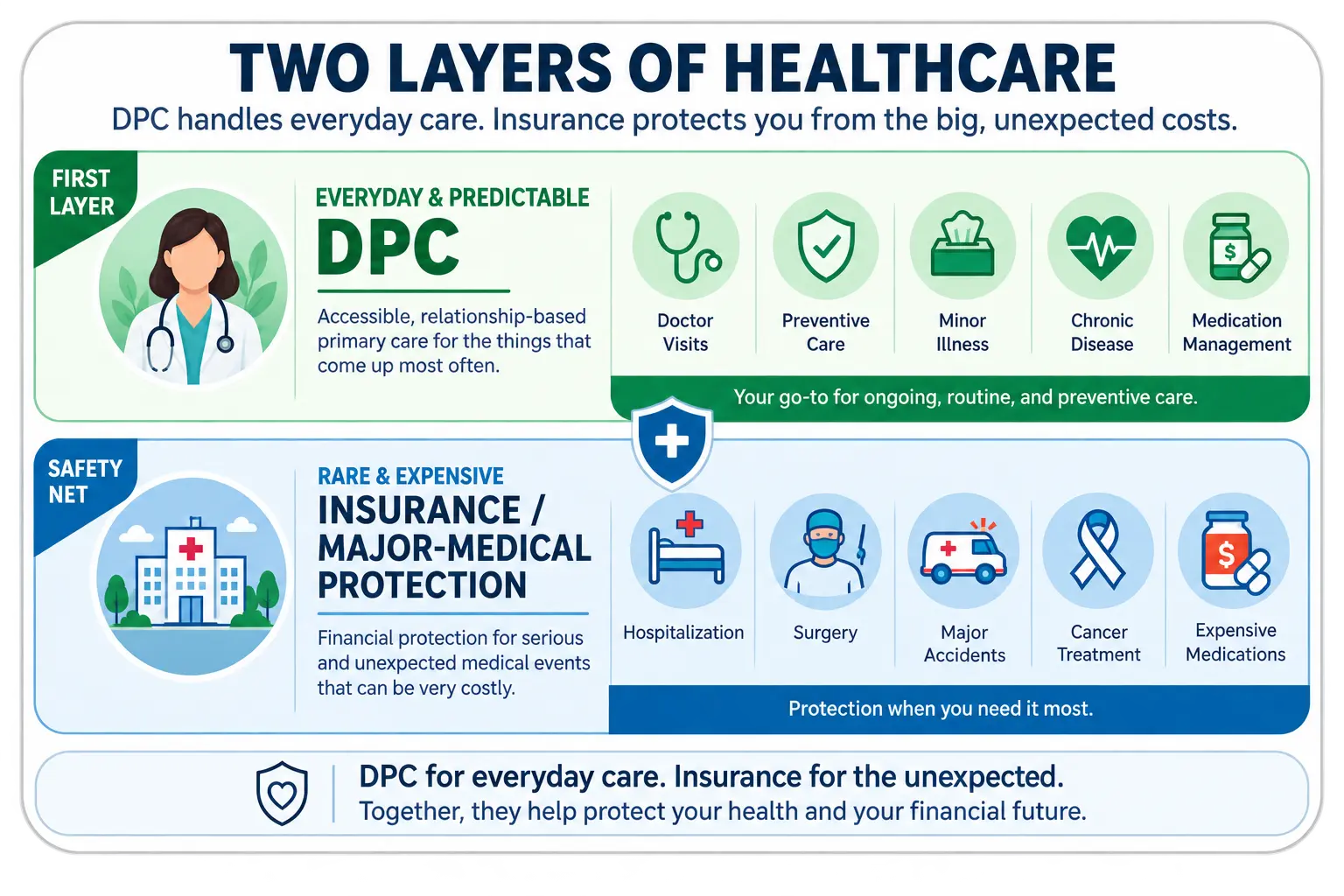
Think of DPC as the “Everyday Healthcare” Layer
A simple way to understand the relationship between Direct Primary Care and health insurance is to think of them as covering two different layers of healthcare.
DPC Handles the Care You Are Most Likely to Use
Direct Primary Care is built around the kinds of medical needs that come up regularly throughout the year.
That may include:
- Routine doctor visits
- Preventive care
- Minor illnesses
- Chronic condition management
- Questions about symptoms
- Medication adjustments
- Follow-up visits
- Early evaluation of new concerns
These are the situations where having easy access to a physician can make the biggest difference in day-to-day healthcare.
Instead of waiting weeks for an appointment or deciding whether a problem is serious enough for urgent care, a DPC patient has a primary care physician they can turn to.
Major-Medical Protection Handles the Care You Hope You Never Need
Health insurance—or another major-medical protection strategy—serves a different purpose.
It is designed to help protect you financially from large, unpredictable events such as:
- Hospitalization
- Major accidents
- Surgery
- Cancer treatment
- Complex specialty care
- Intensive care
- Very expensive medications
These events may be relatively uncommon, but when they occur, the costs can be enormous.
That is where financial protection becomes especially important.
Two Different Jobs
The relationship can be summarized simply:
Routine & Predictable Care → Direct Primary Care
Rare & Expensive Care → Insurance or Other Major-Medical Protection
For many patients, this division makes intuitive sense.
You use DPC for the healthcare you actually need throughout the year, while keeping insurance or another form of protection for the medical events that could create a major financial burden.
In that sense, DPC does not compete with insurance.
It allows each part of the healthcare system to do the job it is best suited to do.
A Common Combination: DPC + Health Insurance
Many Direct Primary Care patients still maintain health insurance.
The difference is that they use their DPC practice as their primary-care home, while insurance remains in place for larger and less predictable medical expenses.
Common arrangements may include:
- Employer-sponsored health insurance
- ACA Marketplace plans
- High-deductible health plans
- Other comprehensive major-medical coverage
With this approach, routine care stays simple.
You see your DPC physician for primary care needs, while insurance is available when care moves beyond what the membership includes.
How This Can Work in Practice
Suppose you develop abdominal pain.
With Direct Primary Care, the first step may be to contact your physician rather than trying to decide on your own whether you need urgent care, the emergency room, a specialist, or simply more time.
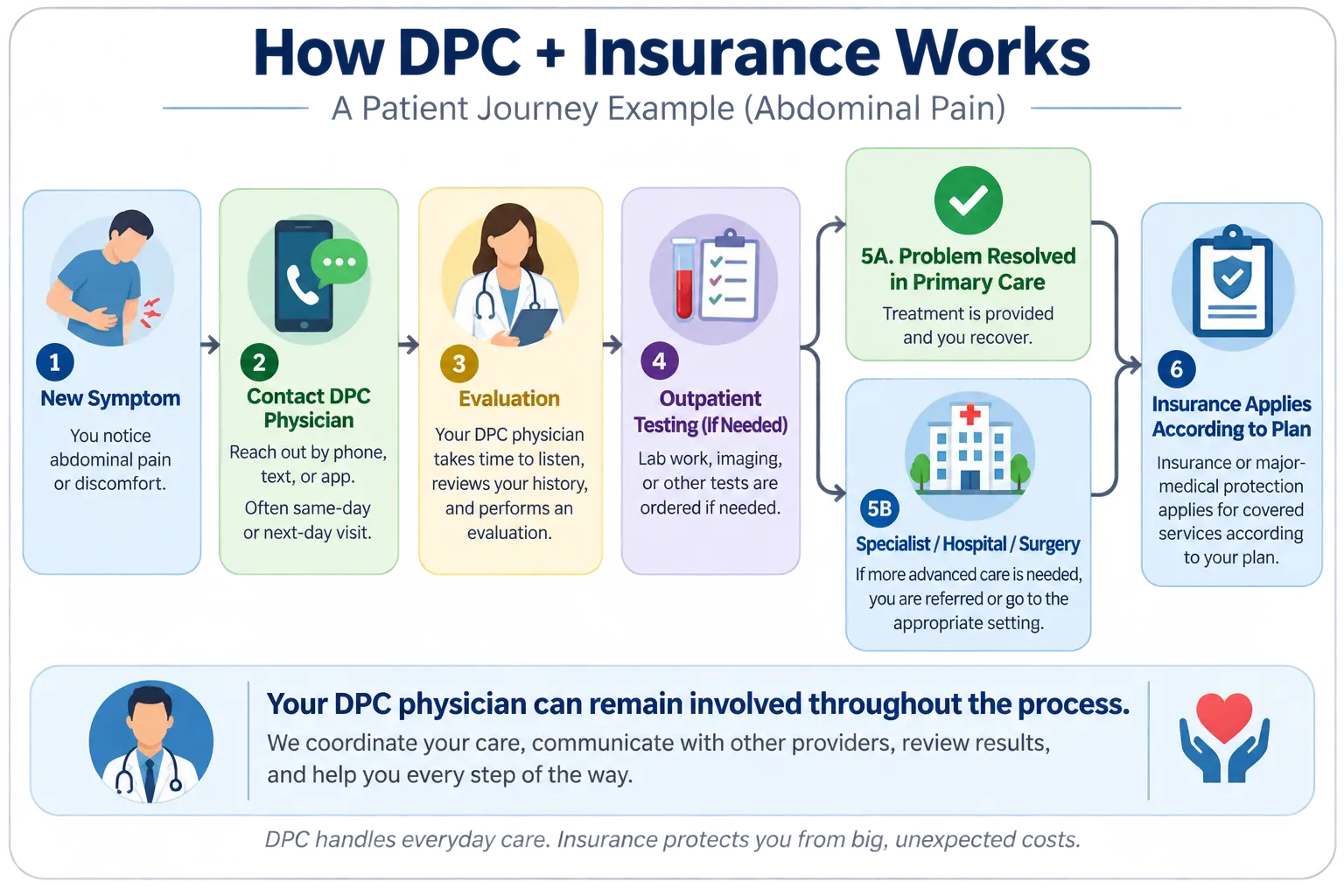
Your DPC physician can:
- Evaluate your symptoms.
- Perform an examination.
- Decide whether testing is needed.
- Arrange appropriate outpatient imaging or laboratory work.
- Help determine whether a specialist or hospital evaluation is necessary. If the problem turns out to be something minor, it may be managed entirely through primary care.
If testing suggests something more serious—such as appendicitis, gallbladder disease, or another condition requiring surgery—your insurance would then apply to the hospital, surgeon, imaging, anesthesia, and other covered services according to the terms of your policy.
Your Primary Care Doctor Can Still Stay Involved
The role of the DPC physician does not necessarily end once outside care begins.
Your doctor may still help:
- Explain test results
- Coordinate referrals
- Review specialist recommendations
- Review hospital records
- Reconcile medications after discharge
- Arrange follow-up care
- Help you understand what should happen next
This continuity can be especially valuable when several different healthcare providers become involved.
DPC for Primary Care, Insurance for Major Expenses
For many people, the combination is straightforward:
Direct Primary Care provides accessible, ongoing primary care.
Health insurance provides financial protection for larger medical expenses.
Rather than asking insurance to manage every routine interaction with your primary care physician, you use each system for the role it is best suited to perform.
Why a High-Deductible Plan Can Pair Naturally With DPC
A high-deductible health plan can be a natural fit with Direct Primary Care for some patients.
The reason is simple: with a high deductible, patients often pay a significant portion of routine medical expenses themselves before insurance begins covering much of the cost.
That can make ordinary primary care feel unpredictable.
A patient may wonder:
- How much will this visit cost?
- Will it apply to my deductible?
- Will there be a separate bill for part of the visit?
- Is this concern important enough to justify another insurance-billed appointment?
With Direct Primary Care, those routine primary-care interactions are handled through the membership instead.
That can mean more predictable access to care without worrying about:
- Visit copays
- Deductible accumulation for routine primary-care visits
- Surprise office bills
- Whether a minor concern is “worth” scheduling an appointment
For some people, this creates a useful division:
Membership for frequent, predictable primary care
Insurance for large, financially dangerous medical events
In other words, DPC can handle the care you are likely to use, while the high-deductible plan remains available for hospitalization, surgery, major accidents, expensive specialty care, and other significant medical expenses.
But a High-Deductible Plan Is Not Automatically the Best Choice
This approach can work well for some people, but it is not right for everyone.
The best health plan still depends on the full picture, including:
- Monthly premium
- Deductible
- Out-of-pocket maximum
- Prescription drug coverage
- Specialist network
- Expected medical needs
- Ongoing conditions
- Family circumstances
For example, someone who uses expensive medications or sees multiple specialists may value richer insurance coverage even if the premium is higher.
Someone who rarely uses care outside primary care may prefer a different balance.
The important point is not that everyone should choose a high-deductible plan.
It is that Direct Primary Care can make that kind of coverage more practical for some patients by giving them a predictable way to access routine medical care without relying on insurance for every office visit.
How Does Direct Primary Care Work With Medicare?
For patients 65 and older, the question is often a little different:
“If I already have Medicare, why would I also want Direct Primary Care?”
Medicare remains an important source of coverage for hospital care, specialists, diagnostic testing, procedures, and many other healthcare expenses.
Direct Primary Care serves a different purpose.
It provides an ongoing primary-care relationship with easier access to your physician, longer appointments, chronic disease management, medication review, and help coordinating an increasingly complex healthcare picture.
For many older adults, the two can complement each other.
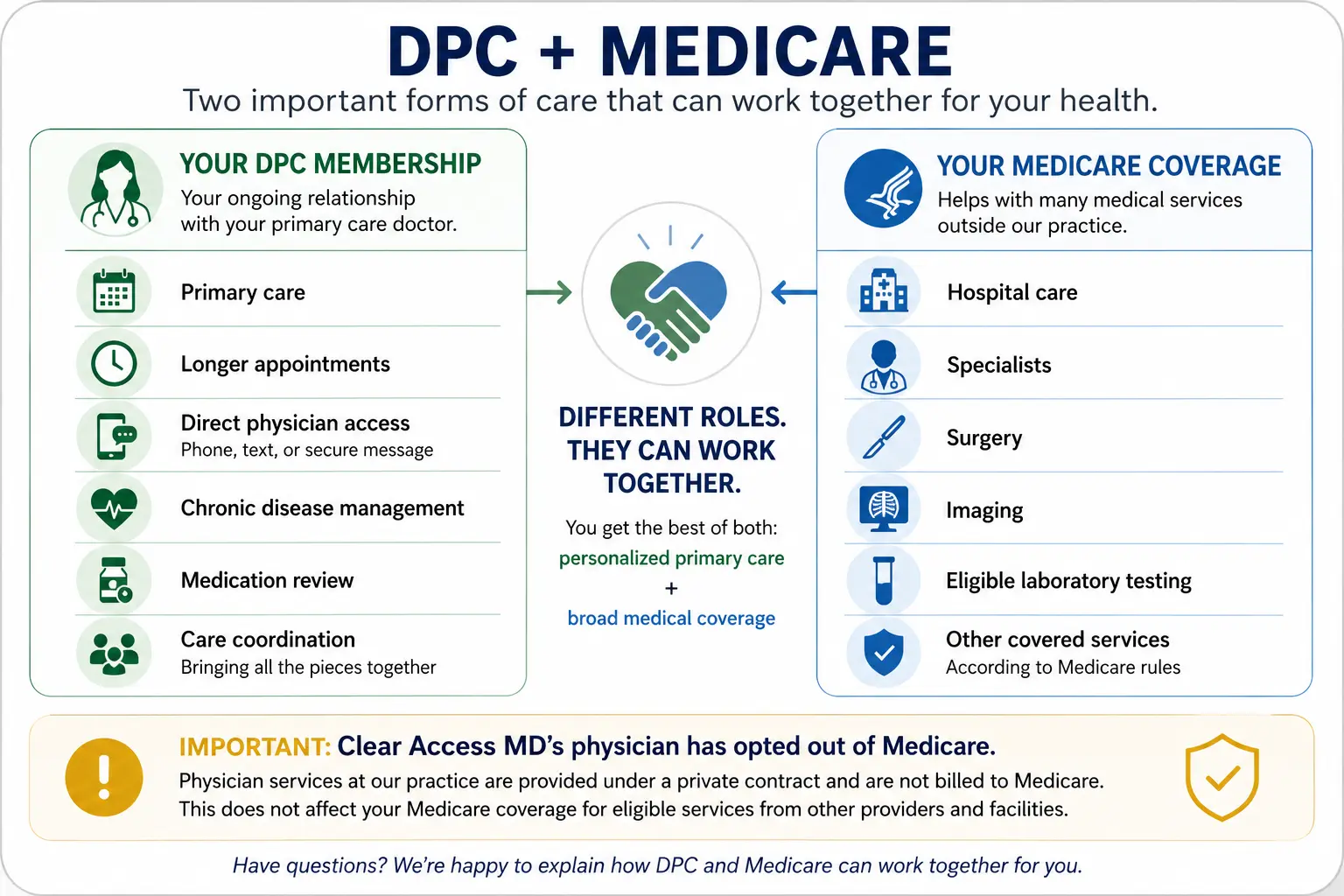
An Important Disclosure: Our Physician Has Opted Out of Medicare
At Clear Access MD, our physician has formally opted out of Medicare.
This means we do not submit claims to Medicare for the professional services your physician provides at our practice. Medicare patients who receive care from us enter into a private contract and pay for that care through their Direct Primary Care membership rather than through Medicare. Under Medicare’s opt-out rules, neither the physician nor the patient submits those privately contracted physician services to Medicare for reimbursement.
In practical terms, your DPC membership pays for your relationship and care with your Clear Access MD physician.
It does not mean that you give up Medicare.
You Can Still Use Medicare for Care Outside Our Practice
Your Medicare coverage can still be extremely valuable when you receive eligible services from other Medicare providers and facilities.
For example, Medicare may continue to apply, according to its normal coverage rules, when you need care such as:
- Hospitalization
- Specialist care
- Surgery
- Emergency care
- Diagnostic imaging
- Laboratory testing
- Medical equipment
- Other Medicare-covered services provided outside our practice
CMS specifically allows physicians who have opted out of Medicare to remain eligible to order or certify certain Medicare-covered services, including clinical laboratory testing and imaging, when the applicable Medicare requirements are met.
So if your Clear Access MD physician determines that you need an MRI, laboratory testing, hospital care, or evaluation by another physician, opting out of Medicare does not by itself prevent Medicare from covering eligible care performed by the outside provider.
Your normal Medicare rules still apply, including any deductibles, coinsurance, medical-necessity requirements, provider requirements, and—in the case of Medicare Advantage—the terms and network rules of your particular plan.
Why Might Someone With Medicare Still Want DPC?
As we get older, healthcare often becomes more complicated.
A patient may be seeing a cardiologist, orthopedist, gastroenterologist, dermatologist, and other specialists while also taking several medications and trying to keep track of preventive screenings, laboratory results, and chronic conditions.
What can easily become missing is one physician who sees the whole picture.
Direct Primary Care can be particularly useful for older adults who want:
- Longer, less rushed appointments
- Easier access when a new concern develops
- Direct communication with their physician
- Management of high blood pressure, diabetes, kidney disease, cholesterol, and other chronic conditions
- Careful review of multiple medications
- Help understanding specialist recommendations
- Review of outside laboratory and imaging results
- Coordination among multiple physicians
- Follow-up after a hospitalization or emergency-room visit
- Ongoing preventive care
- A physician who knows their medical history over time
Consider the Patient With Several Specialists
Imagine a Medicare patient who sees a cardiologist for heart disease, an orthopedist for arthritis, and a urologist for a prostate condition.
Each specialist is appropriately focused on their particular area.
But medications can overlap. Recommendations can interact. New symptoms may not clearly belong to any one specialty.
That is where having an accessible primary-care physician can become particularly valuable.
Your DPC physician can help look across all of those individual pieces and ask:
- Do these medications still make sense together?
- Could a new symptom be a medication side effect?
- Which specialist should address this problem?
- Does this test result change anything?
- Which preventive screenings are still due?
- What should we be monitoring between specialist visits?
The goal is not to replace specialists. It is to help connect the dots between them.
After a Hospitalization, Primary Care Matters Too
The period after a hospitalization can be especially confusing.
A patient may come home with:
- New diagnoses
- Several medication changes
- Follow-up appointments with multiple specialists
- New laboratory or imaging recommendations
- Questions that did not occur until after leaving the hospital
A DPC physician can review what happened, reconcile medications, help explain the plan, and coordinate the next steps.
Medicare may have paid for the hospital care, but the ongoing primary-care relationship can help the patient make sense of what happens afterward.
Medicare and DPC Have Different Jobs
A helpful way to think about the combination is:
Direct Primary Care → ongoing primary care, access, time, continuity, and coordination
Medicare → financial coverage for eligible hospital, specialist, diagnostic, procedural, and other covered services
For Medicare patients at Clear Access MD, the DPC membership is an additional service paid directly to our practice. It does not replace Medicare, and we do not bill Medicare for the physician services we provide under our private contract.
For some older adults, that combination provides something particularly valuable: the broad financial protection of Medicare together with easier access to a primary-care physician who has the time to know them and help coordinate the whole picture.
What About “Catastrophic” Health Insurance?
When people hear about pairing Direct Primary Care with insurance, they often ask whether they can simply buy a “catastrophic” health plan.
Usually, what they mean is a plan that is less focused on paying for routine office visits and more focused on protecting them from very large, unexpected medical expenses.
Examples might include:
- A serious accident
- Hospitalization
- Major surgery
- Cancer treatment
- Intensive care
That basic idea can pair naturally with DPC: use the membership for routine primary care and keep separate protection in place for the kinds of medical events that could create a major financial burden.
“Catastrophic” Has a Specific Meaning Under the ACA
There is an important distinction, however.
Under the Affordable Care Act, Catastrophic health plans are a specific category of insurance, with their own eligibility rules and plan requirements.
They are not available to everyone.
So an inexpensive policy with a large deductible should not automatically be described as a “catastrophic plan.” It may simply be a high-deductible health insurance plan.
For many adults, the more practical question is not:
“Can I buy catastrophic insurance?”
It is:
“What type of major-medical protection makes the most sense alongside my DPC membership?”
That might include:
- A high-deductible ACA health plan
- Employer-sponsored insurance
- Another major-medical insurance policy
- A health-sharing arrangement
Each option has different premiums, deductibles, provider networks, prescription benefits, exclusions, and financial protections.
The important principle remains the same:
Direct Primary Care can handle routine and predictable primary care, while another form of coverage or financial protection is kept in place for the large medical expenses that DPC is not designed to cover.
The right combination depends on your health needs, financial situation, risk tolerance, and the specific terms of the coverage you are considering.
Another Option Some Patients Consider: Health Sharing
Some patients choose to pair Direct Primary Care with a health-sharing organization rather than traditional health insurance.
Examples include organizations such as Zion HealthShare.
The basic concept is different from insurance. Members contribute a monthly amount to a community, and eligible medical expenses may be shared according to the organization’s membership guidelines.
For some people, this creates a structure that looks like:
Direct Primary Care for routine healthcare
Health sharing for larger, unexpected medical expenses
In that arrangement, the DPC membership handles everyday primary care, while the health-sharing organization may help with eligible expenses related to larger medical events.
Important: Health Sharing Is Not Health Insurance
This distinction is essential.
Health-sharing organizations are not health insurance companies, and membership is not the same as having an insurance policy.
They operate under their own guidelines, eligibility requirements, and sharing rules.
Depending on the organization and membership level:
- Payment of medical expenses may not be legally guaranteed in the same way as an insurance claim
- Pre-existing-condition limitations may apply
- Waiting periods may apply
- Certain treatments, conditions, or services may not be eligible for sharing
- Prescription benefits may be limited or structured differently
- Routine and preventive care may not be included
- Members may sometimes need to pay providers directly and then submit expenses for sharing
- There may be specific eligibility, participation, or lifestyle requirements
This means a health-sharing membership should not be evaluated simply by comparing its monthly cost with an insurance premium.
The more important questions are:
- What expenses are actually eligible for sharing?
- What is the member responsible for paying first?
- Are there limits for pre-existing conditions?
- How are hospitalizations and surgeries handled?
- What happens with expensive medications?
- Are there annual or lifetime sharing limits?
- What expenses are specifically excluded?
Read the Guidelines Carefully
Health-sharing organizations can vary significantly from one another, and their rules can change over time.
Anyone considering this approach should carefully review the organization’s current membership guidelines before enrolling and make sure they understand both what is shareable and what is not.
It is also important to think about your own health needs.
Someone who takes expensive medications, expects frequent specialist care, or has significant ongoing medical conditions may view the tradeoffs very differently from someone who is generally healthy and mainly wants protection against large unexpected medical expenses.
For the right person, health sharing may be one option to consider alongside Direct Primary Care.
But it should be chosen with a clear understanding of one fundamental point:
Health sharing can help with eligible medical expenses, but it does not provide the same contractual protections or regulatory structure as traditional health insurance.
How DPC + Health Sharing Might Work in Practice
A simple example can make the relationship between Direct Primary Care and health sharing easier to understand.
Routine Medical Care
Imagine a patient who uses Direct Primary Care for their everyday healthcare needs.
Over the course of the year, they may use their membership for:
- An annual physical
- Blood pressure management
- Treatment of a respiratory infection
- Medication adjustments
- Questions about new symptoms
- Follow-up visits
Because these services are handled through the DPC membership, there is generally no need to submit them to the health-sharing organization.
The patient simply uses their primary care membership as intended—for routine, ongoing medical care.
A Larger Medical Event
Now suppose that same patient develops severe abdominal pain and is diagnosed with appendicitis.
Their care may include:
- Emergency-room evaluation
- CT imaging
- Surgical consultation
- Appendectomy
- Hospitalization
- Anesthesia
- Follow-up related to the hospitalization
Those expenses are outside the scope of a typical DPC membership.
Depending on the health-sharing organization, the patient’s membership level, and the specific circumstances, some or all of those expenses may potentially qualify for sharing after the patient satisfies any applicable member responsibility or initial unshareable amount.
The DPC Physician Can Still Help Coordinate Care
Even though the hospital and surgical expenses are separate from the DPC membership, the patient’s primary care physician may still remain involved.
That can include:
- Helping evaluate symptoms before emergency care is needed, when appropriate
- Reviewing hospital records
- Explaining test results
- Reconciling medications after discharge
- Coordinating follow-up
- Helping the patient understand what should happen next
This continuity can be especially valuable after a major medical event, when several different doctors and facilities may be involved.
Who Decides What Is Shareable?
This point is important:
Eligibility for sharing is determined by the health-sharing organization’s rules—not by the DPC practice.
A Direct Primary Care physician can help manage and coordinate medical care, but the practice does not decide whether a hospital bill, surgery, medication, or other expense qualifies for sharing.
Patients should review the health-sharing organization’s current guidelines so they understand:
- What types of expenses are eligible
- What amount they are responsible for first
- Whether pre-existing-condition rules apply
- Whether there are waiting periods or exclusions
- What documentation may be required
The basic structure can be straightforward:
DPC handles routine primary care.
Health sharing may help with eligible larger medical expenses.
But the exact financial protection depends on the health-sharing organization’s current terms and guidelines.
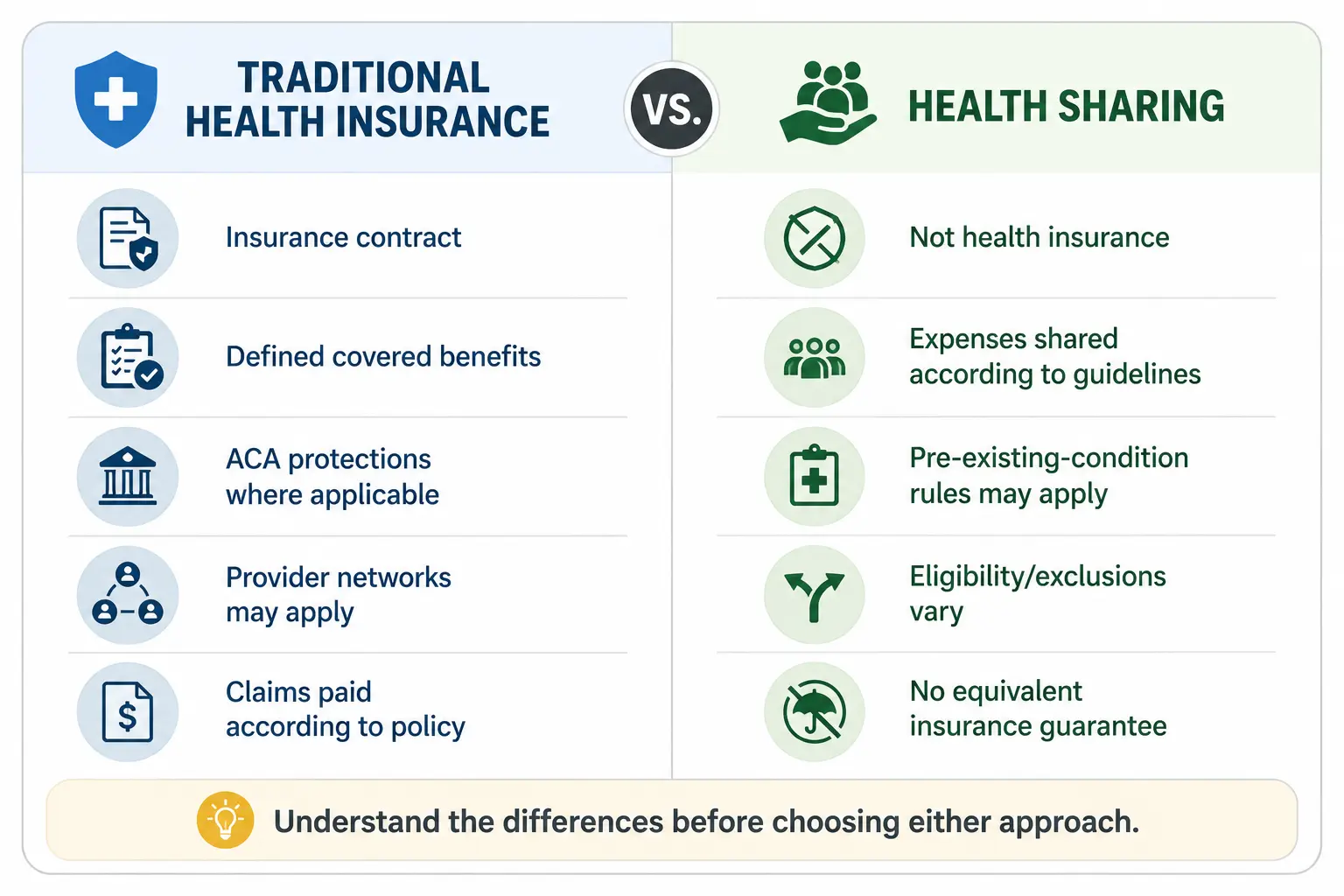
Insurance vs. Health Sharing: Important Differences to Understand
Traditional health insurance and health sharing can both help with larger medical expenses, but they are not the same thing.
The differences matter because they affect what protections you have, how medical bills are handled, and what happens if you develop a serious illness or need expensive care.
A simple comparison looks like this:
| Traditional Health Insurance | Health Sharing | |
|---|---|---|
| Is it health insurance? | Yes | No |
| Routine primary care | Depends on the plan | Often limited or not the main focus |
| Major medical expenses | Covered according to the insurance policy | May be shared according to membership guidelines |
| Insurance benefits legally guaranteed? | Yes, subject to the terms of the policy | No equivalent insurance guarantee |
| Provider networks | Often uses defined networks | Structure varies and may offer broader flexibility |
| Pre-existing conditions | ACA-compliant plans provide strong protections | Limitations, waiting periods, or other rules may apply |
| Monthly cost | Often higher | May be lower |
| Can it work alongside DPC? | Yes | Yes |
The Biggest Difference Is the Legal Structure
With traditional health insurance, you enter into an insurance contract. Covered benefits, deductibles, copays, provider networks, and out-of-pocket limits are defined by the policy and subject to insurance regulation.
Health sharing works differently.
Members participate in a community that shares eligible medical expenses according to the organization’s guidelines. The rules governing what qualifies for sharing may differ significantly from the protections available under an insurance policy.
That does not automatically make one approach better than the other, but it does mean they should not be compared solely on monthly cost.
Pre-Existing Conditions Can Be Especially Important
ACA-compliant health insurance generally cannot deny coverage or charge more because of a pre-existing medical condition.
Health-sharing organizations may have different rules.
Depending on the program, there may be:
- Waiting periods
- Limits on sharing for pre-existing conditions
- Gradual eligibility over time
- Specific exclusions
Anyone with an ongoing medical condition should pay particular attention to these provisions before choosing a health-sharing membership.
Provider Access May Work Differently
Many insurance plans use networks of contracted physicians, hospitals, laboratories, and specialists.
Going outside that network may result in higher costs or no coverage at all, depending on the plan.
Health-sharing arrangements may operate differently and sometimes allow greater freedom in choosing providers, but members should still understand how bills are submitted, negotiated, and determined to be eligible for sharing.
Routine Care May Not Be the Main Focus of Health Sharing
Traditional insurance plans may include preventive visits, laboratory testing, prescriptions, and other routine services, although cost-sharing varies considerably.
Health-sharing programs are often more focused on larger medical events.
That is one reason some people pair them with Direct Primary Care:
DPC handles routine primary care, while the health-sharing arrangement may help with eligible larger medical expenses.
Monthly Cost Is Only Part of the Decision
Health-sharing memberships may have lower monthly contributions than some insurance plans, but the monthly amount is only one piece of the financial picture.
It is also important to consider:
- How much you must pay before expenses become eligible
- Whether there are limits on sharing
- How prescription medications are handled
- What happens with pre-existing conditions
- Whether maternity care is included
- Which services are excluded
- How very large medical bills are handled
- Whether payment is contractually guaranteed or governed by sharing guidelines
The right choice depends on your medical needs, financial situation, risk tolerance, and how comfortable you are with the differences between the two models.
The most important point is simple:
Health sharing can be an alternative some people consider for large medical expenses, but it should not be mistaken for traditional health insurance.
Can DPC Help Even When Something Falls Outside the Membership?
One of the advantages of having an ongoing relationship with a primary-care physician is that their role does not end when you need care somewhere else.
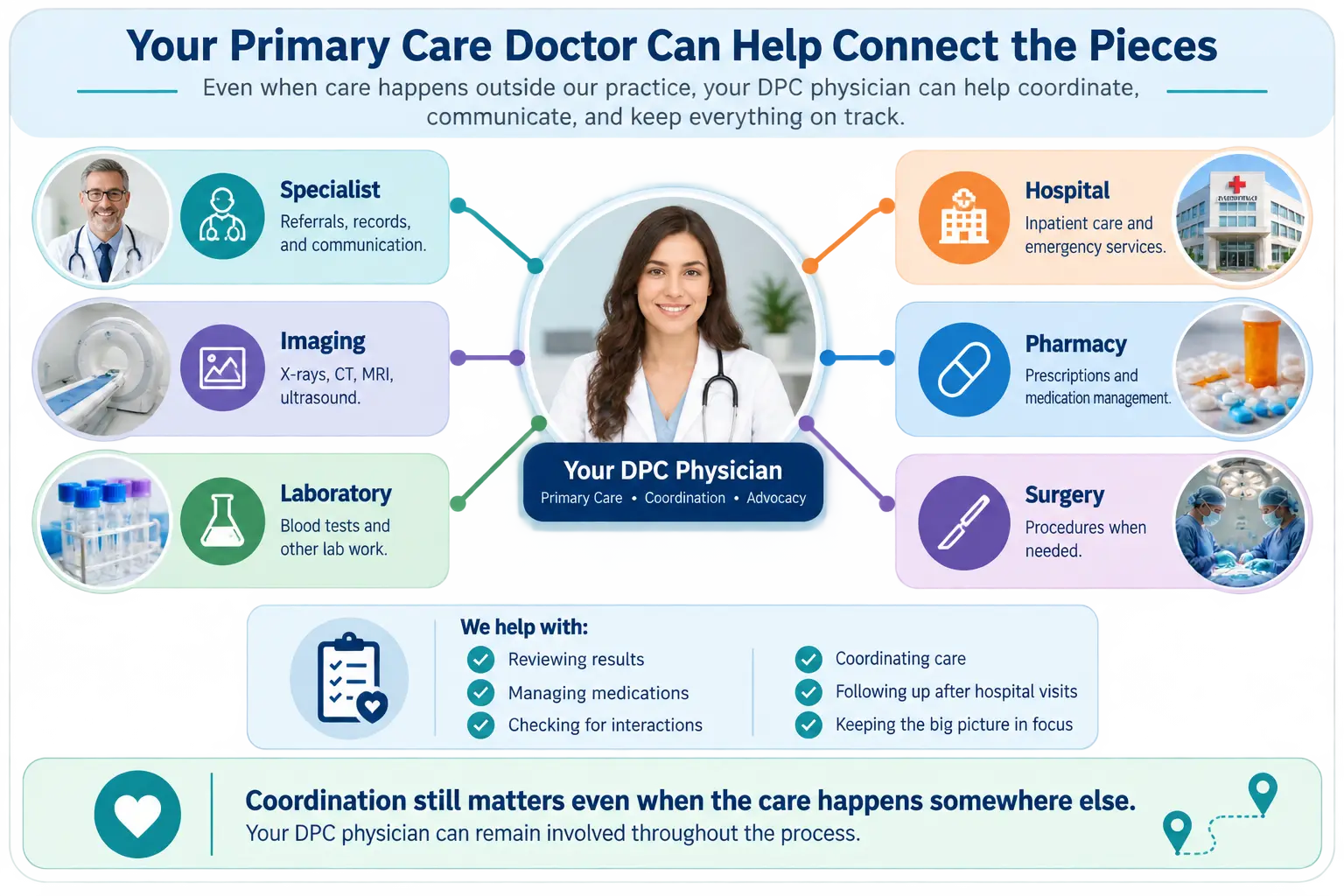
A specialist, hospital, imaging center, or laboratory may provide part of your care, but your DPC physician can still help you understand how those pieces fit together.
That may include helping to:
- Determine whether specialist care is actually necessary
- Identify the type of specialist who is most appropriate
- Coordinate referrals
- Review outside medical records
- Explain specialist recommendations
- Compare imaging or laboratory options
- Look for lower self-pay prices when appropriate
- Review medication changes after hospitalization
- Coordinate follow-up care
Helping You Navigate the Next Step
Healthcare can become confusing quickly once several different providers are involved.
A patient may leave a specialist visit with new medications, additional testing, or recommendations that are difficult to interpret.
A DPC physician can help put those recommendations into context.
For example, if a specialist orders an MRI, your primary-care doctor may help explain why it was recommended, whether it is urgent, and what the results may mean once they are available.
If you are discharged from the hospital with several medication changes, your physician can review the updated list and help make sure there are no unnecessary duplications, interactions, or misunderstandings.
Helping With Cost When Appropriate
For patients with high deductibles, limited coverage, or no traditional insurance, the price of outside services can vary significantly.
When practical, a DPC practice may help patients compare options for:
- Laboratory testing
- Imaging
- Certain procedures
- Medications
The lowest-cost option is not always the best choice, but knowing what alternatives exist can help patients make more informed decisions.
Continuity Still Matters
The broader value of primary care is not simply that your doctor performs office visits.
It is that someone knows your medical history, understands your medications and risk factors, and can help coordinate care when the situation becomes more complicated.
Your primary-care doctor does not stop being useful simply because another physician or facility is providing part of your care.
In many cases, that is exactly when having a trusted primary-care physician becomes most valuable.
What Combination Is Right for You?
There is no single coverage strategy that is right for everyone.
The best combination depends on your health, medications, expected medical needs, finances, family situation, and how much risk you are comfortable taking on yourself.
For many people, Direct Primary Care works best as one part of a broader healthcare strategy rather than as a standalone solution.
DPC + Comprehensive Health Insurance
This combination may make sense for someone who:
- Wants strong protection against major medical expenses
- Uses expensive prescription medications
- Has significant chronic medical conditions
- Expects regular specialist care
- Values the protections built into ACA-compliant coverage
- Receives employer-subsidized insurance
In this arrangement, DPC provides the day-to-day primary care relationship, while comprehensive insurance remains available for specialists, hospital care, surgery, expensive medications, and other higher-cost services.
DPC + High-Deductible Health Insurance
This approach may appeal to someone who:
- Wants to reduce monthly insurance premiums
- Primarily wants insurance for major medical events
- Is comfortable paying more out of pocket before insurance begins covering expenses
- Uses DPC for most routine primary care
For some patients, this creates a practical division between predictable care and financial protection.
The DPC membership covers frequent access to primary care, while the high-deductible plan is kept in place for larger expenses that would be difficult to absorb personally.
That said, the total cost still matters. A lower premium does not automatically mean a better plan if the deductible, prescription coverage, specialist network, or out-of-pocket maximum creates too much financial exposure.
DPC + Health Sharing
Some people consider pairing DPC with a health-sharing organization instead of traditional insurance.
This may appeal to someone who:
- Clearly understands that health sharing is not health insurance
- Is comfortable with the organization’s eligibility rules and limitations
- Wants a different approach to handling large, unexpected medical bills
- Has carefully reviewed what is and is not eligible for sharing
- Is comfortable with the financial risk that remains outside the program
This option requires especially careful review because health-sharing arrangements do not provide the same contractual guarantees and regulatory protections as traditional health insurance.
Compare the Whole Picture
It is easy to focus only on the monthly cost, but that is just one part of the decision.
Before choosing a strategy, consider:
- Monthly premium or contribution
- Deductible or initial member responsibility
- Out-of-pocket maximum, if applicable
- Prescription coverage
- Specialist access
- Hospital network
- Pre-existing-condition rules
- Expected healthcare needs
- Potential financial exposure in a serious medical event
The best choice is the one that gives you the balance of access, protection, and affordability that fits your situation.
Direct Primary Care can work alongside several different coverage strategies. The important question is not which combination is universally best, but which one gives you the right level of protection for your own health and financial circumstances.
Questions to Ask Before Choosing Coverage
Whether you are comparing traditional health insurance, a high-deductible plan, or a health-sharing arrangement, the monthly cost should not be the only factor.
What matters just as much is what happens when you actually need care—especially during a serious illness, hospitalization, or other expensive medical event.
Before choosing coverage, it is worth asking:
- What is my monthly premium or contribution?
- What is my deductible or initial member responsibility?
- What is my maximum financial exposure during a very bad year?
- Would hospitalization be covered or eligible for sharing?
- What happens if I develop cancer?
- Are my prescription medications covered?
- How are expensive specialty medications handled?
- Are pre-existing conditions covered, limited, or excluded?
- Can I use the hospitals and specialists I prefer?
- Are there provider-network restrictions?
- What expenses are specifically excluded?
- Who pays first when a large medical bill occurs?
- Do I need to pay providers upfront and seek reimbursement later?
- Is payment contractually guaranteed under an insurance policy, or is it subject to membership sharing guidelines?
Think Beyond the Monthly Price
A plan with a lower monthly cost can look attractive, but it may expose you to much higher costs when care is actually needed.
For example, it is important to understand:
- The deductible
- Coinsurance
- Copays
- Out-of-pocket limits
- Prescription benefits
- Specialist access
- Hospital coverage
- Exclusions
- Pre-existing-condition rules
For health sharing, it is equally important to understand the organization’s definition of an eligible medical expense and what responsibilities remain with the member.
Ask the “Worst-Case Scenario” Question
One of the most useful questions is:
What happens financially if I have a very bad medical year?
Imagine a hospitalization, major surgery, cancer diagnosis, or serious accident.
How much could you realistically be responsible for?
That question often reveals more about the strength of a coverage strategy than the monthly premium alone.
Read the Actual Terms
Marketing summaries are helpful, but they are not a substitute for reviewing the actual policy or membership guidelines.
Before enrolling, make sure you understand:
- What is included
- What is excluded
- What requires prior authorization
- What has waiting periods
- What may be limited because of pre-existing conditions
- What happens if a claim or sharing request is denied
The goal is not to find the cheapest option on paper.
It is to choose a healthcare strategy that you understand and that provides a level of financial protection you are comfortable relying on when something significant happens.
How This Fits With Direct Primary Care at Clear Access MD
At Clear Access MD, our membership is designed to provide accessible, relationship-based primary care—not to replace health insurance.
The goal is to give patients a physician they can turn to for the healthcare needs that come up most often, with more time, easier access, and continuity of care.
Membership includes support for areas such as:
- Preventive care
- Acute concerns and minor illnesses
- Chronic disease management
- Medication management
- Direct communication with your physician
- Longer, unrushed appointments
- Coordination with specialists and outside care
For many patients, this means they can use Clear Access MD as their primary-care home while keeping separate coverage or financial protection in place for major medical expenses.
That might be:
- Employer-sponsored insurance
- An individual health insurance plan
- A high-deductible health plan
- Another form of major-medical coverage
- A health-sharing arrangement, after carefully reviewing how it differs from insurance
We do not require patients to choose a particular insurance carrier or health-sharing organization.
The important part is understanding the role each piece plays.
Your DPC membership is there to provide ongoing primary care and help you navigate your health. Insurance or another major-medical strategy is there to help protect you from the larger expenses that fall outside the scope of primary care.
That separation can make healthcare feel simpler while still preserving financial protection for the situations where it matters most.
The Bigger Idea: Use Insurance for What Insurance Does Best
Traditional health insurance has gradually become involved in many relatively small healthcare transactions.
A routine office visit may generate a claim.
Basic laboratory testing may generate another.
A medication refill, imaging study, or follow-up appointment may all pass through the insurance system, even when the actual cost is relatively modest.
That can make routine healthcare feel more complicated than it needs to be.
Direct Primary Care takes a different approach.
Instead of submitting an insurance claim every time you speak with your primary-care physician, the membership pays for the ongoing primary-care relationship directly.
That allows routine care to be handled more simply, while insurance—or another major-medical protection strategy—can remain focused on the kinds of expenses that have the potential to create genuine financial hardship.
Those may include:
- Hospitalization
- Major surgery
- Serious illness
- Major accidents
- Complex specialty care
- Very expensive medications
This is one of the central ideas behind combining DPC with insurance.
You do not necessarily need insurance to manage every ordinary interaction with your primary-care doctor.
But you may still very much want financial protection for the medical events that can cost tens or hundreds of thousands of dollars.
That creates a clearer division of responsibility:
Direct Primary Care for ongoing, everyday care.
Insurance or another major-medical strategy for large, unpredictable expenses.
DPC does not eliminate the need to think about major medical costs.
It changes which part of healthcare you ask insurance to handle.
And for many patients, that can make both primary care and financial planning for healthcare easier to understand.
Curious Whether Direct Primary Care Could Fit With Your Current Health Coverage?
You do not need to give up your current health insurance to become a Clear Access MD member.
Direct Primary Care is designed to work alongside the coverage you already have by giving you a simpler, more direct way to access primary care.
If you are considering membership, you can learn more about:
- What is included
- How visits work
- How Direct Primary Care can complement insurance
- What kinds of care remain outside the membership
- How membership may fit with a high-deductible plan or another coverage strategy
If the model sounds like a good fit, you can explore the membership details or schedule a brief introductory visit to ask questions before deciding.
Disclaimer
This article is for general educational purposes only and is not insurance, tax, legal, or financial advice. Health insurance policies and health-sharing memberships vary significantly in their benefits, exclusions, eligibility rules, and financial protections. Review the current terms of any insurance plan or health-sharing organization carefully before enrolling.